50 Taper Fade Haircut Long on Top Looks: Ultimate Barber Guide

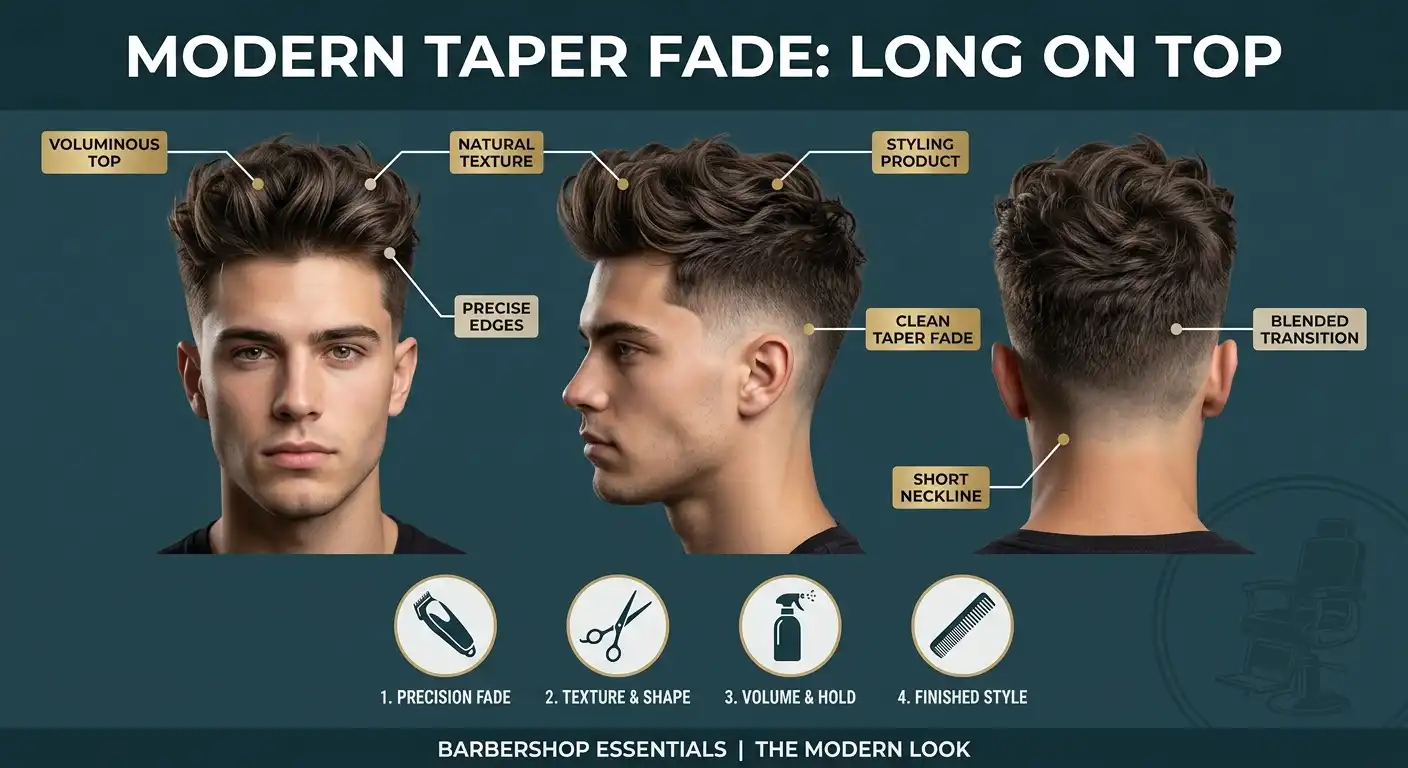
If you want clean sides without giving up your top length, a taper fade haircut long on top gives you plenty of room to style, part, brush back, or leave your hair natural. The sides and neckline become cleaner while the longer top creates the shape and personality of the cut.
Below are 50 distinct ideas for straight, wavy, curly, thick, fine, short, and long hair. Each option changes the top, taper placement, texture, part, or styling method so you can show your barber exactly what you want.
50 Taper Fade Haircut Long on Top Ideas
1. Classic Long Top Taper
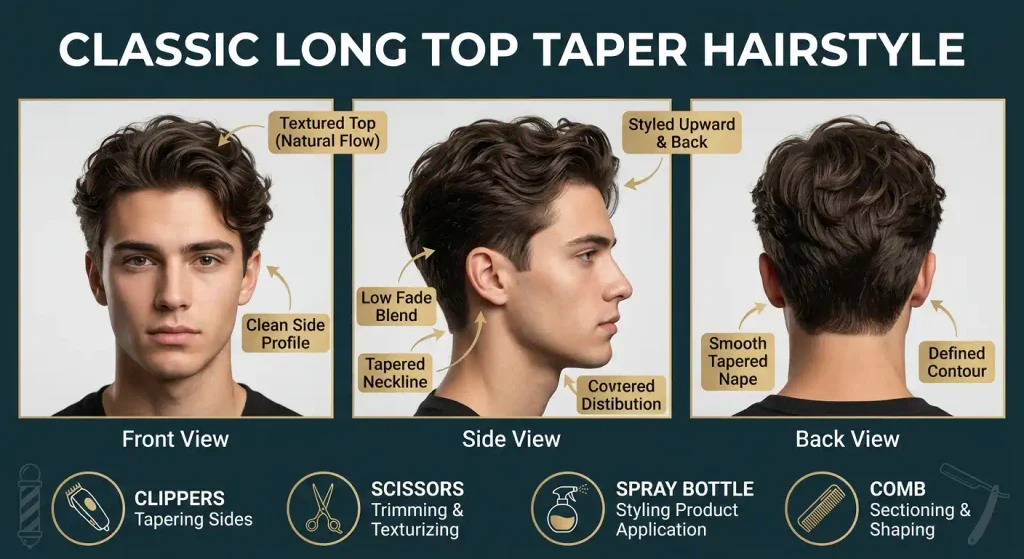
This is the clean starting point for men who want noticeable length on top without an extreme fade. Keep the top full and lightly shaped, while the sides gradually become shorter around the temples, ears, and neckline. Straight or slightly wavy hair works especially well. A light styling cream can add control while keeping the finish natural. It is also an easy option for work, school, and everyday wear.
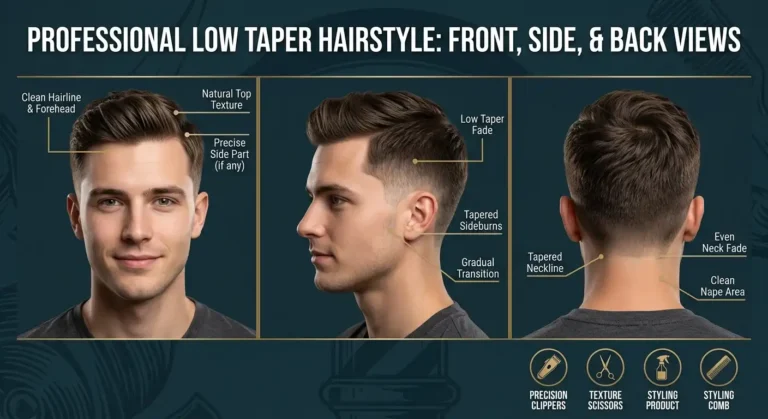
2. Low Taper Long on Top
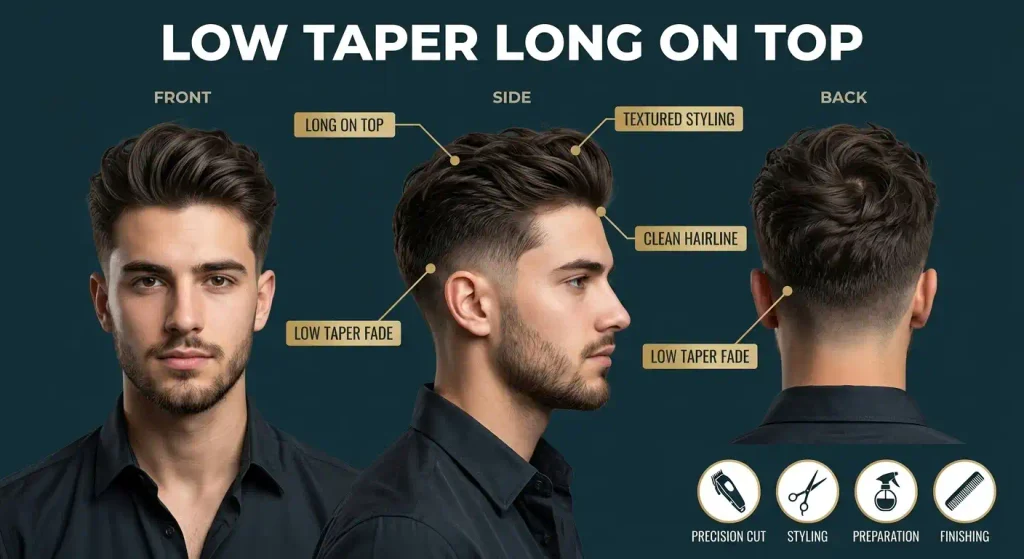
A low taper long on top keeps most of the side weight while cleaning the lower edges. The taper stays close to the sideburns and neckline, making this a softer choice than a high fade. It suits straight, wavy, and thick hair. Leave the top loose for an easy finish, or brush it back with a small amount of styling cream. This option also grows out naturally.
3. Textured Long Top Taper Fade
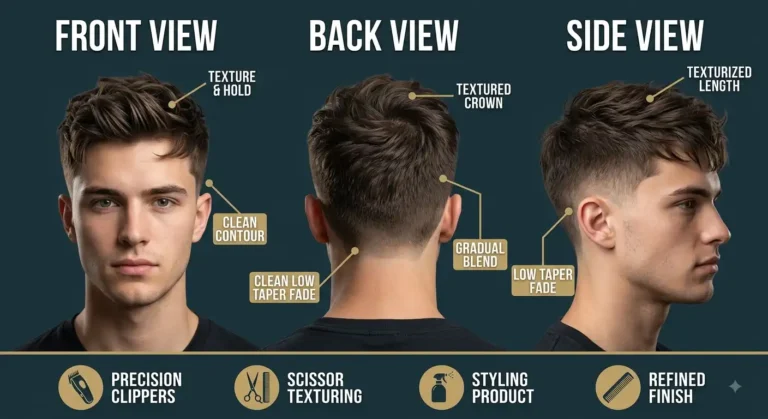
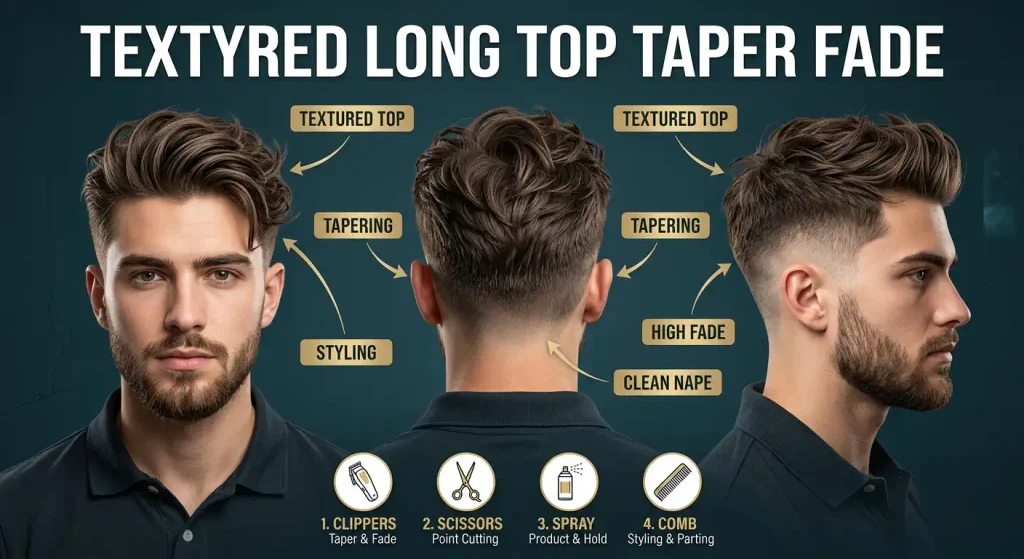
Ask your barber for texture through the top rather than simply removing length. The result gives straight or thick hair more movement and stops the top from looking heavy. The tapered sides create a clean frame around that texture. A matte clay or texture paste works well when you want separation without a glossy finish. Keep the taper moderate if you want the textured top to remain the main feature.
4. Slicked-Back Long Top
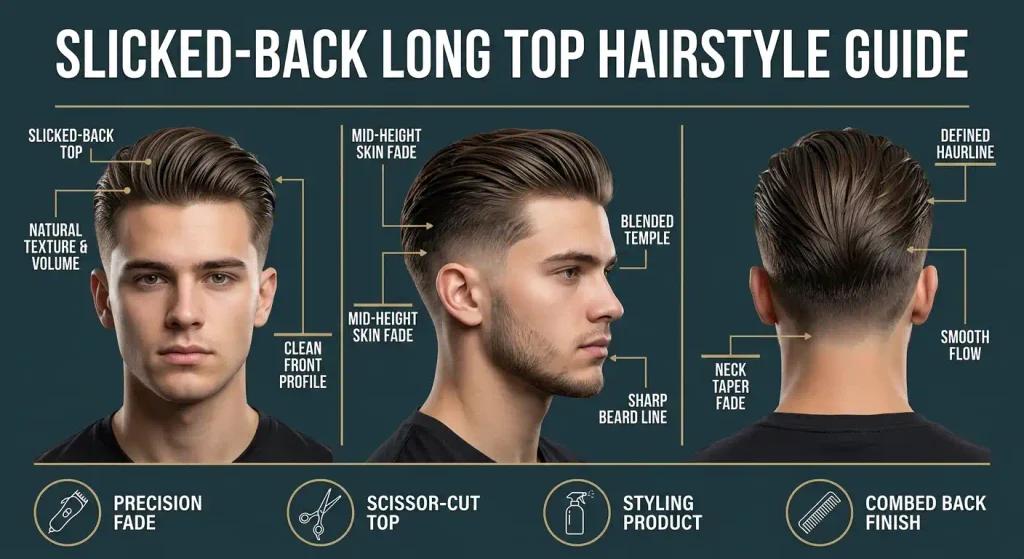
The slick-back turns longer top hair into a polished style. The taper keeps the area around the ears and neck neat while the top is brushed toward the back. Straight and medium-density hair usually makes the shape easy to control, although wavy hair can create a softer result. Use a comb for a clean finish or your fingers for more separation. A medium-hold pomade works well for a controlled look.
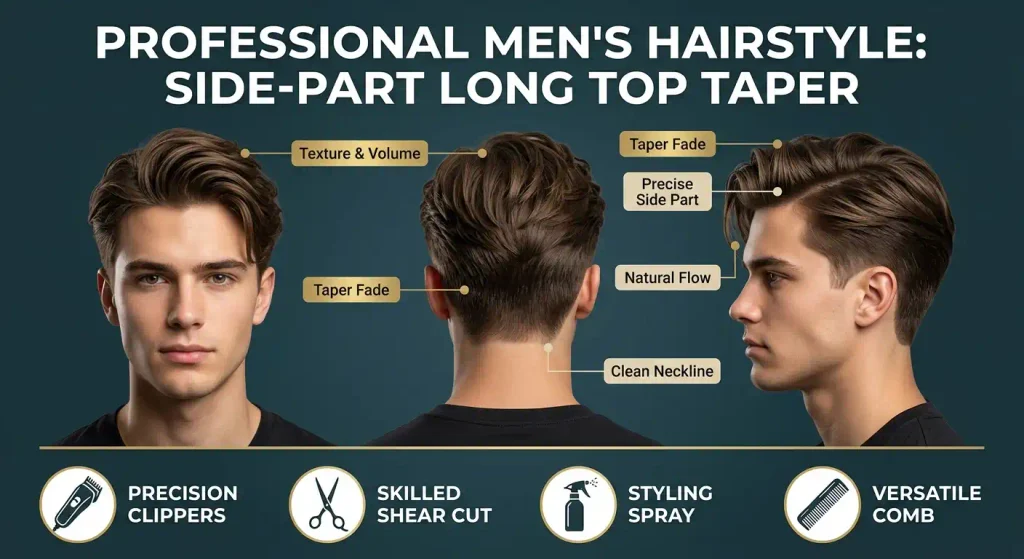
5. Side-Part Long Top Taper
A defined side part gives the longer top a clear direction. Keep enough length near the front so the hair can sweep naturally across the head. The tapered sides add structure without taking away the traditional feel of the part. This works particularly well for straight and slightly wavy hair. For a professional finish, use a comb and low-shine pomade. For a relaxed look, create the part with your fingers.
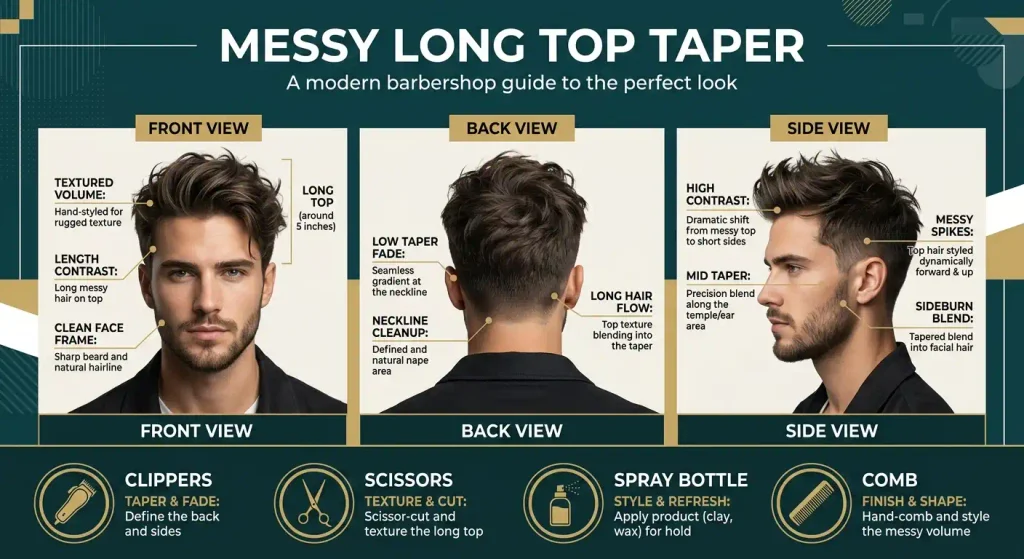
6. Messy Long Top Taper
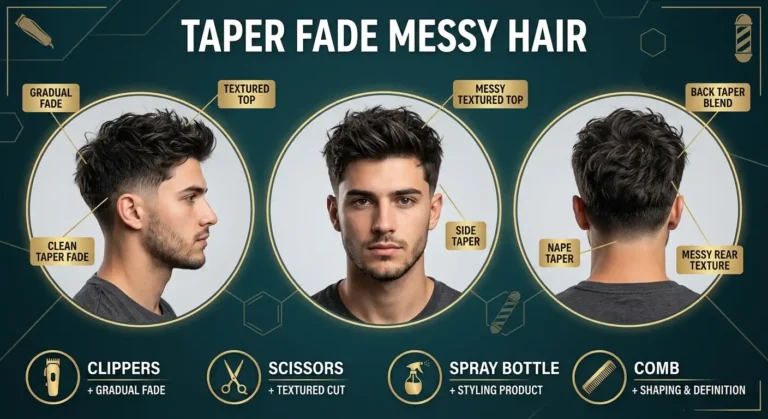
This version keeps the top deliberately loose and uneven while the sides remain clean. It is useful for men who dislike a heavily groomed finish. Thick or naturally textured hair can create plenty of movement without much work. Ask your barber to preserve the top’s natural direction instead of over-layering it. Apply a small amount of matte product and push the hair into place with your fingers.
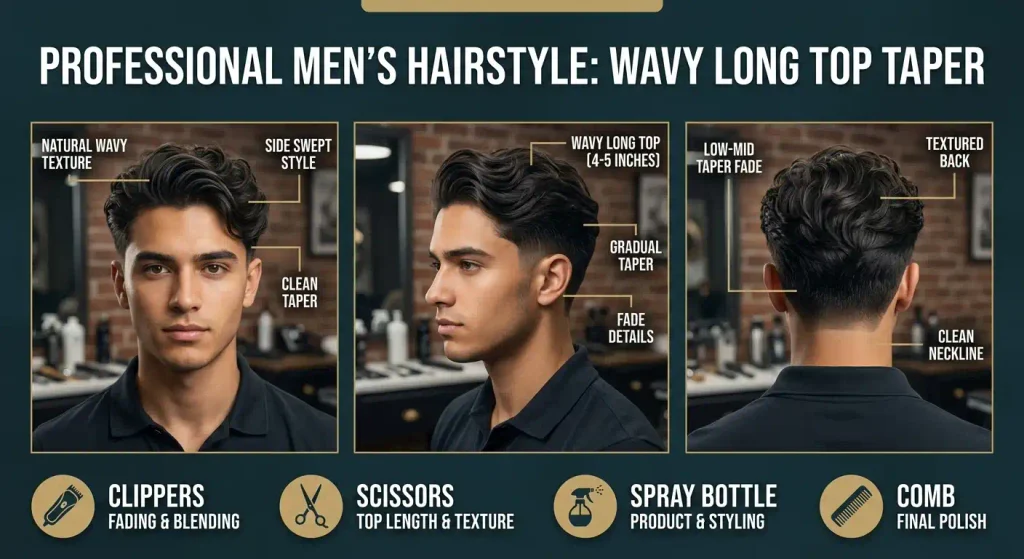
7. Wavy Long Top Taper
Natural waves become the main feature here. The taper removes some visual weight around the sides while leaving enough length for the waves to form across the top. Avoid asking for aggressive thinning if your waves depend on density. A lightweight curl cream can help define the pattern without making it stiff. This option works well on oval, square, and heart-shaped faces when the top is allowed to move naturally.
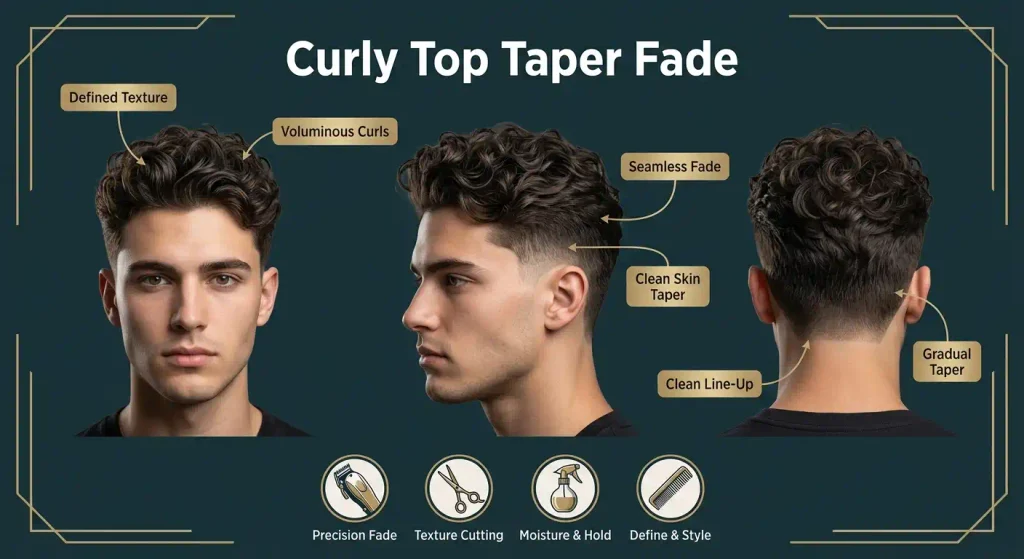
8. Curly Top Taper Fade
Curly hair can look fuller on top, so a taper helps create a cleaner outline without removing the curls themselves. Keep the top long enough for the curl pattern to remain visible. The sides can be tapered around the temple and neckline for contrast. Moisturizing products usually suit curls better than heavy waxes. Ask your barber to work with your natural curl pattern instead of treating it like straight hair.
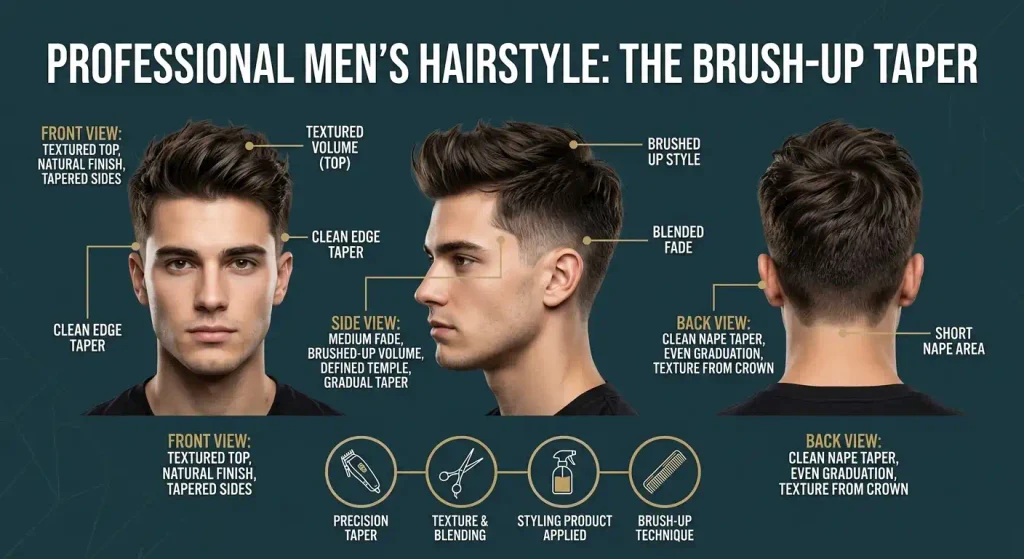
9. Brush-Up Taper
The brush-up directs the front upward and slightly backward to create height. It is different from a slick-back because the front remains lifted instead of lying flat. Thick, straight, or slightly wavy hair can hold this shape well. Blow-dry the front upward while using your fingers or a brush to guide it. Finish with a matte paste when you want texture rather than a shiny, formal appearance.
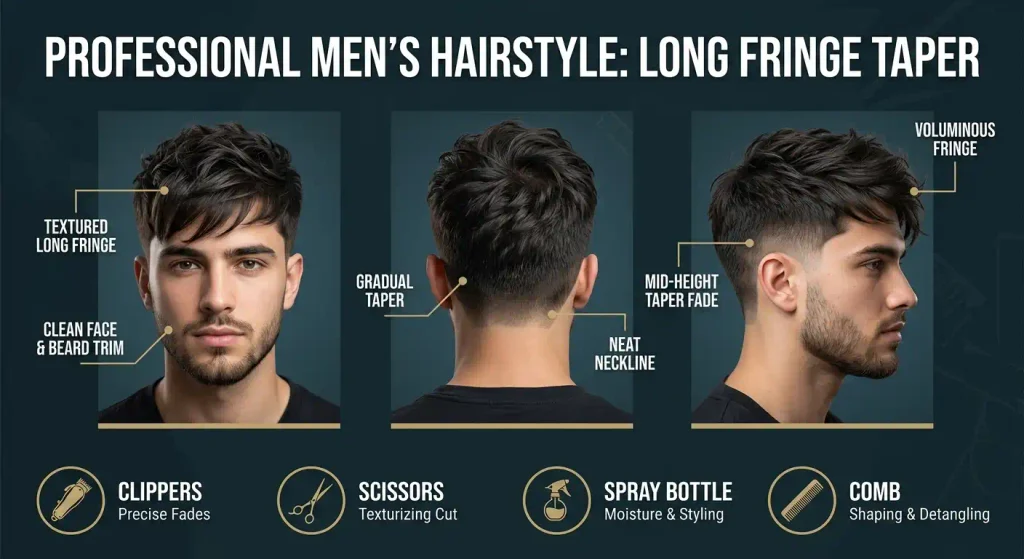
10. Long Fringe Taper
Instead of pushing the top backward, this version lets the front fall toward the forehead. The fringe can be blunt, soft, or lightly textured depending on your hair. The tapered sides keep the lower shape tidy while the front stays relaxed. It can work well for straight and wavy hair. If you have a longer face, keeping some fringe across the forehead can visually reduce the amount of exposed forehead.
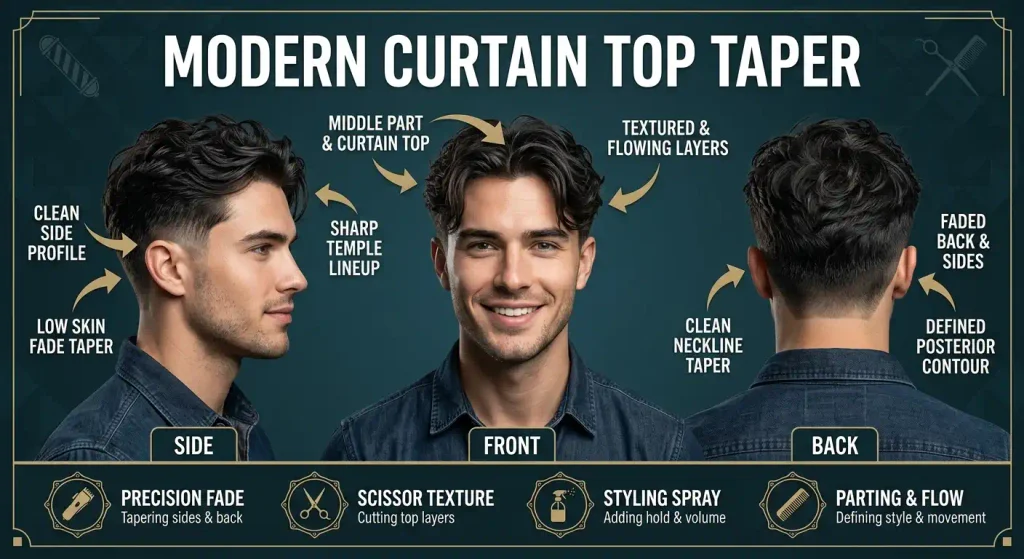
11. Curtain Top Taper
A middle part divides the longer top into two sections that fall toward each side of the face. The taper gives the hairstyle a cleaner edge without taking away its relaxed curtain shape. Straight and wavy hair are natural matches. Ask your barber to preserve enough length around the front for the curtains to open properly. A lightweight cream can enhance movement without making the hair look greasy.
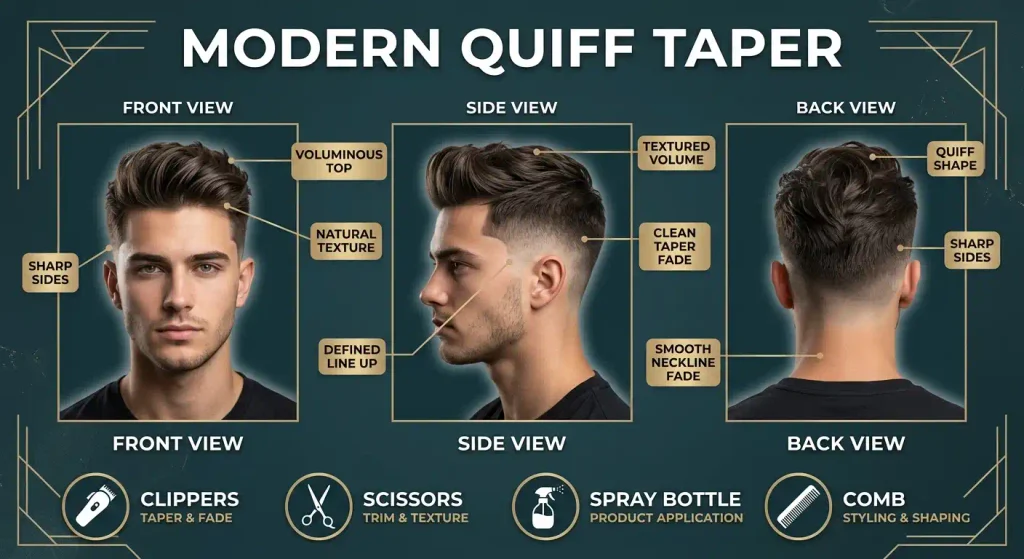
12. Modern Quiff Taper
The quiff places the focus at the front by lifting the longer top and sweeping it backward. Unlike a flat side part, it creates visible height above the forehead. Medium to thick hair is usually easier to shape into this form. Ask for enough front length to build the quiff, while keeping the taper clean around the sides. Blow-drying the front upward makes styling easier.
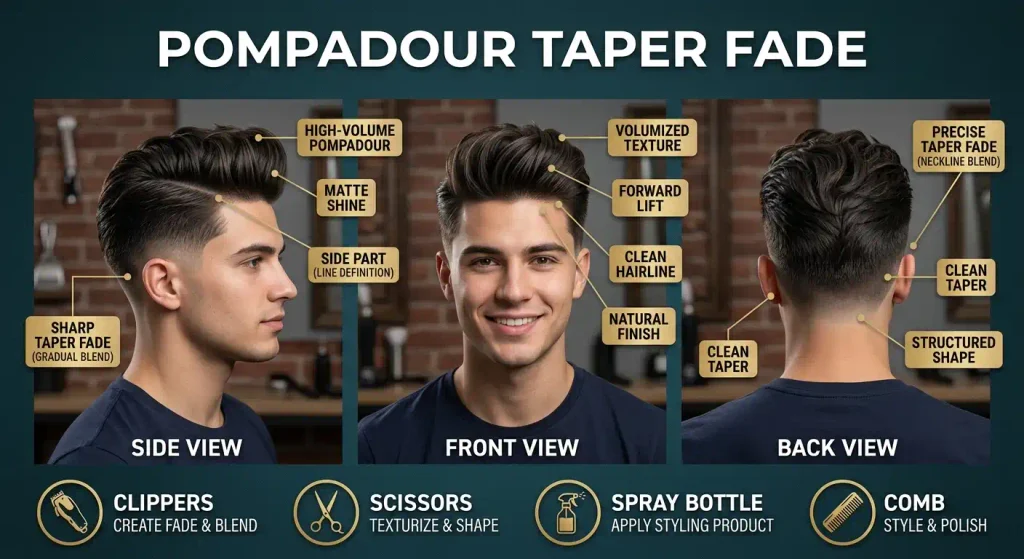
13. Pompadour Taper Fade
The pompadour takes the long-on-top concept into a more polished direction. The front is lifted and rolled back while the sides stay controlled. Thick straight hair can provide natural fullness, but other textures can also work with the right styling. Use a blow dryer to shape the front, then apply a product with enough hold to keep the volume in place. Keep the taper clean but not so high that it competes with the top.
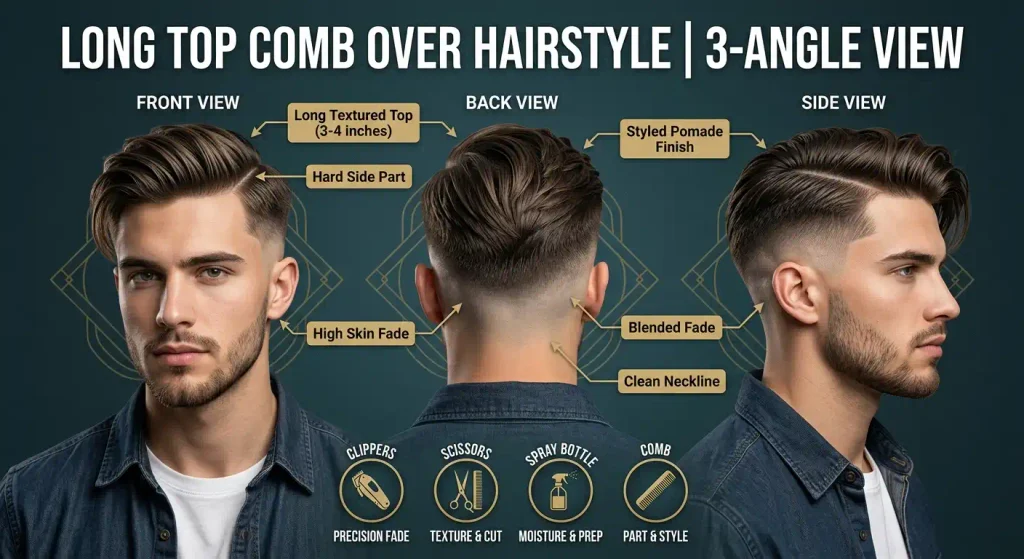
14. Long Top Comb Over
This cut combines longer top hair with a deliberate sweep from one side to the other. It differs from a traditional short comb-over because the top has enough length to create movement and volume. Straight hair makes the direction easy to see, while wavy hair gives the style a softer finish. A low or medium taper works well when you want the comb-over to remain the main focus.
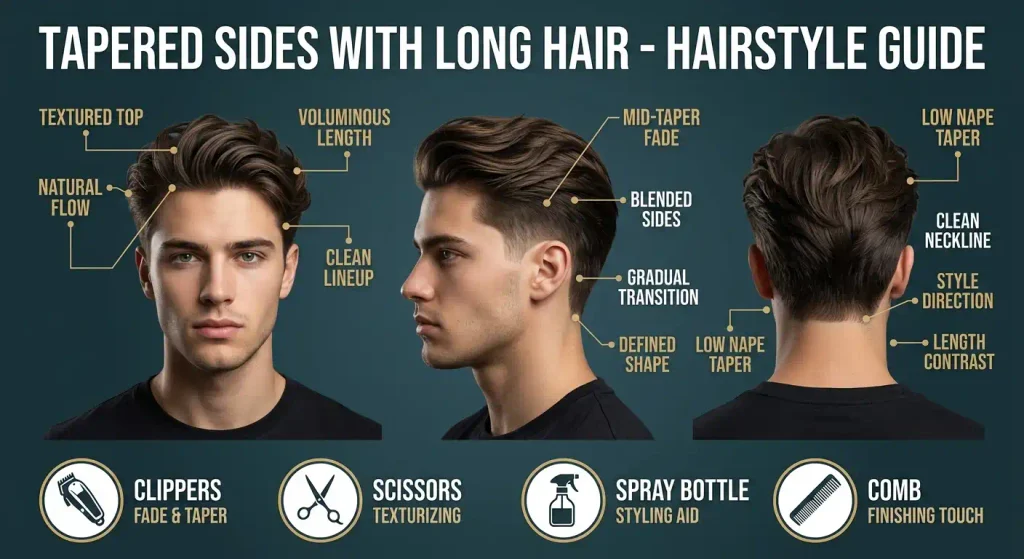
15. Tapered Sides With Long Hair
This option leaves more side length than a conventional fade while still cleaning the perimeter. The result is useful for men who are growing their hair but do not want the sides to look uncontrolled. Keep the top and upper side panels connected, then taper only where needed. It works with straight, wavy, and curly hair. A natural finish usually suits this relaxed long-hair shape best.
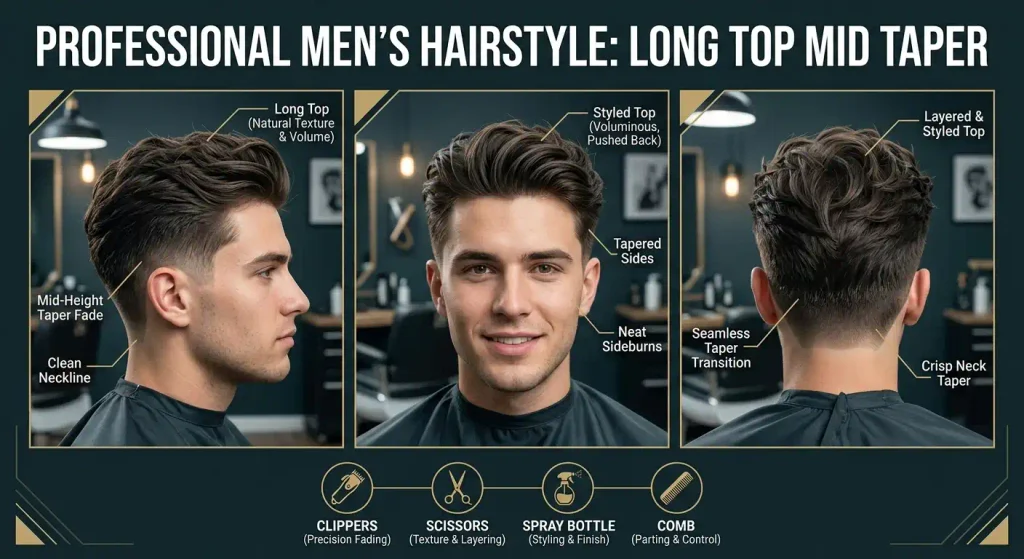
16. Long Top Mid Taper
A mid taper creates more visible contrast than a low taper while keeping the top as the main feature. It suits men who want a modern silhouette without taking the taper extremely high. Straight, wavy, and curly textures can all work. The top can be parted, brushed back, or worn messy. Tell your barber exactly how much top length you want preserved before discussing the taper height.
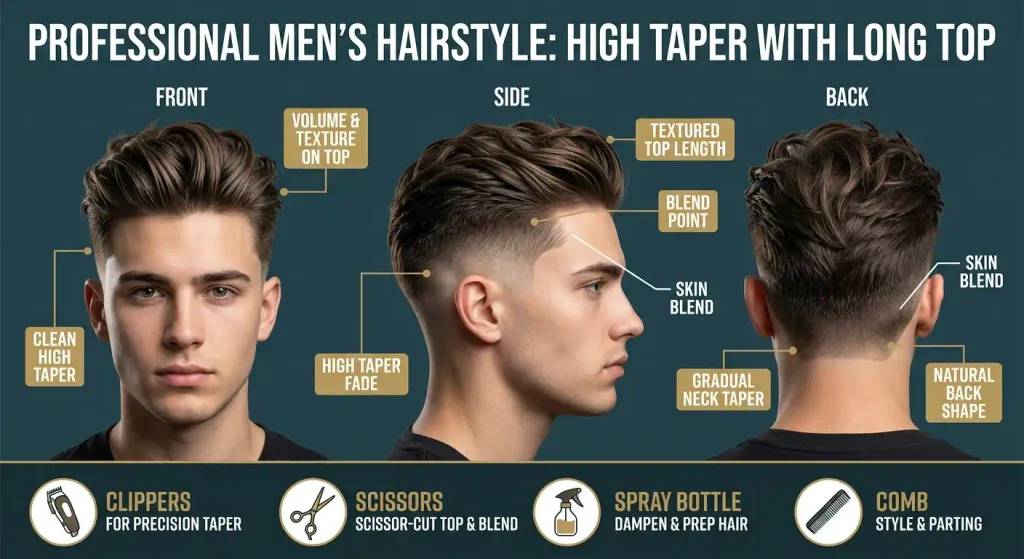
17. High Taper With Long Top
A high taper removes more side bulk and makes the long top stand out strongly. This creates a sharper visual contrast than a low taper. Thick hair benefits from the extra removal of side weight, while fine hair may need careful shaping to avoid making the top appear too thin. It works particularly well when the top has a strong shape such as a quiff, brush-up, or textured finish.
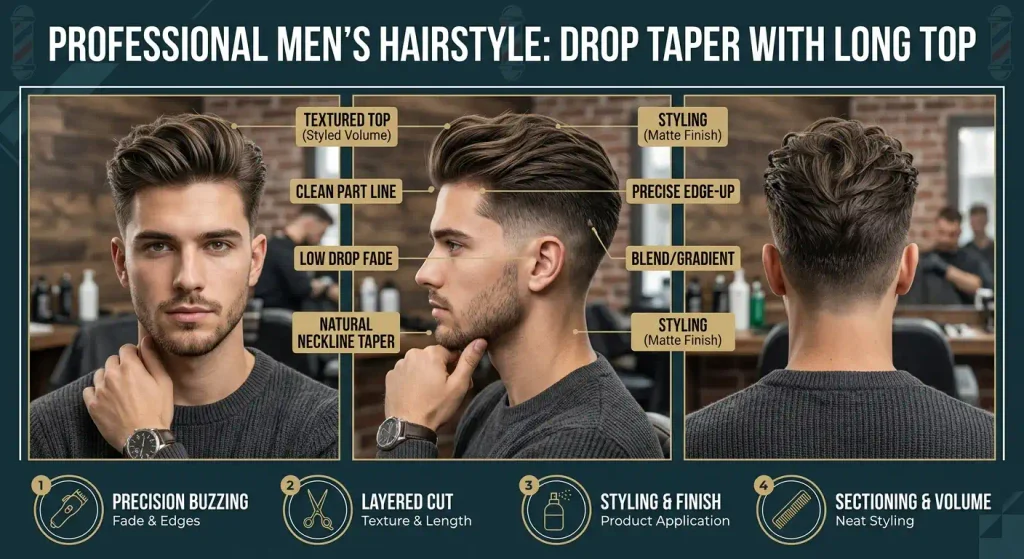
18. Drop Taper With Long Top
A drop taper follows the natural curve behind the ear rather than keeping the taper at one straight level. This can create a more rounded and connected appearance from the side and back. It works especially well with longer tops that have natural flow. Ask your barber to follow your head shape instead of forcing a flat line. The result can be worn loose, brushed back, or lightly textured.
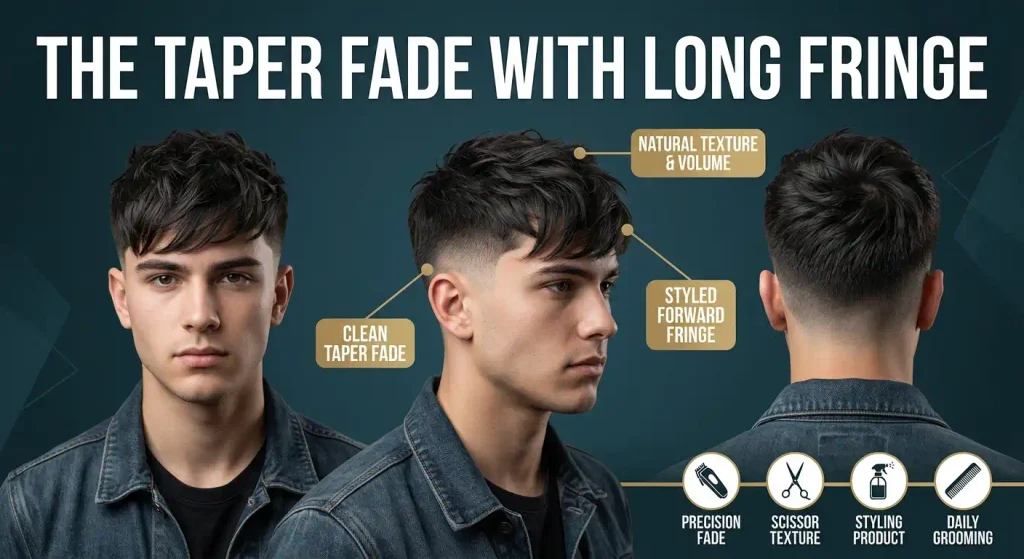
19. Taper Fade With Long Fringe
Here the fringe stays longer and becomes the defining feature. The sides are cleaned up with a taper, creating contrast between the forward-facing fringe and shorter perimeter. Straight hair gives the fringe a clean edge, while wavy hair creates a softer fall. You can wear it across the forehead or push it slightly to one side. Ask for texture if you want the fringe to look less heavy.
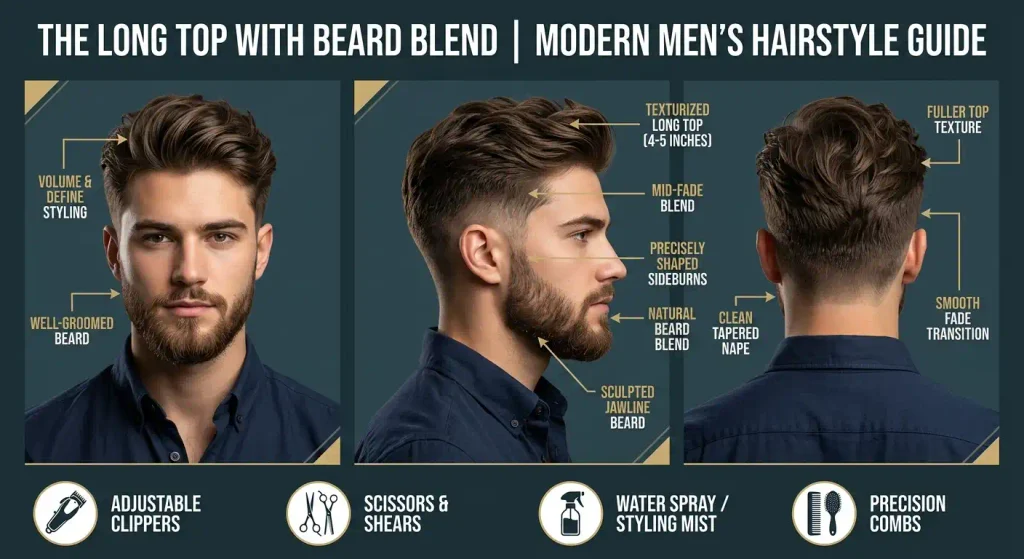
20. Long Top With Beard Blend
A beard can extend the visual line of the haircut, especially when the sideburn area is blended carefully. Keep the long top styled backward, sideways, or naturally loose while the taper connects cleanly with the beard. This option suits men who already wear facial hair and want a unified shape. Tell your barber whether you want the beard connection soft or sharply defined so the haircut and beard do not compete.
21. Long Top With Sharp Line-Up
A sharp line-up adds a defined border around the forehead and temples. It creates more structure than a natural hairline, especially when paired with a textured or brushed-up top. This style is most useful when you want a crisp barbershop finish. Keep in mind that a natural hairline and a line-up grow differently, so tell your barber whether you want your existing hairline followed or visually reshaped.
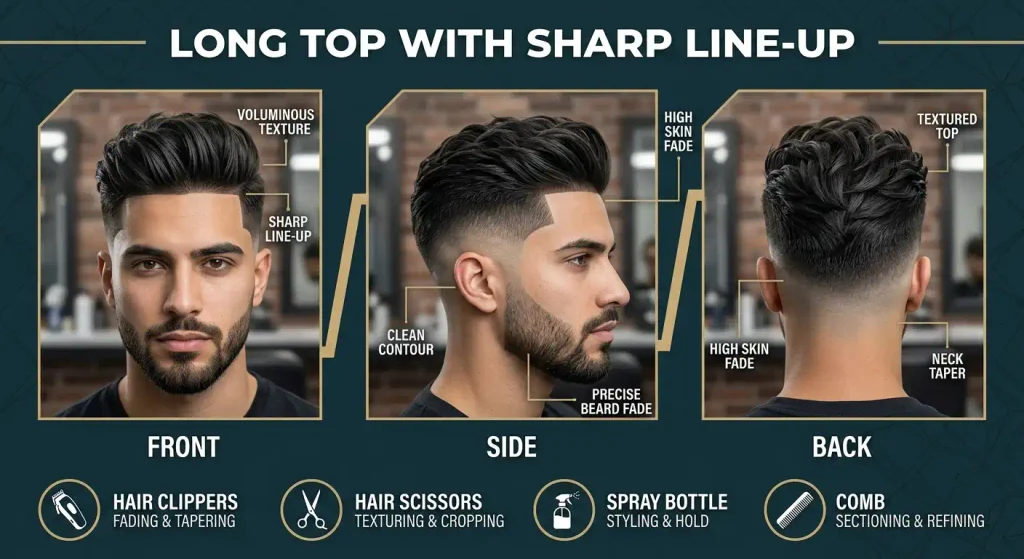
22. Long Top With Temple Taper
A temple taper focuses attention around the temples while leaving much of the side panel fuller. It is a subtle way to clean up a long hairstyle without turning the entire side into a strong fade. Straight and wavy hair suit this approach particularly well. It also works during a growing phase because less overall length is removed. Style the top naturally or sweep it away from the face.
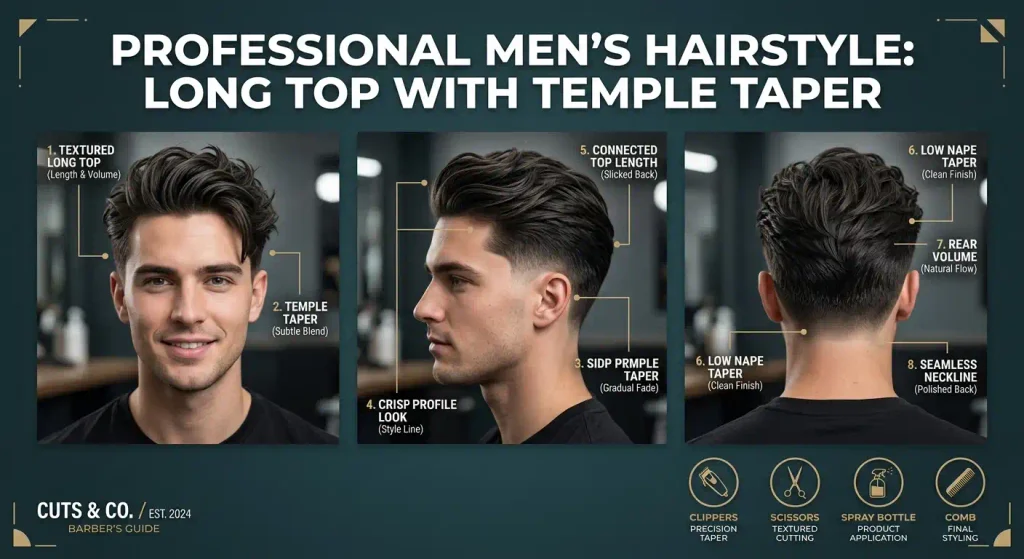
23. Long Top With Neck Taper
This version puts most of the taper work at the neckline. The top and sides stay relatively full, which makes it useful for men who want to keep a long-hair silhouette. The neck taper simply prevents the back edge from looking overgrown. It is especially practical for straight hair because the neckline can become noticeable as it grows. Ask for a soft finish if you want the grow-out to look natural.
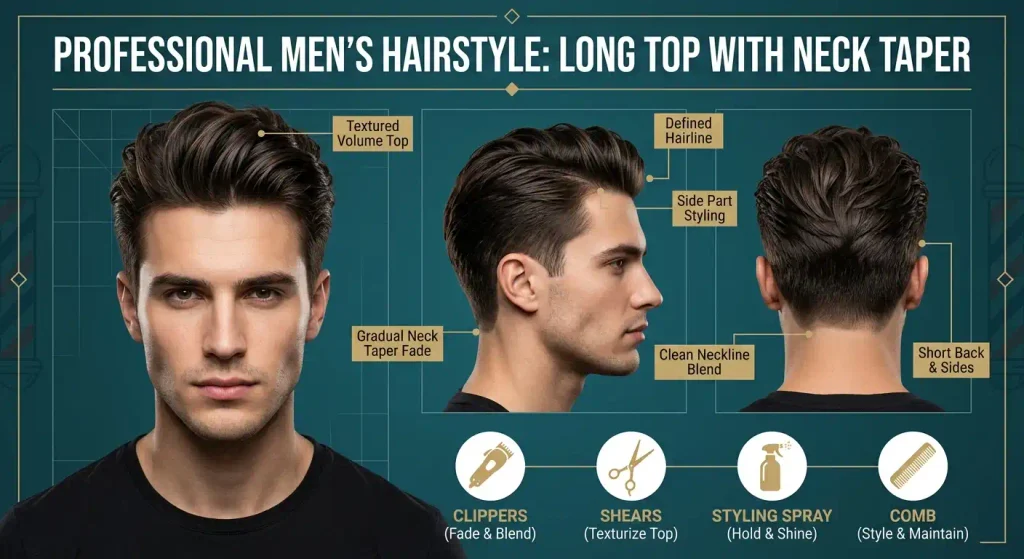
24. Long Top With Natural Taper
A natural taper avoids an overly tight fade and keeps more hair around the sides. The goal is a smooth transition rather than a dramatic contrast. This makes it a strong choice for conservative workplaces or anyone who wants a haircut that looks good several days after the appointment. Use scissors and moderate clipper work to preserve the natural shape. A light cream is enough for most styling needs.
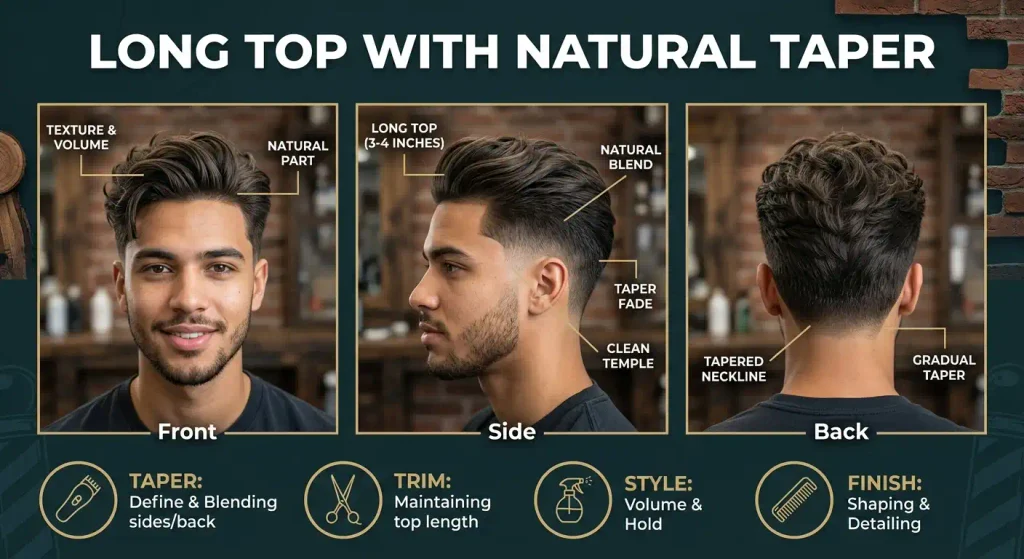
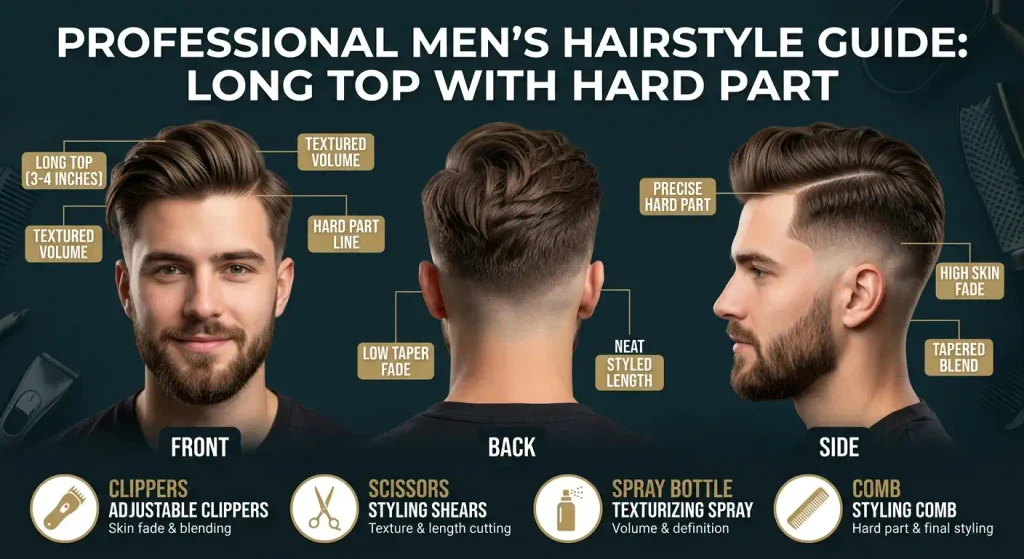
25. Long Top With Hard Part
A hard part creates a visible shaved line that separates the longer top from the shorter side. It makes the direction of the hairstyle immediately clear. The top can then be combed over, slicked back, or styled with volume. This is a more defined choice than a natural part. Because the line is deliberate, regular edge maintenance helps keep it visible and clean as the hair grows.
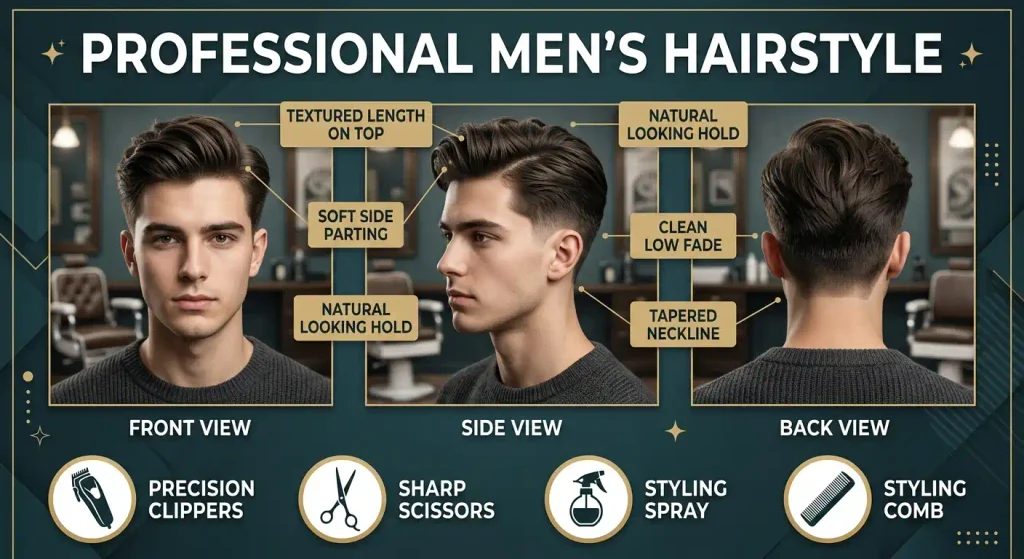
26. Long Top With Soft Side Part
If a hard part feels too strong, a soft side part offers a more natural alternative. The barber leaves enough length on top for the hair to separate without carving a line into the scalp. It works well for office settings and everyday wear. Straight hair shows the part clearly, while wavy hair creates a more relaxed finish. A comb and light styling cream are usually enough.
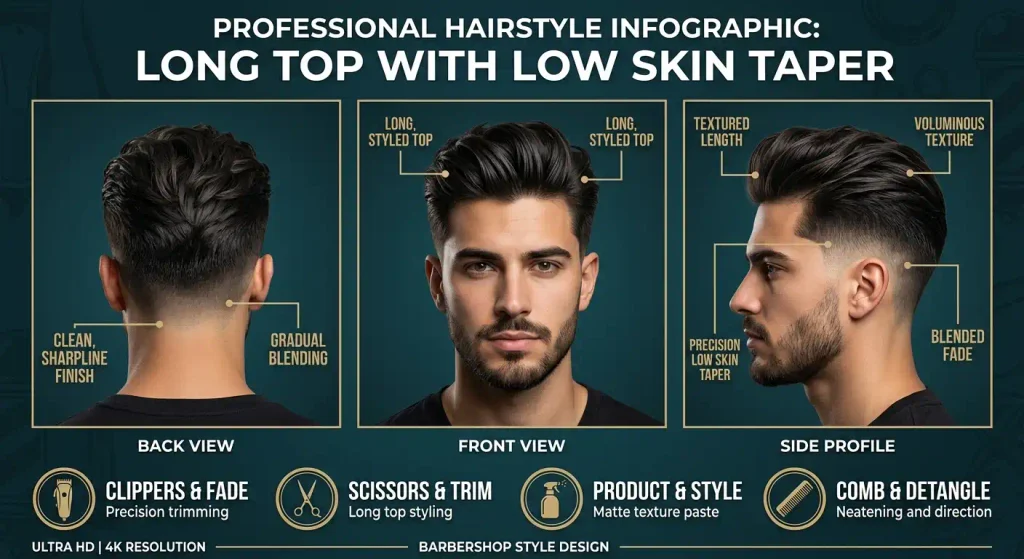
27. Long Top With Low Skin Taper
A low skin taper combines a subtle placement with a very short finish at selected areas. The skin exposure stays low, so the long top still dominates the haircut. It works well when you want crisp sideburns and a clean neckline without a high bald fade. Straight and wavy hair can carry the contrast easily. Because skin-level sections show regrowth quickly, consistent barber visits help preserve the sharp edge.
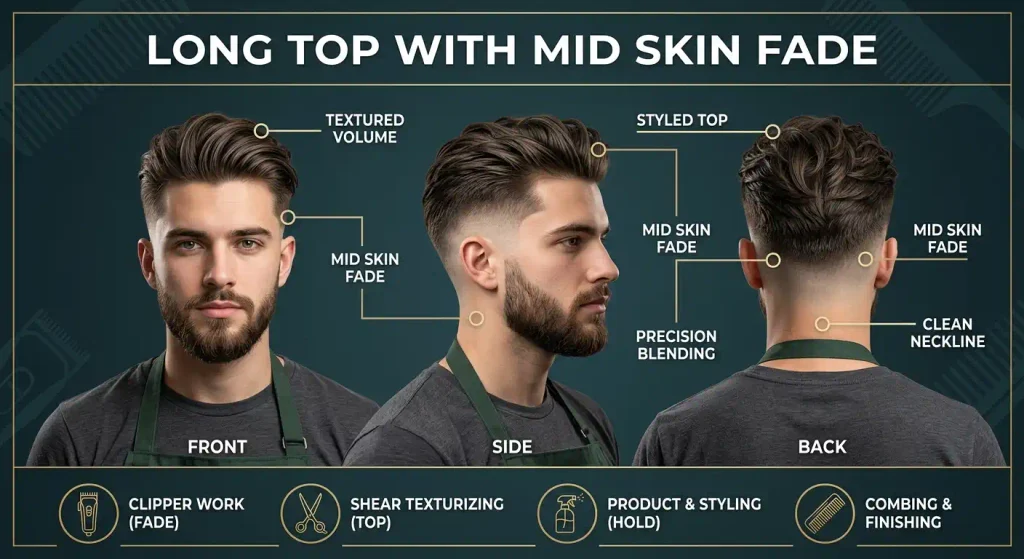
28. Long Top With Mid Skin Fade
This is a stronger contrast option. The sides transition down to skin around a mid-level area, while the top stays noticeably longer. Thick hair can look especially structured because the skin section removes surrounding bulk. Keep the top textured or swept back so the haircut has a clear focal point. This look needs more upkeep than a traditional taper because the short faded area becomes visible as it grows.
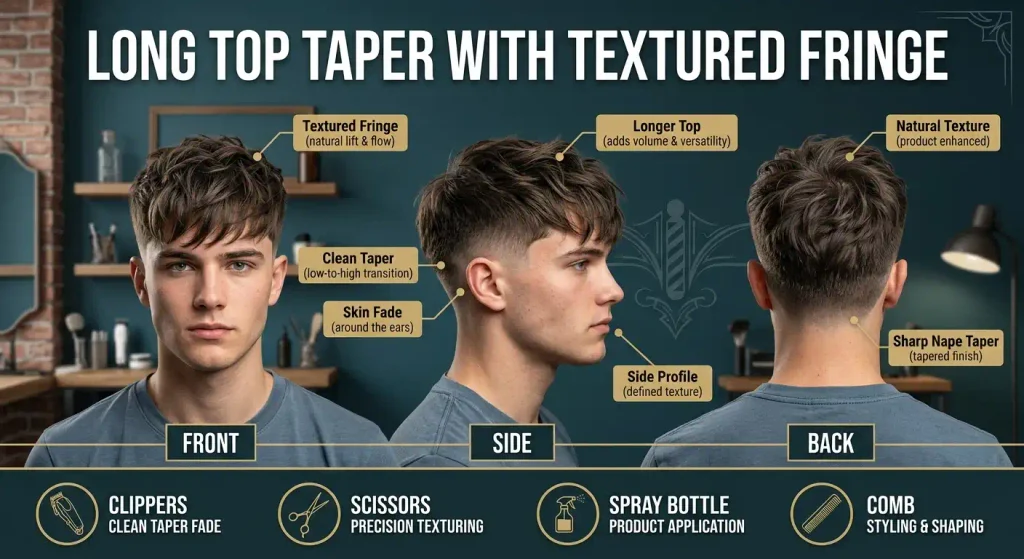
29. Long Top Taper With Textured Fringe
The textured fringe creates separation at the front rather than a single heavy block of hair. The sides taper neatly, giving the messy front a controlled frame. This can work well for medium or thick straight hair and natural waves. Ask your barber for point-cut texture rather than simply taking large amounts of length away. A matte product applied with the fingertips keeps the fringe flexible.
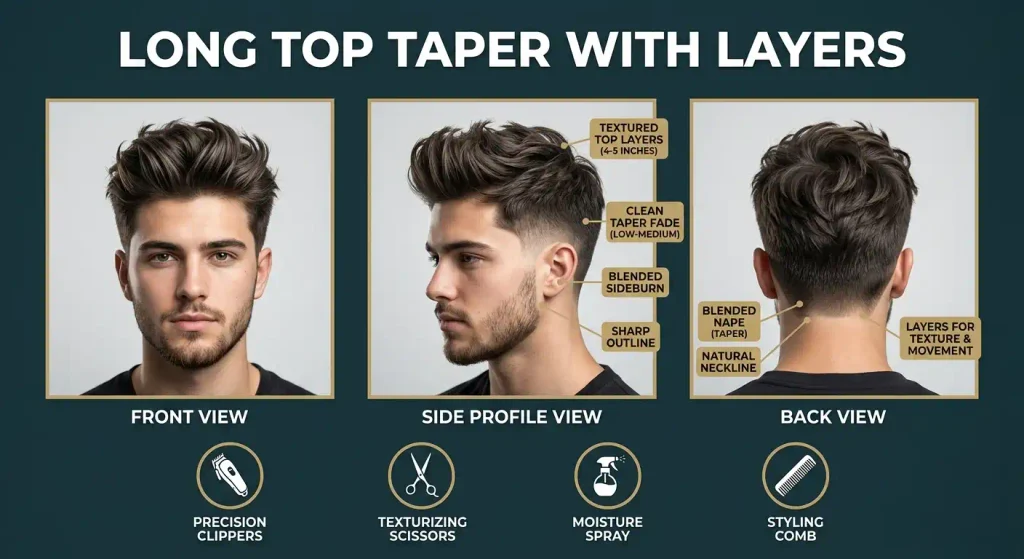
30. Long Top Taper With Layers
Layers can make longer hair move more freely and reduce the feeling of a heavy top. The taper then cleans the perimeter while the layered top provides shape. This option is useful for thick or medium-density hair that becomes bulky when kept at one solid length. Ask for layers that match your natural movement. Style with a lightweight cream or leave-in product instead of heavy wax.
31. Long Top Taper With Middle Part
The middle part gives the long top a symmetrical shape that frames the face. A low or mid taper keeps the area around the ears and neck neat without changing the main flow. Straight hair produces a clean curtain effect, while waves create more movement. Let the front retain enough length to fall naturally on both sides. Blow-dry from the center outward when you want extra direction.
32. Long Top Taper With Slick Side Sweep
The side sweep combines the polish of a slick style with the movement of a longer top. Hair is directed diagonally backward from the part rather than straight across the head. This gives straight or wavy hair a strong shape without requiring a hard part. A medium-hold product keeps the sweep controlled. For a softer version, use your fingers instead of a fine-tooth comb.
33. Long Top Taper With Natural Flow
This is for men who want their hair to move naturally instead of forcing it into a fixed direction. The taper simply cleans the areas around the ears, temples, and neckline. Longer top and side length can then fall where the hair naturally wants to go. It works particularly well with medium or long wavy hair. Use a lightweight leave-in product if the hair needs extra moisture and control.
34. Long Top Taper With Bro Flow
The bro flow keeps the top and back long enough to move toward the sides and rear of the head. A subtle taper around the perimeter stops the shape from becoming too bulky. This is a strong choice for naturally wavy or thick hair. Avoid removing too much length from the back because the flowing shape depends on it. Let the hair air-dry or use a diffuser for natural texture.
35. Long Top Taper With Man Bun
Long enough hair can be pulled into a bun while the taper keeps the temples, ears, and neckline tidy. This is especially useful during a long-hair growth phase when you want the perimeter to look intentional. The bun can sit high or low depending on your top length. Avoid pulling wet hair too tightly. A soft tie and regular conditioning help protect longer strands from unnecessary stress.
36. Long Top Taper With Ponytail
A ponytail creates a practical option for men with substantial length. The taper provides a clean frame around the face and neck while the longer hair stays gathered behind the head. This works best once the top and back have enough length to tie comfortably. Keep the taper subtle if you want a traditional long-hair appearance. For daily wear, use a fabric-covered tie rather than a tight elastic.
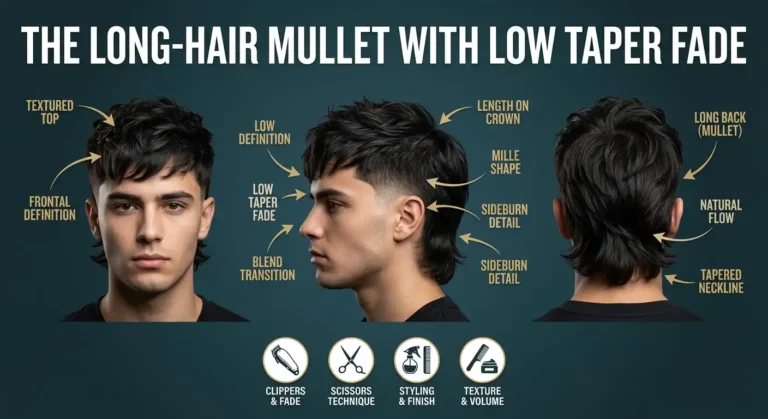
37. Long Top Taper Mullet
The modern mullet keeps extra length through the back while the sides and temples are tapered. The top can remain textured, swept back, or slightly messy. This creates a stronger shape than a standard long-top taper because the back length is intentional. Wavy and textured hair can make the silhouette especially noticeable. Tell your barber that the rear length should remain connected to the overall design.
38. Long Top Taper With Wolf-Cut Texture
A wolf-cut approach adds layers and movement across the top and back. The taper then provides a cleaner perimeter around the ears and temples. This works best when the hair already has natural texture or enough density to support layers. It is not a neat, traditional haircut, so ask for visible movement rather than a perfectly smooth finish. Matte styling products help keep the layers separated.
39. Long Top Taper With Spikes
Instead of sweeping the top back, separate sections upward to create controlled spikes. The taper keeps the sides tight enough to make the texture visible. Straight, thick hair is a natural match, but fine hair can also use texture to create more visual separation. Use a matte paste or clay and pinch small sections with your fingers. Keep the spikes irregular for a modern finish rather than making every section identical.
40. Long Top Taper With Faux Hawk
A faux hawk directs the longer top toward the center, creating a raised strip without the fully shaved sides of a traditional mohawk. The taper provides enough contrast for the central shape to stand out. It works best with medium to thick hair. Ask your barber to preserve enough width through the center. Style the top upward and inward with matte paste for flexible structure.
41. Long Top Taper for Thick Hair
Thick hair gives you plenty of volume, but it can also create unwanted weight on the sides. A taper removes some of that bulk without sacrificing the top. Ask your barber to control density with careful shaping rather than aggressively thinning everything. The top can be brushed back, textured, or parted. A lightweight cream is often enough when the hair already has natural body.
42. Long Top Taper for Fine Hair
Fine hair benefits from a shape that does not remove too much density from the top. Keep the taper clean but moderate, then use texture and direction to create the appearance of fuller hair. Avoid heavy, oily products that flatten the top. A lightweight matte product can provide control without adding excessive weight. Ask your barber to preserve the front and crown instead of over-thinning them.
43. Long Top Taper for Straight Hair
Straight hair shows the transition between the long top and tapered sides very clearly. That makes clean shaping important. You can choose almost any top direction, including a side part, slick-back, fringe, or curtain. If your hair is very straight and fine, avoid taking too much weight away from the top. A small amount of styling cream can create separation without making the hair stiff.
44. Long Top Taper for Curly Hair
Curly hair changes shape as it dries, so the barber should consider your natural curl pattern before deciding how much length to remove. Keep the curls longer on top and taper the perimeter for a clean frame. Avoid brushing curls dry after styling. Instead, use your fingers or a wide-tooth comb when needed. A curl-friendly cream can help maintain definition while keeping the top soft.
45. Long Top Taper for Wavy Hair
Wavy hair gives this haircut a relaxed middle ground between straight and curly textures. The taper keeps the edges controlled while the waves provide movement through the top. Ask your barber to preserve the wave pattern rather than cutting the top too short. A lightweight styling cream or texture product can enhance the waves. Let the hair dry naturally when possible for a softer finish.
46. Long Top Taper for Receding Hairline
A longer top can be styled forward, diagonally, or slightly across the forehead to create the coverage you prefer. Keep the taper moderate so the contrast does not make the hairline the only focus. Texture can also help prevent the top from looking flat. Avoid combing the hair tightly over areas you want to cover. A natural, slightly textured finish often looks more believable than a rigid sweep.
47. Long Top Taper for a Professional Look
For a workplace-friendly version, choose a low or moderate taper and a controlled top. A side part, soft comb-over, or slick-back can keep the longer length looking intentional. Avoid excessive shaved designs or extreme contrast if your workplace has conservative grooming rules. Straight and wavy hair are easy to style this way. A low-shine cream or pomade gives control without making the finish overly glossy.
48. Long Top Taper for Teens
A teen-friendly version can use a moderate taper with enough top length for messy texture, a fringe, curtain part, or brush-up. It gives room to change the styling without needing another haircut immediately. Straight and wavy hair can both work well. Keep the design simple if school grooming rules are strict. A lightweight styling cream is usually easier for younger users to manage than a heavy wax.
49. Long Top Taper With Hair Design
A small shaved line or simple geometric detail can make a long-top taper more personal. The design should sit within the shorter section so it remains visible without interfering with the longer top. This works best with a medium or high taper that creates enough clean space. Bring your barber a reference photo for the exact design. Remember that carved designs grow out quickly and need regular refreshes.
50. Long Top Taper With Natural Texture
This final option keeps the haircut simple: longer hair on top, clean tapered edges, and the hair’s natural texture left visible. There is no need for a hard part, dramatic fade, or strong product finish. It works across straight, wavy, and curly textures. Ask your barber to preserve the natural top shape and only clean the areas that need control. This is an easy everyday version of the cut.
Long Top Taper vs. Other Taper and Fade Options
The biggest decision is not only the top length. Taper height changes how much contrast you see around the sides, temples, and neckline. A lower taper keeps more side weight, while a higher fade creates a stronger separation from the longer top.
| Option | Typical Shortest Area | Contrast | Top Styling | Good For |
|---|---|---|---|---|
| Low Taper | Sideburns and neckline | Low | Natural, part, flow | Professional and subtle looks |
| Mid Taper | Temple and side area | Medium | Quiff, texture, side sweep | Balanced modern cuts |
| High Taper | Higher side area | High | Quiff, brush-up, textured top | Bold contrast |
| Drop Taper | Curved area behind ear | Medium | Flow, curls, longer styles | Head-shape-following designs |
| Skin Taper | Selected areas to skin | High | Strong contrast styles | Crisp, high-contrast looks |
| Classic Taper | Lower sides and neckline | Low | Part, brush-back, natural | Traditional styling |
Guard numbers are not universal instructions because barbers may use different clipper systems and blending techniques. Instead of relying only on a number, show your barber a photo and explain where you want the taper to start and how much length must stay on top.
Why This Long-Top Style Works
The main advantage is flexibility. Shorter sides give the haircut a defined outline, while the longer top can be changed from a fringe to a side part, slick-back, quiff, curtain, flow, or natural texture.
It also gives you control over the visual balance of your haircut. More top volume can add height, while a flatter or forward style can reduce emphasis on height. The taper itself can stay subtle or become more noticeable depending on your preference.
Who Should Wear It?
For Straight Hair
Straight hair makes clean parts, slick-backs, fringes, and comb-overs easy to see. Keep enough density through the top so the style does not look flat.
For Wavy Hair
Waves add movement without needing heavy styling. A medium or low taper can frame the natural texture while leaving the top loose.
For Curly Hair
Let the curl pattern decide the top shape. Keep the perimeter controlled and avoid cutting the top based only on how the hair looks when wet.
For Thick Hair
A taper can remove side bulk while leaving the top full. Layering or careful weight removal may help prevent the haircut from becoming too heavy.
For Fine Hair
Keep density through the top and avoid excessive thinning. Texture, direction, and a lightweight matte product can create a fuller visual effect.
Best Face Shapes for a Long Top Taper
| Face Shape | Useful Top Approach | Taper Approach |
|---|---|---|
| Oval | Most top shapes work | Low, mid, or high |
| Round | Moderate height or texture | Medium or higher contrast |
| Square | Texture, side sweep, or natural flow | Most taper heights |
| Oblong | Moderate height with some forward movement | Low or medium |
| Heart | Fringe or natural side movement | Low or medium |
| Diamond | Flow, fringe, or textured top | Low or medium |
These are starting points, not strict rules. Hair density, growth direction, forehead shape, and personal styling preference can matter just as much as face shape.
How to Style It
- Start with clean, damp hair. Remove excess water with a towel without rough rubbing.
- Choose the direction. Decide whether the top will go forward, backward, sideways, upward, or into a middle part.
- Apply the right product. Use a light cream for natural movement, matte paste for texture, or pomade for a smoother finish.
- Use a blow dryer when needed. Direct the airflow in the same direction you want the hair to sit.
- Shape with your fingers or comb. A comb creates a cleaner finish; fingers create more separation and texture.
- Finish lightly. Add only enough product to control flyaways and keep the shape in place.
How to Ask Your Barber for This Cut
Do not simply say “long on top” because that can mean very different things to different barbers. Tell your barber how much length you want to keep, where you want the taper to begin, and how you plan to style the top.
Copy-and-paste barber request:
“I want to keep the top long and make that the main feature. Please taper the sides and back gradually, keep the transition clean, and do not take too much length from the top. I want enough length to style it with a side part, slick-back, fringe, or textured finish. Please show me the taper height before taking it higher.”
For a Low Taper
“Keep the taper low around the sideburns and neckline. I want the sides to stay fairly full above that area.”
For a Mid Taper
“Start the taper around the temple area and keep the top long enough for a textured quiff or side sweep.”
For a High Taper
“I want a higher, stronger taper with clear contrast, but please preserve the long top and its natural shape.”
For Curly or Wavy Hair
“Please cut with my natural curl or wave pattern in mind. Keep the top long and avoid removing too much density from the curls.”
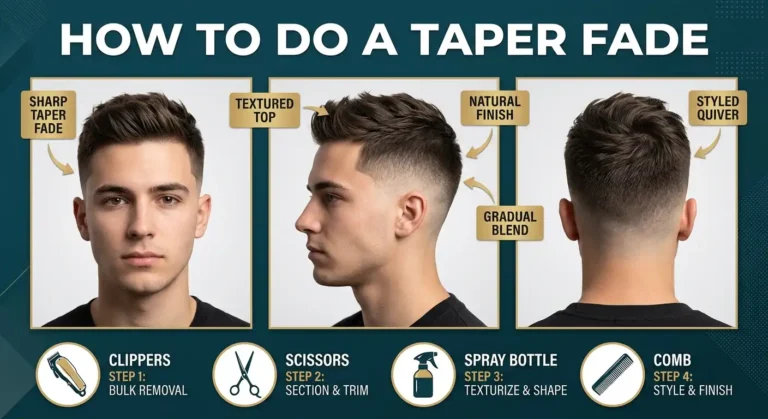
Step-by-Step Tutorial for This Long-Top Taper Fade
- Discuss the finished shape first. Decide whether the top will be slicked back, parted, textured, curly, or left natural.
- Preserve the top. Shape the longer section before removing significant side length so the barber can judge the final proportions.
- Set the taper area. Establish where the shortest section will sit around the temples, ears, and neckline.
- Create the blend. Move through suitable clipper lengths gradually rather than leaving a visible step between sections.
- Refine the transition. Check both sides and the back from multiple angles. Hair growth patterns can make one side appear different from the other.
- Clean the perimeter. Detail around the ears, sideburns, neckline, and temples according to the requested finish.
- Check the top again. Make sure the longer section still has enough length and weight for the intended style.
- Style the finished cut. Use the appropriate product and direction so you can see the final silhouette.
For a long-top cut, the key is preserving the contrast between the top and the tapered perimeter. Removing too much from the top can change the entire hairstyle, so discuss the final styling goal before the clippers come out.
Best Styling Products for This Long-Top Taper
- Matte clay: Useful for textured, messy, and brushed-up finishes that need stronger control without high shine.
- Matte paste: A flexible option for side sweeps, textured fringes, and natural separation.
- Light styling cream: Good for wavy, straight, and natural-flow styles where you want softness and movement.
- Pomade: Useful for slick-backs, side parts, comb-overs, and polished styles where direction matters.
- Curl cream: A better match for curly or highly textured tops that need moisture and definition.
- Texture spray: Can add movement and grip when you want a less polished, more natural finish.
Choose the product according to the finish, not simply the haircut. A natural-flow top needs a very different product from a slick pompadour.
Common Mistakes to Avoid
- Taking too much from the top: The longer top is the main reason for choosing this haircut. Do not sacrifice it without discussing the result.
- Choosing the taper height without considering your top: A very high taper can create much stronger contrast than a low taper.
- Using too much product: Heavy product can flatten long or fine hair and make textured styles look greasy.
- Ignoring natural growth patterns: Cowlicks, curls, and waves can change how the finished top sits.
- Copying a photo without matching hair type: A style worn by thick straight hair may behave very differently on fine curly hair.
- Over-defining the hairline: A sharp line-up changes the appearance of the front and may require more regular maintenance.
- Letting the taper grow too far: The perimeter can lose its clean shape before the longer top actually needs trimming.
Maintenance and Upkeep
The top and the taper often need different types of maintenance. You may be able to keep the top for several weeks or longer while refreshing the taper sooner to maintain a clean perimeter.
Many men choose a taper refresh roughly every 2–4 weeks, depending on how quickly their hair grows and how crisp they want the sides to look. A softer taper can be allowed to grow longer than a skin-level finish.
At home, wash according to your hair type and use conditioner when the longer top feels dry. Avoid aggressive towel rubbing, especially if the hair is curly or wavy. When growing the top, regular small shape-ups can prevent split or uneven ends from taking over the hairstyle.
Frequently Asked Questions
1. What is a taper fade with long hair on top?
It is a haircut that keeps more length through the top while the sides, temples, and neckline become progressively shorter. The top can then be styled in many ways, including a fringe, side part, slick-back, quiff, curtain, or natural flow.
2. Is a low taper long on top good for straight hair?
Yes. Straight hair can show the shape of a low taper clearly while keeping plenty of side and top length. It is especially useful if you want a natural look rather than a dramatic fade.
3. Which of the 50 styles is easiest to maintain?
The Classic Long Top Taper, Natural Taper With Long Top, and Long Top With Neck Taper generally require less styling than options such as a pompadour, hard part, or faux hawk. The simpler the top shape and the softer the taper, the easier the grow-out usually feels.
4. Can curly hair have a long-top taper?
Yes. The Curly Top Taper Fade in idea #8 is designed around keeping the curl pattern visible while cleaning the perimeter. Your barber should consider how much the curls shrink and how they sit when dry.
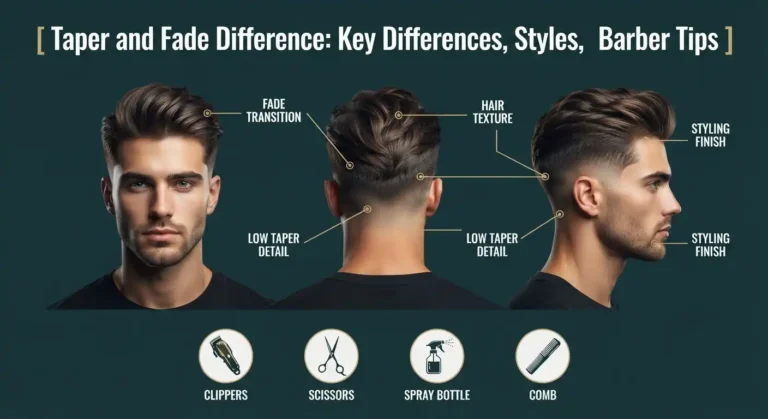
5. What is the difference between a taper and a fade?
A taper usually focuses on gradually shortening specific perimeter areas such as the temples, sideburns, and neckline. A fade can extend farther up the sides and create a stronger contrast. The exact terminology can vary between barbershops, so showing a reference photo is useful.
6. How long should the top be?
There is no single required top length. Your choice depends on the hairstyle. A short textured top needs less length than a slick-back, curtain, man bun, or ponytail. Tell your barber what you want to do with the top rather than relying only on a measurement.
7. Is a high taper better for thick hair?
A high taper can remove more side bulk, which may help thick hair feel cleaner around the perimeter. However, the best height depends on your desired contrast and top shape. If you want a softer appearance, a low or mid taper may make more sense.
8. Which style works for a professional workplace?
The Long Top Taper for a Professional Look in idea #47 is a useful starting point. A low or moderate taper paired with a side part, soft comb-over, or controlled slick-back usually creates a more conservative appearance than a high skin fade or shaved design.
Final Thoughts
A long top gives you the freedom to change your hairstyle without changing the basic haircut. You can wear it forward, backward, sideways, textured, curly, tied up, or naturally loose while the taper keeps the perimeter clean.
The most important choice is the relationship between top length and taper height. If you want a softer result, start with a low taper. For more contrast, consider a mid or high taper. Your hair texture, face shape, growth pattern, and daily styling routine should guide the final decision.
Before your next barber appointment, save one or two reference photos from this list and explain exactly what you want preserved on top. A clear request about length, taper height, texture, and styling direction can make the final result much easier to achieve.
Name: Ryan Cole
Role: Lead Grooming Editor, TaperHaircutGuide.com
Bio angle: Men’s grooming/style content researcher — 4+ years covering barbering trends, hairstyling terminology, and men’s style content for US audience. Cross-checks every guide with practicing barbers before publishing.