50 Best Fade Hairstyles for Men in 2026: The Ultimate Grooming Guide

Introduction & Direct Answer Definition
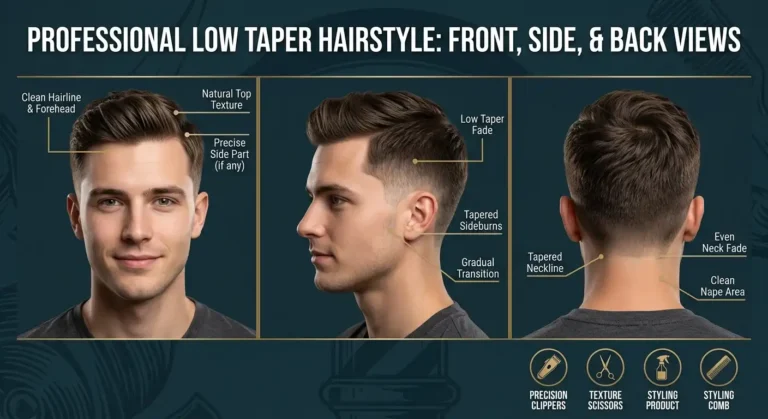
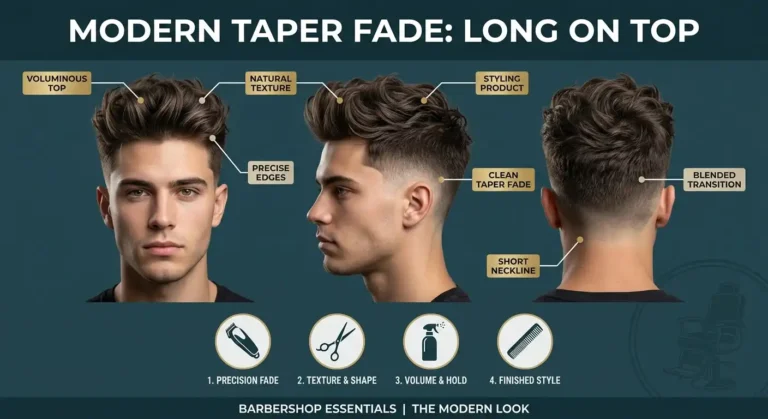
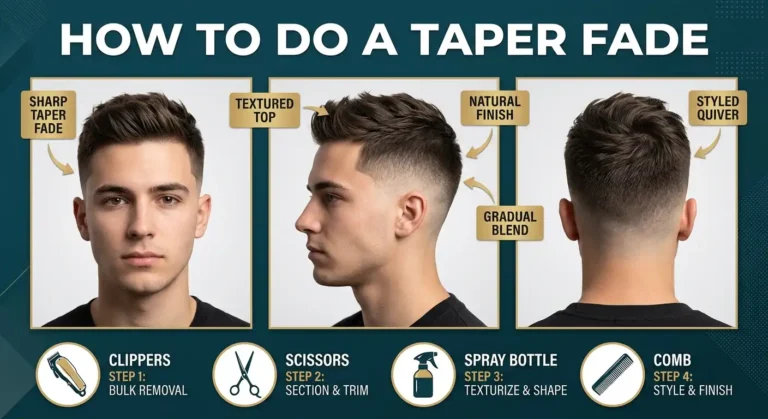
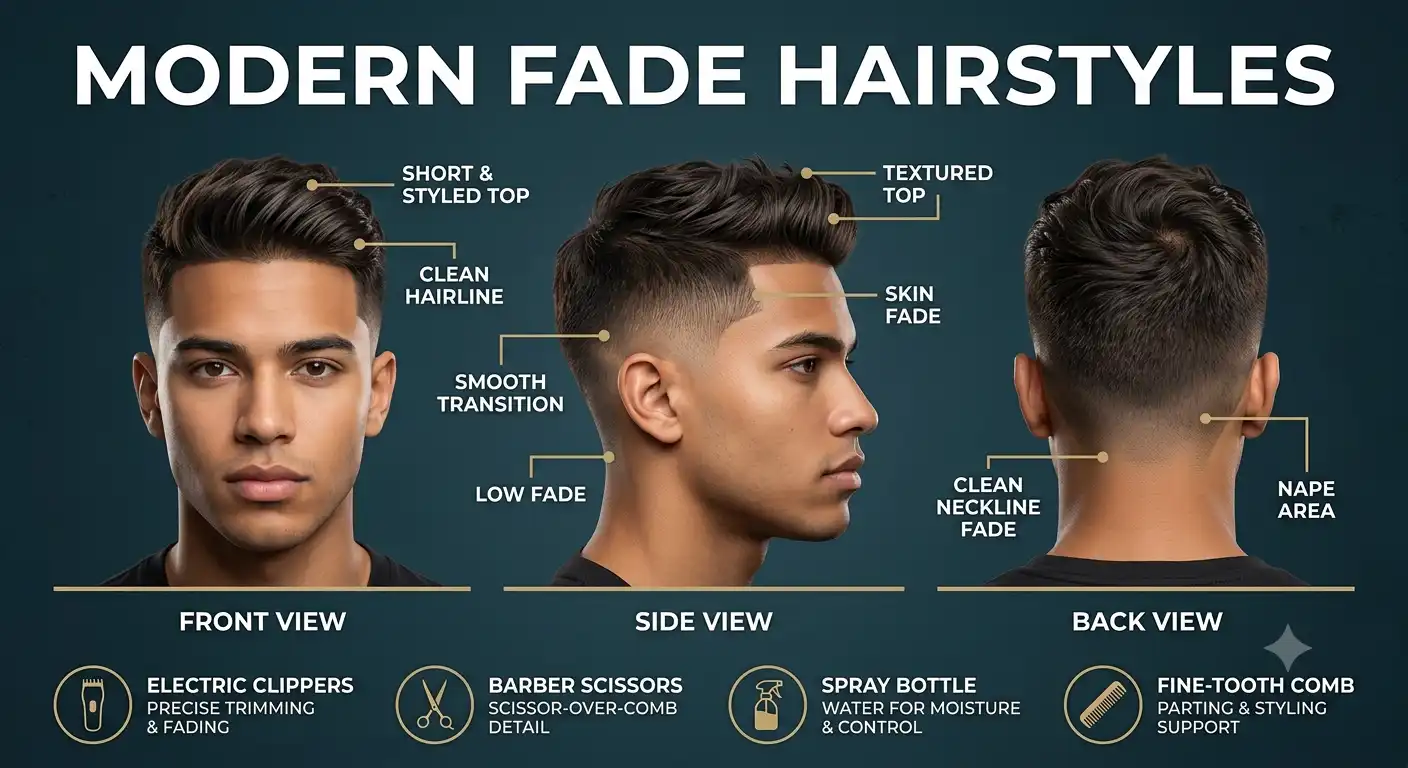
Among modern grooming choices, fade hairstyles represent a precise hair-cutting technique where hair length smoothly transitions from longer density on top to ultra-short hair or bare skin along the sides and lower perimeter of the head. By using varying clipper guard lengths, a master barber creates a seamless gradient—ranging from high, dramatic skin drops to subtle, low shadow tapers.
This visual gradient draws attention upward toward top hair volume, accentuates facial angles, and provides a crisp line-up around the ears and nape. Whether you want a conservative cut for the office, a low-maintenance buzz, or a textured crop for naturally curly strands, understanding guard lengths and taper points is key to picking the right look.
Below, we break down 50 distinct style variations organized across five major categories, complete with guard settings, styling product chemistry, face-shape matching, and exact barber consultation scripts.
Quick Key Takeaways: Top 5 Styles Overview
| Style Name | Recommended Guard Range | Primary Visual Feature | Best Face Shape | Primary Benefit |
|---|---|---|---|---|
| Low Fade Classic Crew Cut | #1 to #3 Guard | Subtle perimeter blend around lower ear | Oval, Square | Professional, clean, low daily maintenance |
| Mid Fade Textured Crop Fringe | #0.5 to #2 Guard | Forward-swept textured bangs with mid taper | Round, Heart | Frames forehead and balances facial proportions |
| 3a Curly High Drop Fade | #0 to #1.5 Guard | Bouncy ringlet volume dropping behind ears | Oval, Diamond | Highlights natural 3a curl definition with high contrast |
| High Skin Fade Buzz Cut | #0 (Bare Skin) to #2 Guard | Ultra-clean scalp contrast with short top | Square, Oval | Minimalist aesthetic with zero daily styling time |
| Beard-Integrated Low Shadow Fade | #0.5 to #2 Guard | Smooth sideburn gradient into facial stubble | Oval, Round | Unifies jawline structure and cleans side profile |
Master Barber Phrasing: How to Ask Your Barber
Clear communication with your barber prevents common mistakes, such as cutting the fade line too high or removing crucial bulk around the parietal ridge. Use this exact consultation script during your next salon or barbershop visit:
Master Barber Consultation Script:
“I want a custom fade that starts around my [ choose: lower earlobe for a low fade / mid-temple for a mid fade / upper temple for a high fade ] and smoothly tapers down to [ choose:
#0bare skin /#0.5guard /#1guard ]. On top, keep roughly [ choose: 1 inch / 2 inches / 3 inches ] of length, using point-cutting to build piecey texture so the sides sit flush without creating bulky corners.”
Style-Specific Script Add-Ons
- For 3a curly hair: “Please cut the top dry using shear point-cutting so the natural curl pattern stays intact without fraying the ends.”
- For drop fade variations: “Ensure the fade line curves downward behind my ears following the occipital bone, rather than cutting straight across the back.”
- For beard integration: “Taper my lower sideburn down to skin, then reverse-blend it smoothly into the top line of my facial hair.”
- For fine or thinning hair: “Keep the fade low near the ear canal to preserve side hair density higher up near the crown.”
Categorized Core Gallery: 50 Top Fade Hairstyles for Men
Category 1: Subtle & Professional Men’s Low Fade Hairstyles
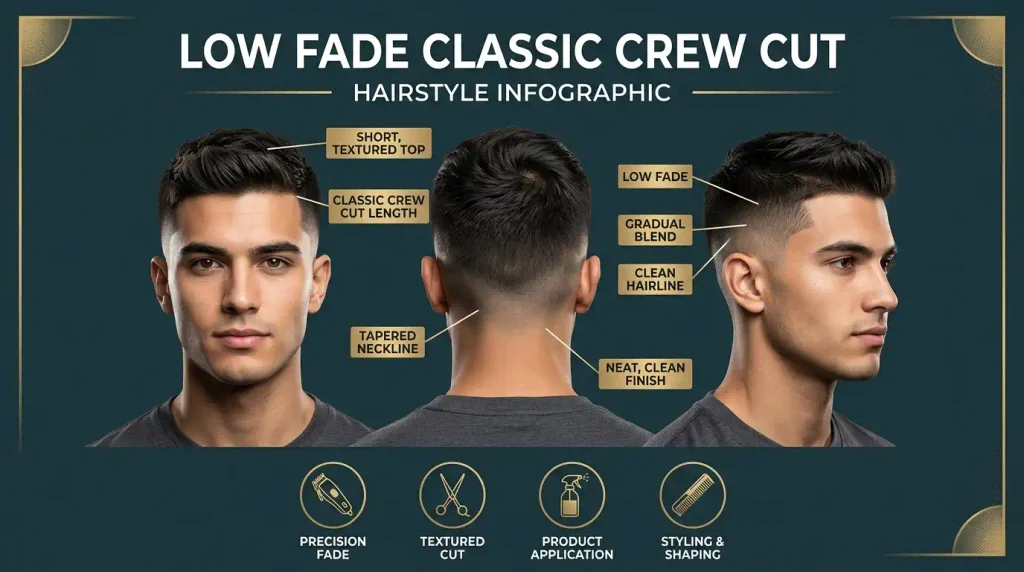
1. Low Fade Classic Crew Cut
Short, tidy top layers transition smoothly into a soft perimeter blend starting right above the earlobe. The barber clips the lower edges with a #1 guard, tapering upward into a #3 guard near the temple ridge. Oval and square face shapes gain a refined silhouette that suits strict corporate dress codes. A light dab of matte paste worked through damp hair keeps the top neat.
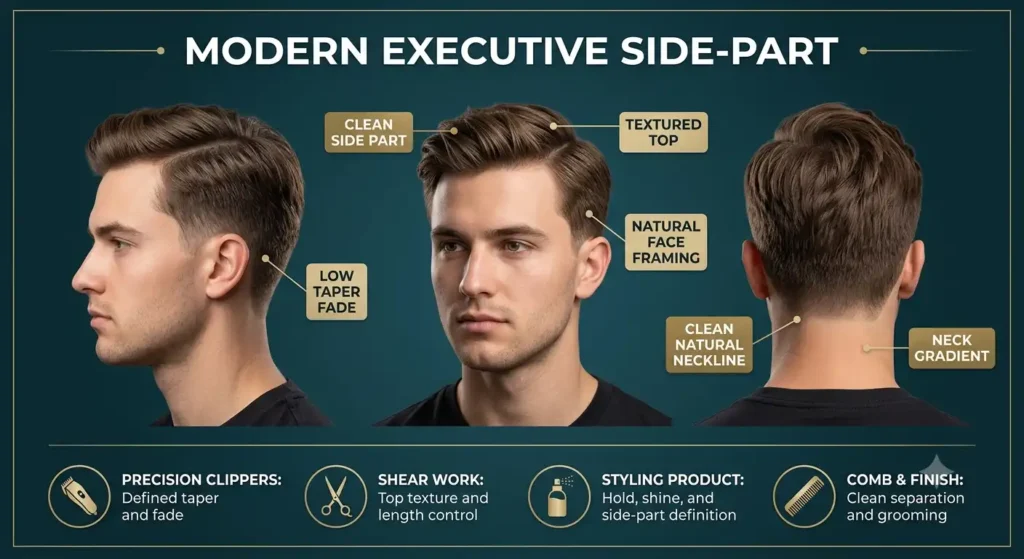
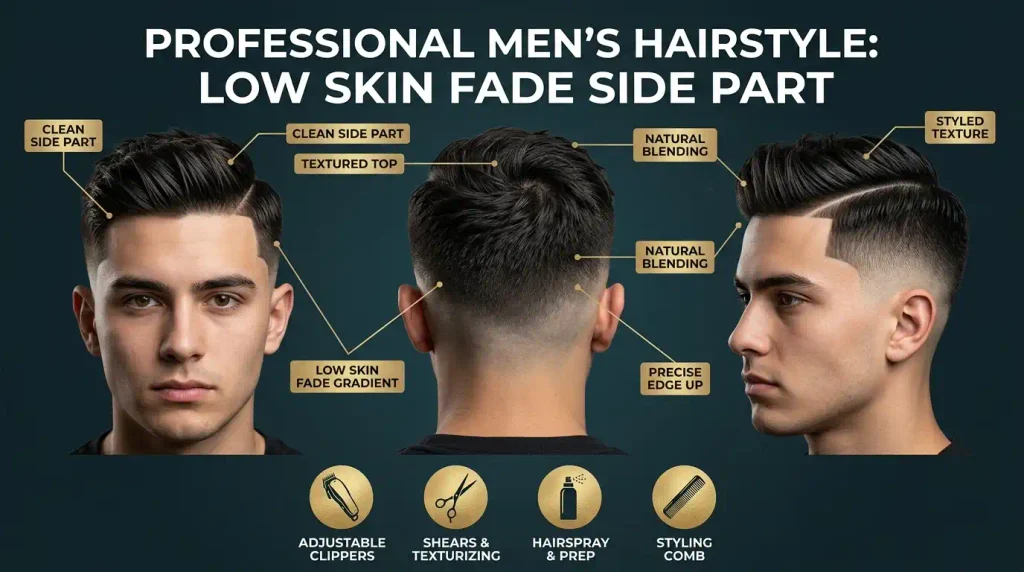
2. Low Skin Fade Side Part
A defined side part separates structured top hair from a clean, skin-blended lower perimeter. Fading the lower sideburns down to a #0 open lever creates a sharp baseline without stripping density from the upper sides. Diamond and rectangular face shapes benefit from the balanced side structure. Secure the top sweep using a medium-shine pomade and a fine-tooth comb.
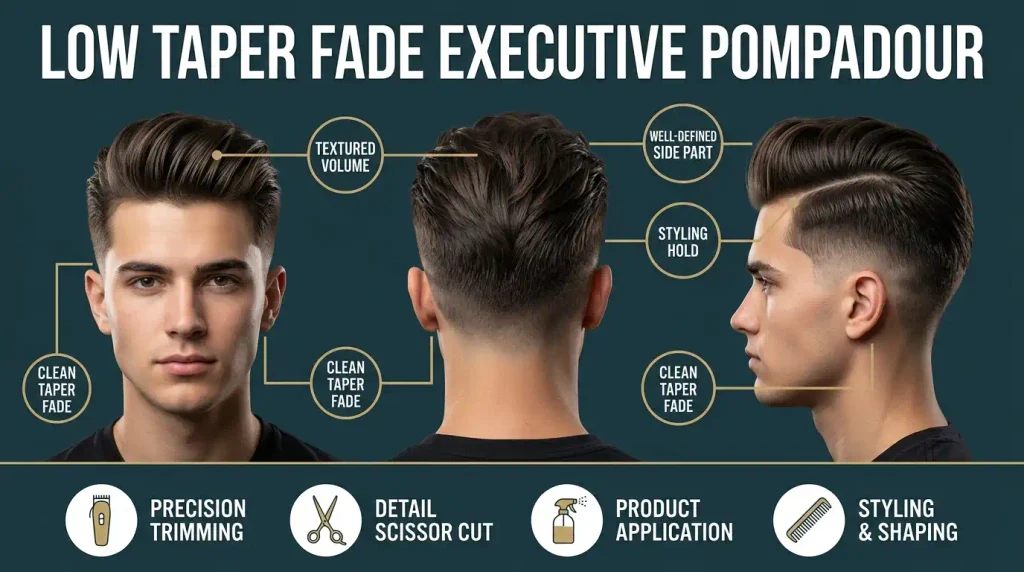
3. Low Taper Fade Executive Pompadour
Smooth, backward-swept volume on top tapers subtly around the sideburns and nape. Utilizing a #1.5 guard baseline keeps the side transition gradual, preventing scalp exposure high on the head. Works exceptionally well on straight to wavy hair textures. Set the height by blow-drying upward before applying a dime-sized portion of pliable wax.
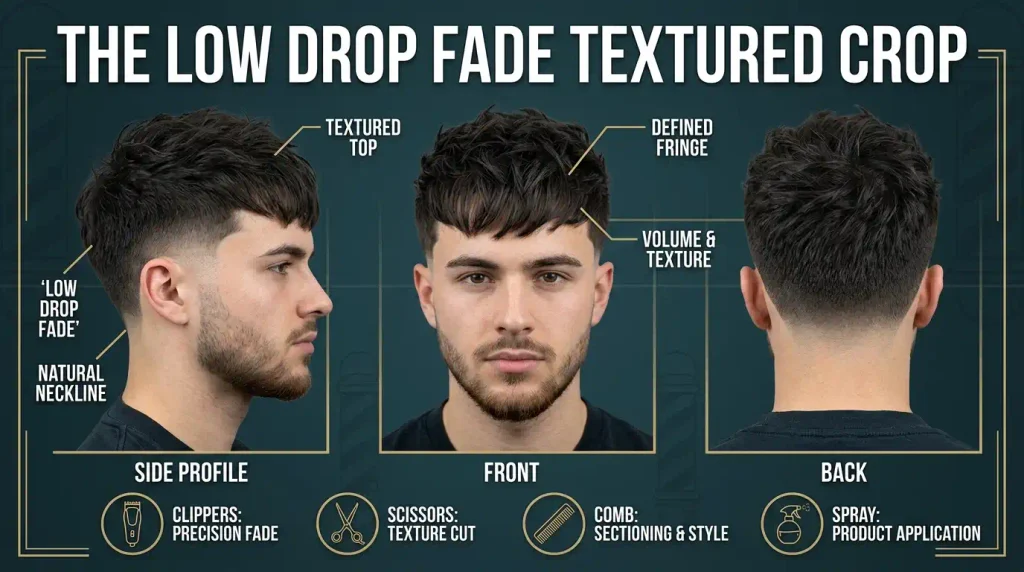
4. Low Drop Fade Textured Crop
Forward-swept, piecey fringe layers sit over a low fade line that curves gracefully behind the ear. The barber uses point-cutting shears on top and a #0.5 guard along the lower nape. Heart and oblong face shapes benefit from reduced forehead height. Work a small dusting of texturizing powder into dry roots for flexible hold.
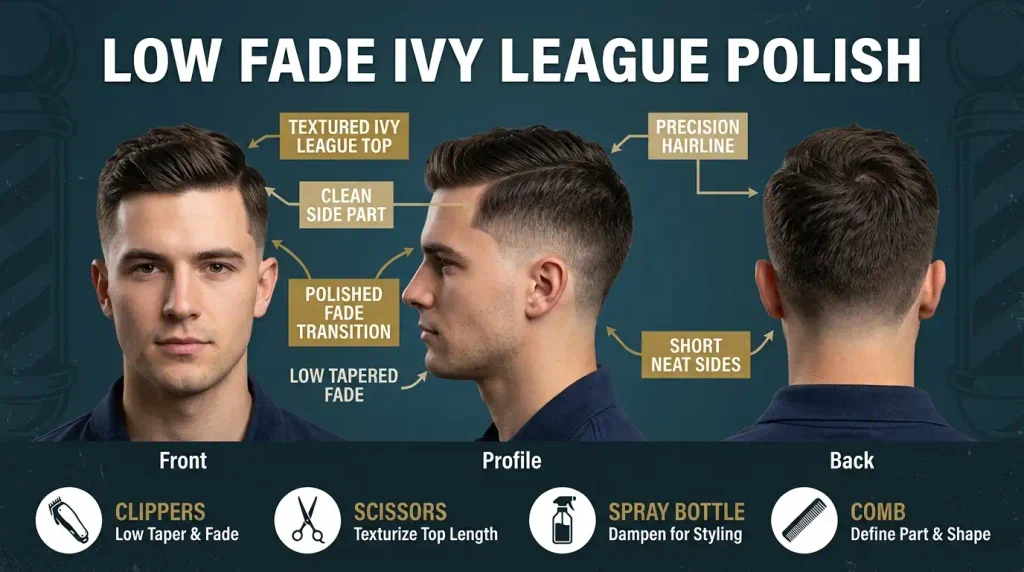
5. Low Fade Ivy League Polish
Slightly longer front fringe hair sweeps neatly to the side, blending into a subtle taper along the ears. Running a #2 guard along the lower sides retains maximum side thickness while cleaning up boundary lines. Perfect for active professionals wanting minimal morning effort. Style quickly by smoothing lightweight grooming cream through towel-dried strands.
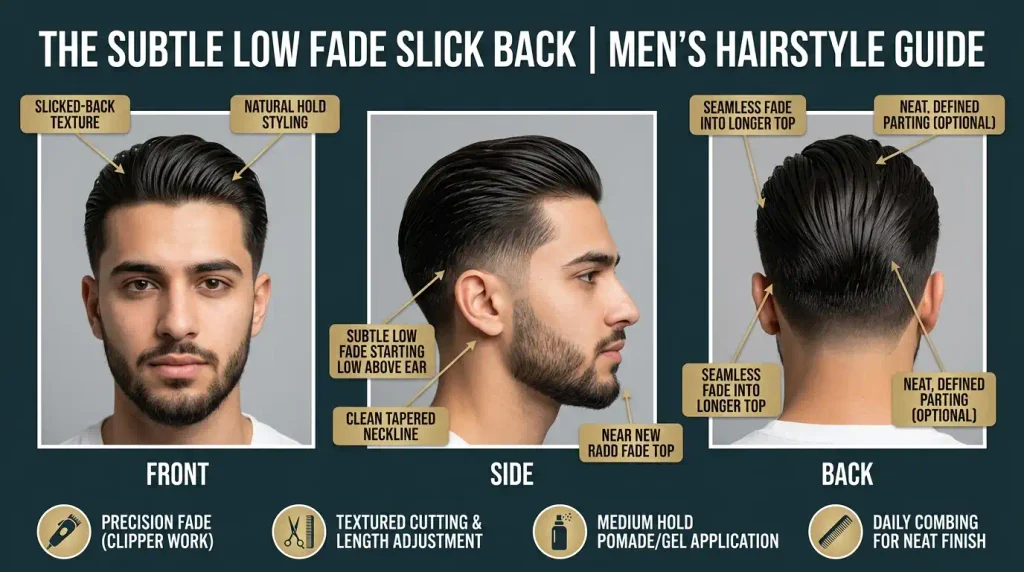
6. Subtle Low Fade Slick Back
Tapered edges around the lower ears ground a medium-length top swept directly toward the crown. The barber sets a #1 guard baseline, blending gently into upper shears to eliminate harsh contrast lines. Fits square jawlines looking for a streamlined lateral profile. Distribute firm-hold paste evenly from front hairline to crown.
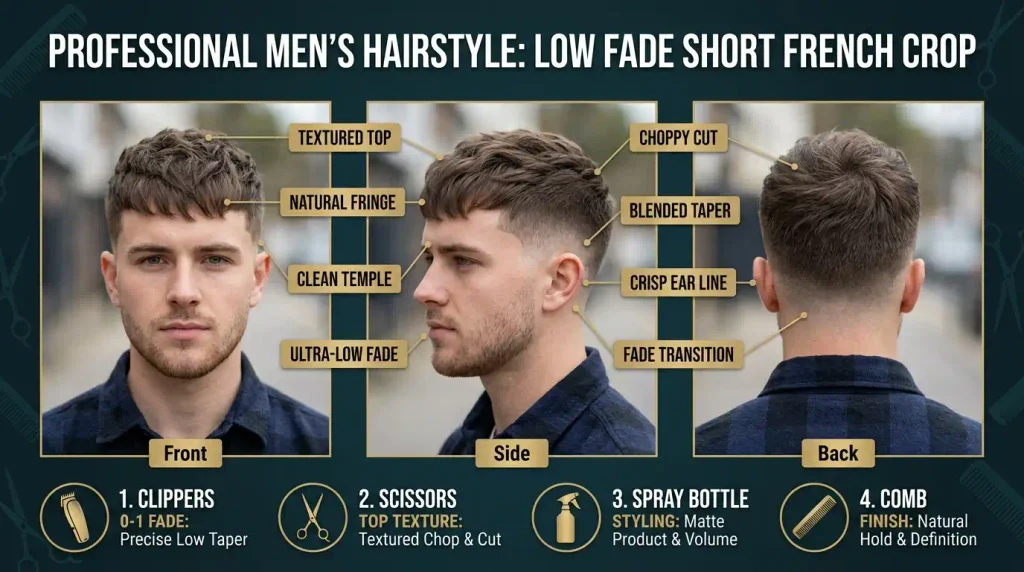
7. Low Fade Short French Crop
Blunt horizontal fringe lines across the upper forehead sit atop a soft low shadow blend. Clipping the perimeter with a #1.5 guard gives a clean outline while protecting natural density around the temples. Ideal for men with thinning temporal corners. Tousle slightly using a low-shine matte clay for an organic feel.
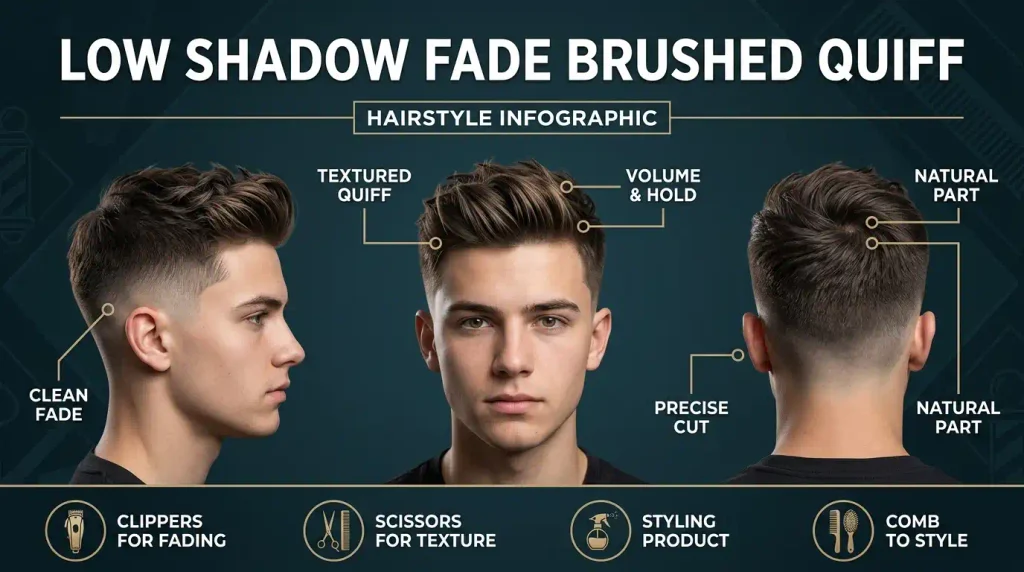
8. Low Shadow Fade Brushed Quiff
Vertical volume at the front hairline slopes back toward a shorter crown, framed by subtle sideburn tapering. Utilizing a #1 guard around the ear canal keeps the perimeter tight while maintaining upper-side volume. Round and oval faces achieve pleasant vertical balance. Blow-dry roots upward using a vent brush before applying styling wax.
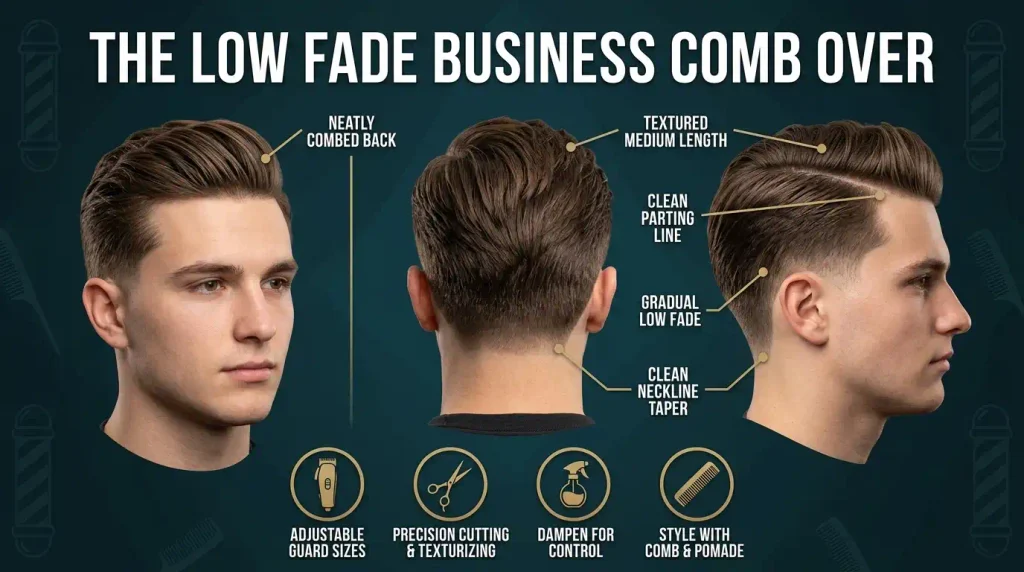
9. Low Fade Business Comb Over
A subtle side sweep passes over a conservative low taper that stays close to the natural hairline. The barber maintains length above the ears using a #2 guard, tapering only the bottom half-inch. Recommended for formal corporate environments requiring traditional cuts. Finish with a light application of flexible styling cream.
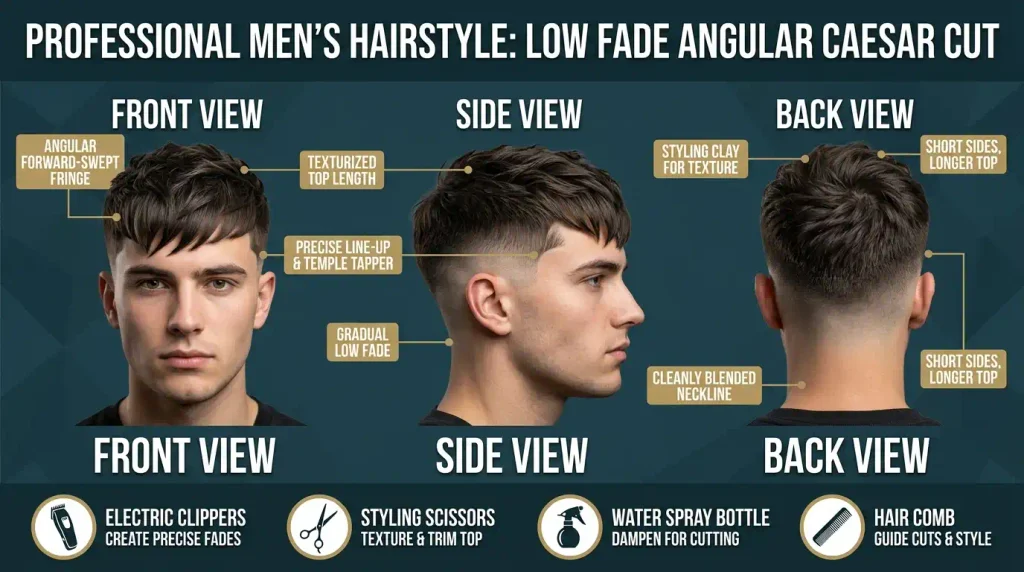
10. Low Fade Angular Caesar Cut
Short, forward-directed micro-fringe layers pair with a precise perimeter blend around the ears. Setting a #0.5 guard at the lower nape creates a crisp boundary without aggressive scalp exposure. Fits men seeking low-maintenance framing for prominent brows. Apply a small drop of styling lotion to set the forward motion.
Category 2: Medium Contrast & Mid Fade Styles
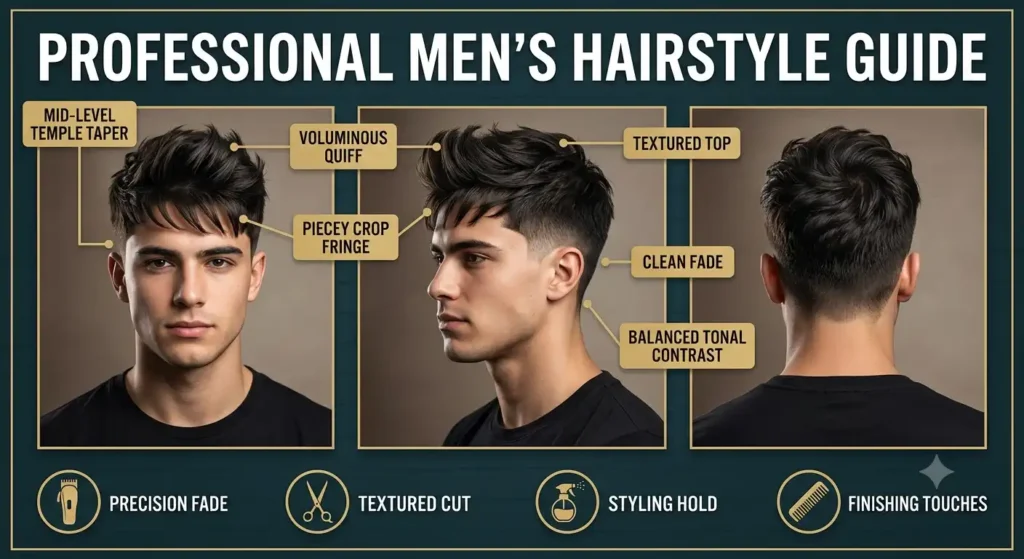
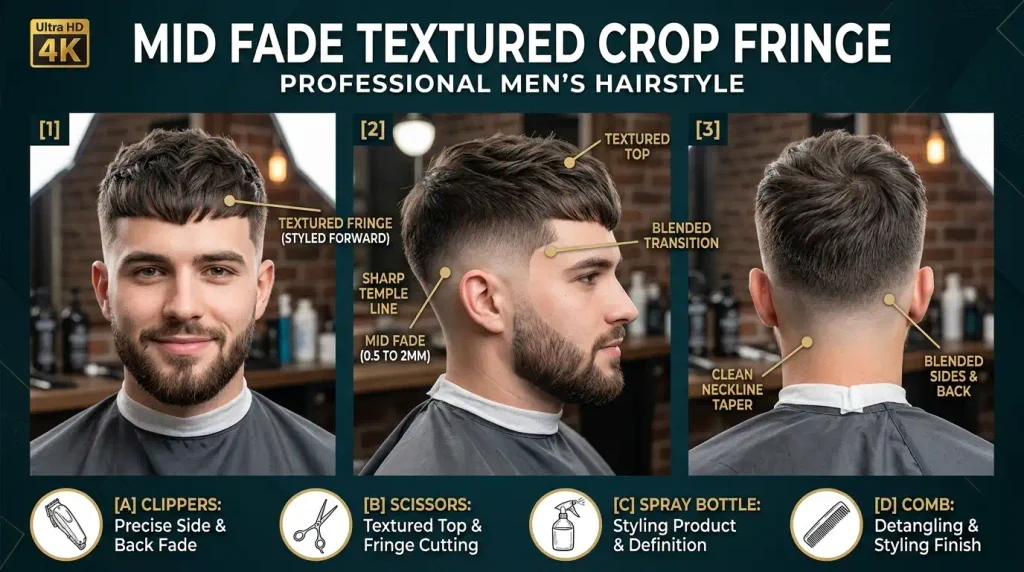
11. Mid Fade Textured Crop Fringe
Tousled crown layers flow forward into choppy bangs, supported by a taper line starting mid-temple. Fading lower edges down to a #0.5 guard provides noticeable visual contrast without exposing excessive scalp. Round and oval face shapes gain structured definition. Work matte clay through dry hair to accentuate piecey separation.
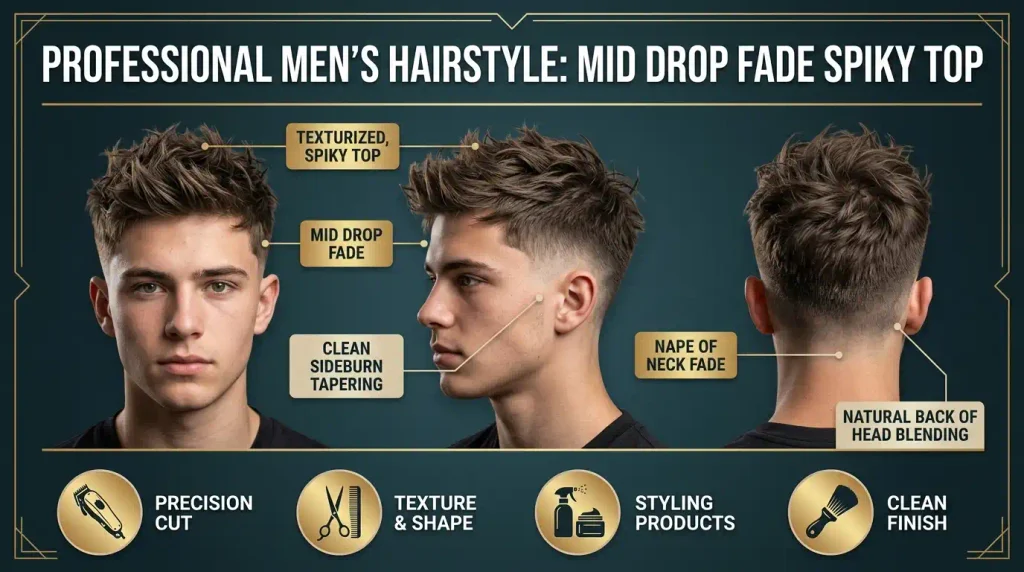
12. Mid Drop Fade Spiky Top
Upward-directed top spikes contrast with a fade line that arches down along the occipital bone. The barber uses a #1 guard baseline at the ears, blending smoothly into longer crown shears. Excellent for oval and heart face shapes wanting dynamic height. Sculpt top strands using a firm-hold fiber paste applied with fingertips.
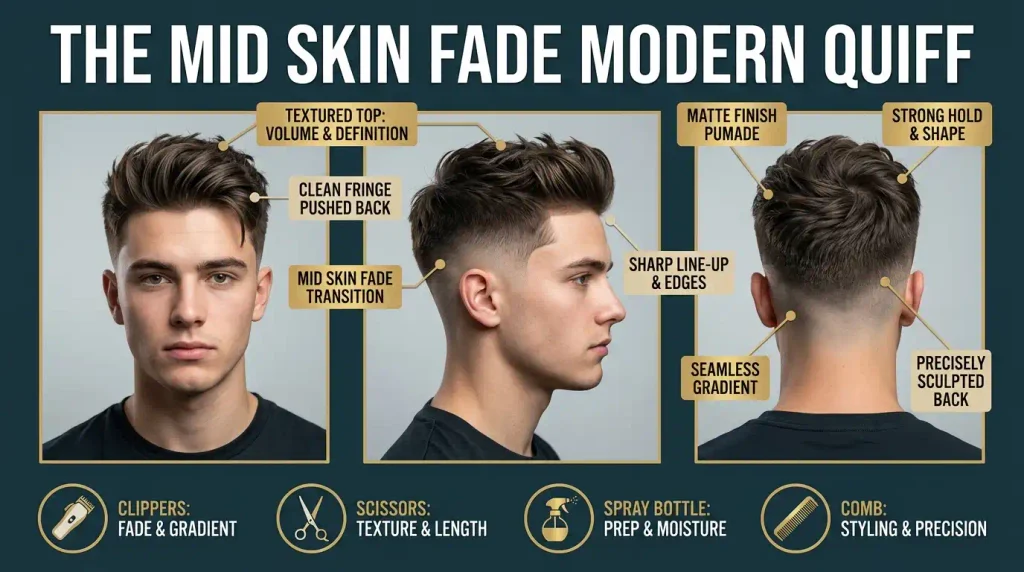
13. Mid Skin Fade Modern Quiff
High front volume arches gracefully backward over a clean mid-level skin blend. Clipping lower sideburns down to a #0 bare-skin level isolates top texture for strong visual pop. Recommended for thick hair needing lateral bulk reduction. Lock in height by blow-drying with a round brush and applying high-hold pomade.
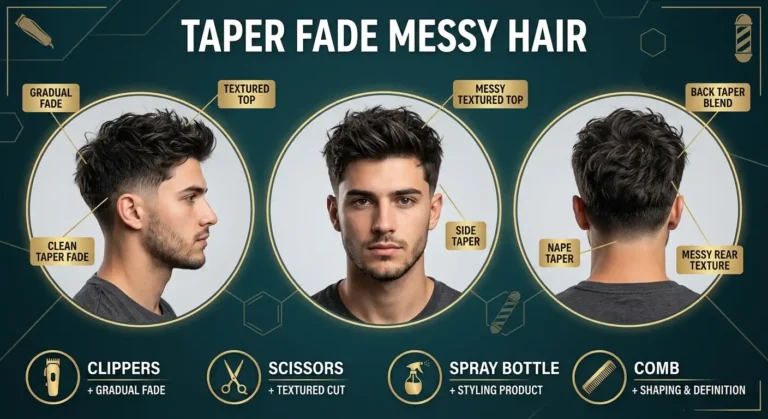
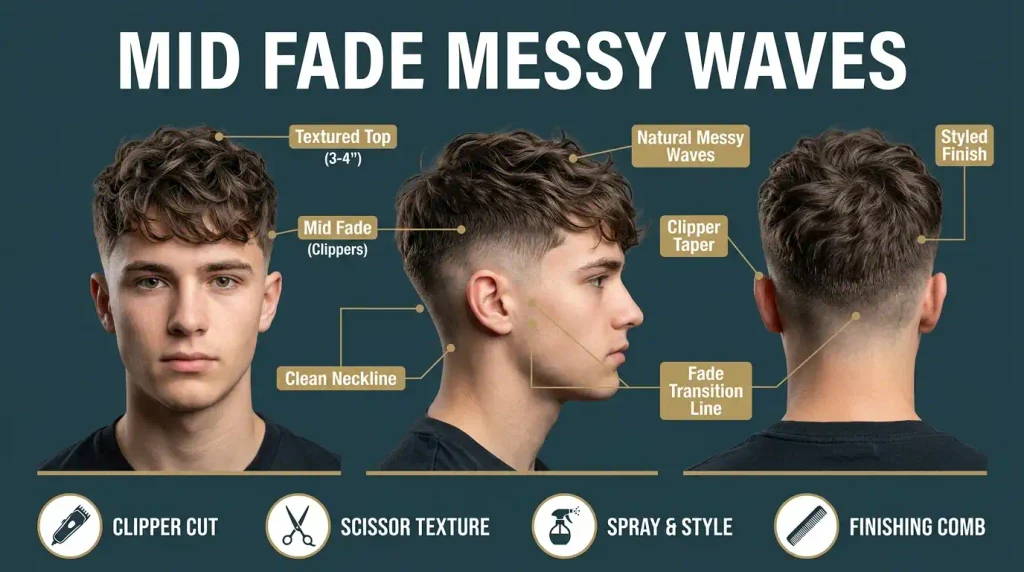
14. Mid Fade Messy Waves
Loose, natural top waves drop into a balanced side taper positioned midway between temple and ear. Blending with a #1.5 guard preserves wave weight while removing messy lower fuzz. Fits wavy Type 2 hair perfectly. Scrunch a small amount of sea salt spray into damp strands and let air-dry naturally.
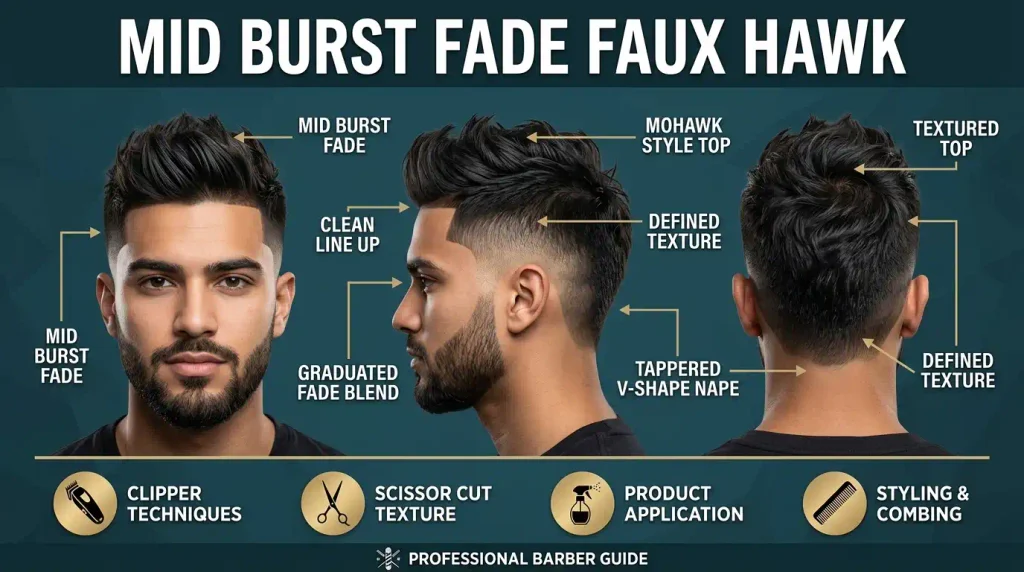
15. Mid Burst Fade Faux Hawk
Top hair gathers along the central crest, flanked by circular burst tapers fading around both ears. The barber uses a #0 guard around the ear arch, curving upward into #2 side layers. Works exceptionally well for round face shapes seeking angular structure. Mold the center ridge using high-tack styling wax.
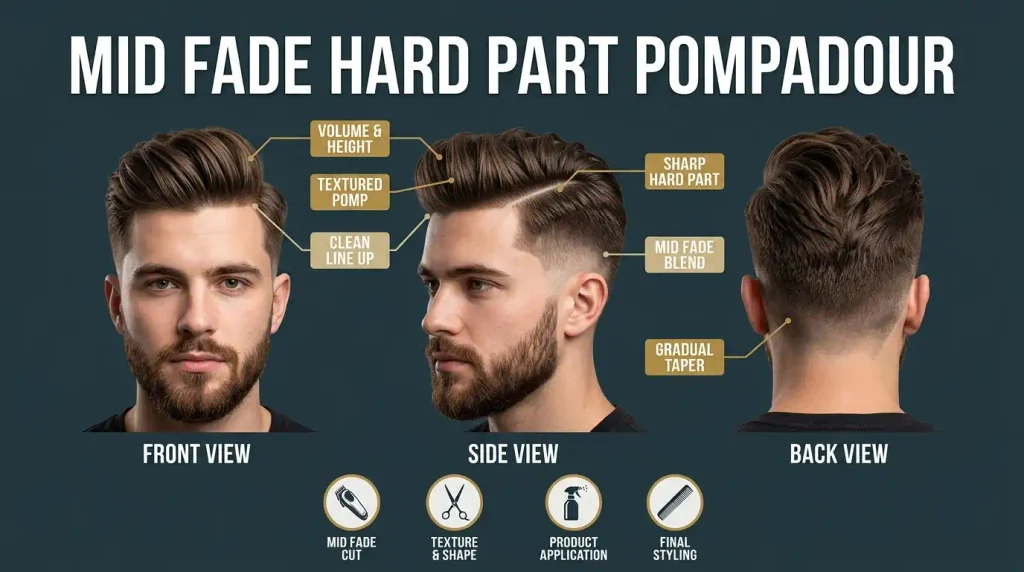
16. Mid Fade Hard Part Pompadour
A crisp razor line separates a voluminous pompadour from mid-temple side blending. Setting a #0.5 guard baseline gives clean contrast against the structured side part. Ideal for formal events requiring distinct styling lines. Comb through wet hair with firm-hold sheen pomade to establish sharp direction.
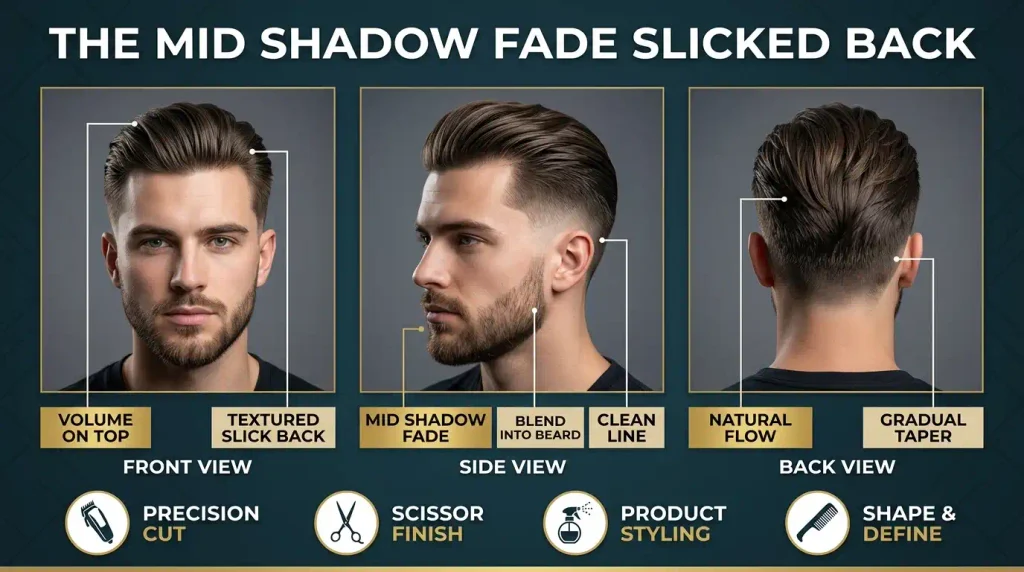
17. Mid Shadow Fade Slicked Back
Medium-length top layers are combed straight back over a mid-level shadow transition. Utilizing a #1 guard baseline keeps sides dark enough to avoid bare scalp look while maintaining clean borders. Fits rectangular face shapes wanting sleek symmetry. Distribute medium-shine pomade from roots to ends with a comb.
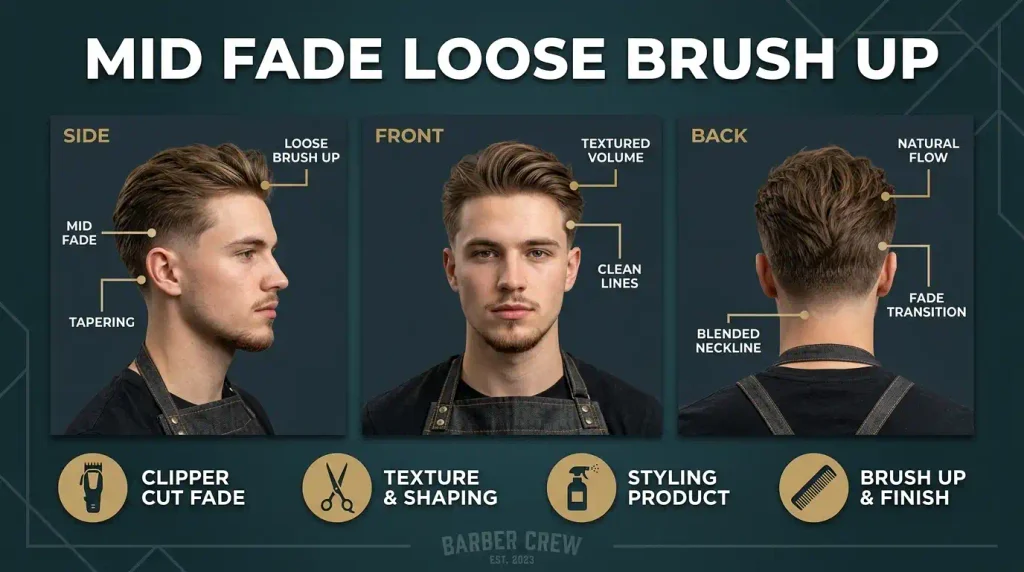
18. Mid Fade Loose Brush Up
Airy, finger-combed top volume sweeps upward over a subtle mid-level side taper. The barber uses point-cutting on top and a #1.5 guard along the mid-sides for soft, natural motion. Recommended for fine hair needing structural lift. Spray roots with texturizing sea salt mist before drying.
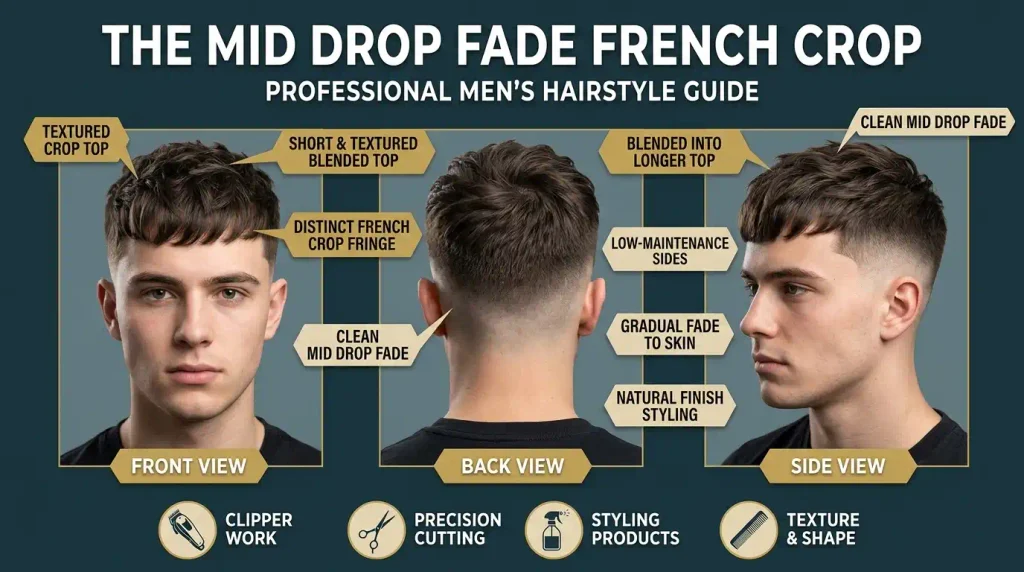
19. Mid Drop Fade French Crop
Horizontal front bangs combine with a curved drop fade that swoops low around the back nape. Clipping lower boundaries with a #0.5 guard sharpens the transition against dense top layers. Heart face shapes achieve balanced proportions with this cut. Set position using a small dab of lightweight matte paste.
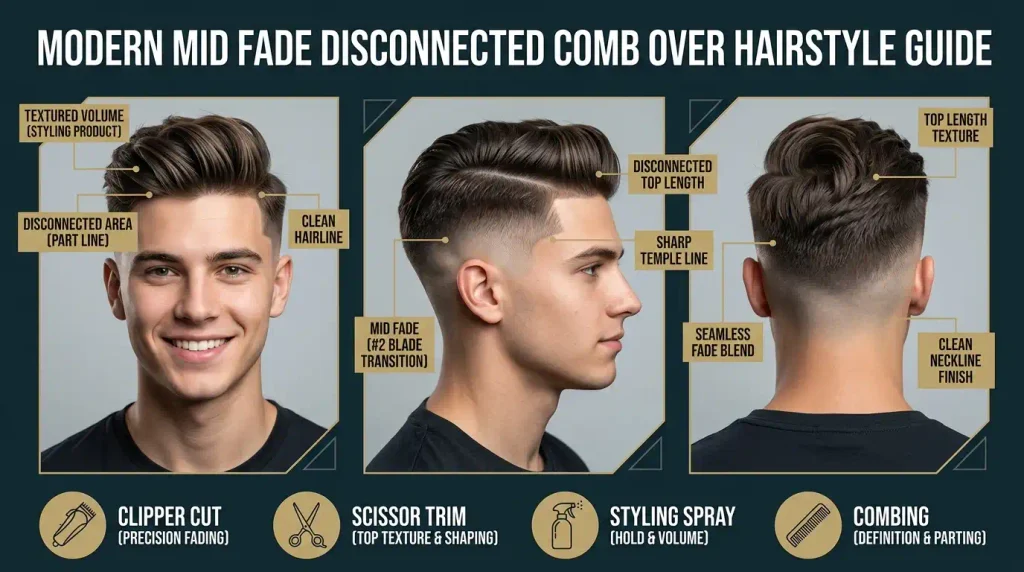
20. Mid Fade Disconnected Comb Over
Long top hair drapes to the side over a mid-level fade without a continuous shear blend. Setting a #1 guard baseline isolates top length, creating a clear contrast boundary. Fits thick straight hair types seeking sharp styling separation. Secure top direction with medium-hold styling gel.
Category 3: Wavy & Curly Hairstyles for 3a Hair Male
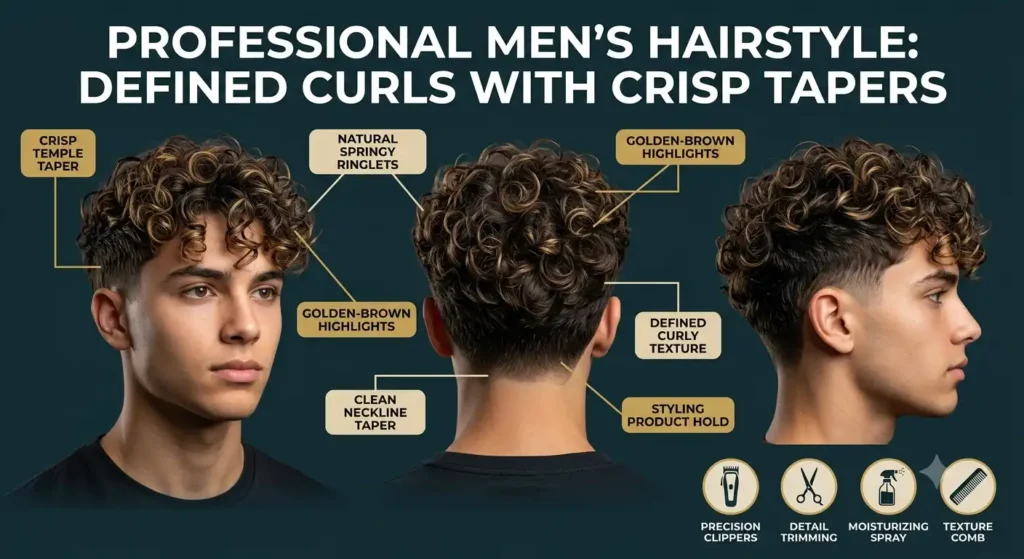
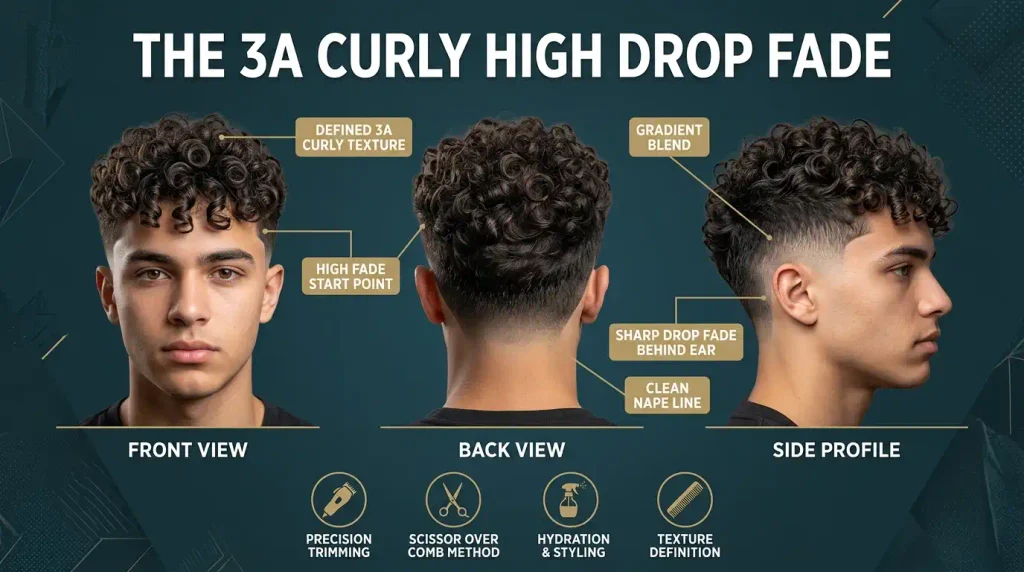
21. 3a Curly High Drop Fade
Springy 3a ringlets tumble over the forehead while the side fade line drops steeply behind the ears. The barber clips the lower perimeter to bare skin with a #0 guard, isolating top curl bounce. Ideal for men seeking dynamic contrast on curly textures. Scrunch curl-defining cream into damp ringlets to eliminate frizz.
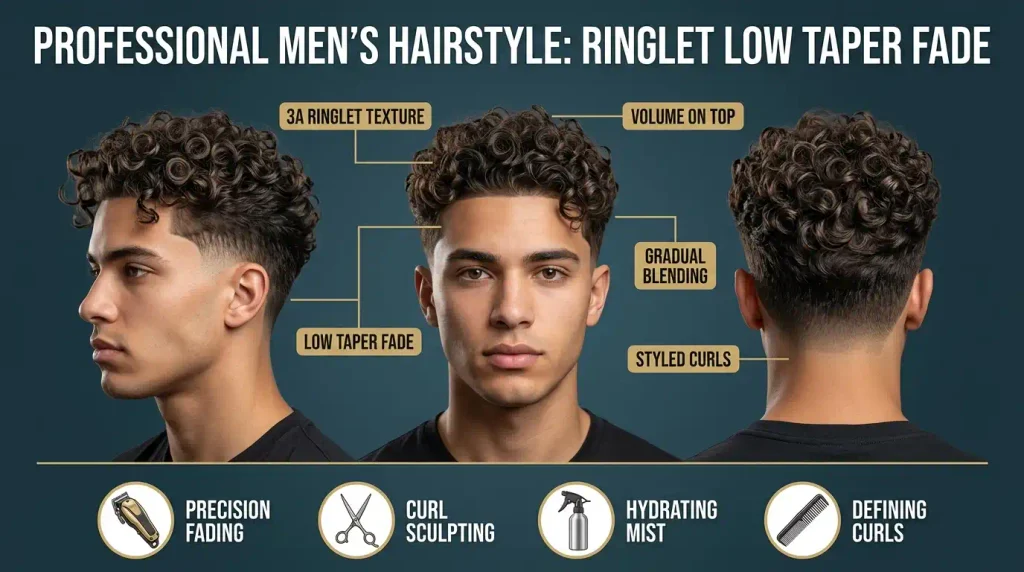
22. 3a Ringlet Low Taper Fade
Defined 3a curls retain full crown volume while sideburns and nape fade softly into the skin. Utilizing a #1 guard baseline keeps upper-side density thick, supporting the natural coil structure above. Fits oval and square face shapes. Hydrate daily with a light leave-in conditioner spray.
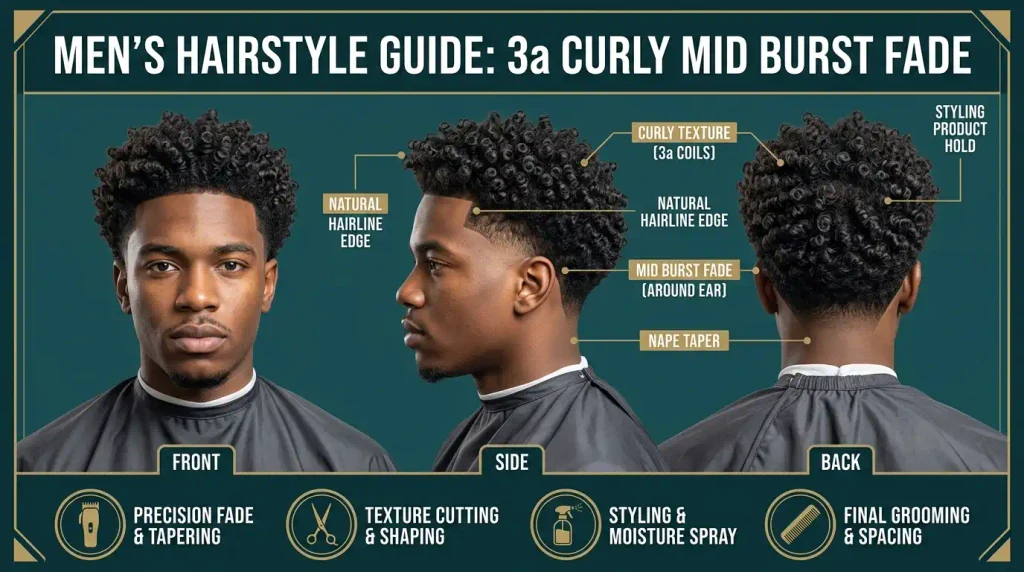
23. 3a Curly Mid Burst Fade
Natural 3a ringlets form a rounded top crown, framed by semi-circular burst tapers around the ears. Fading to a #0.5 guard around the ear canal prevents lateral flare-ups while maintaining top height. Great for round faces needing vertical elongation. Work hydrating curl mousse through wet coils before drying with a diffuser.
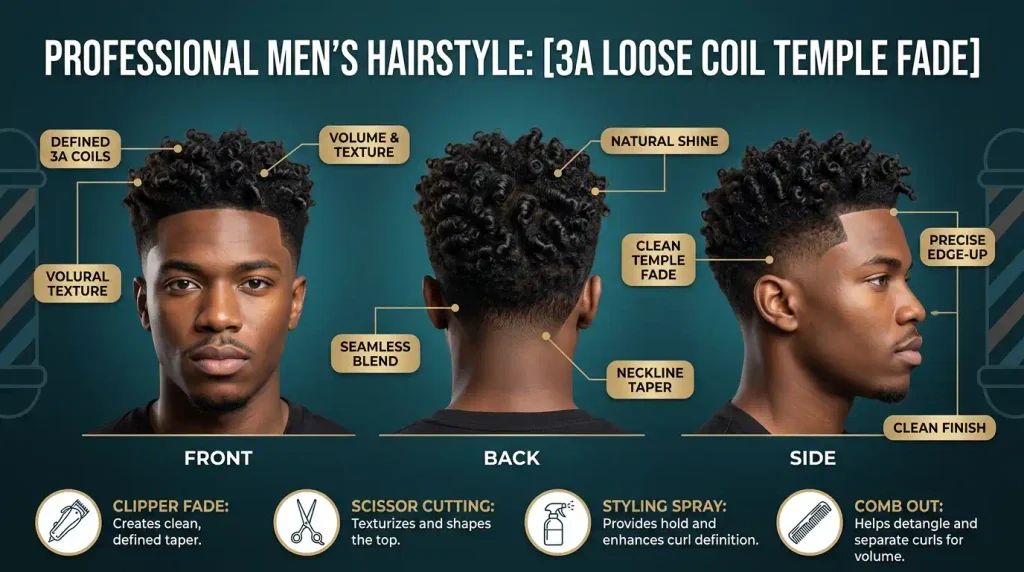
24. 3a Loose Coil Temple Fade
Compact 3a curls sit uniformly across the crown while bare skin tapers clean up only the temples and lower nape. Blending lower points with a #0 guard keeps natural hair outlines sharp without removing top density. Recommended for athletic men with coarse curly textures. Apply natural hair oil twice weekly for shine.
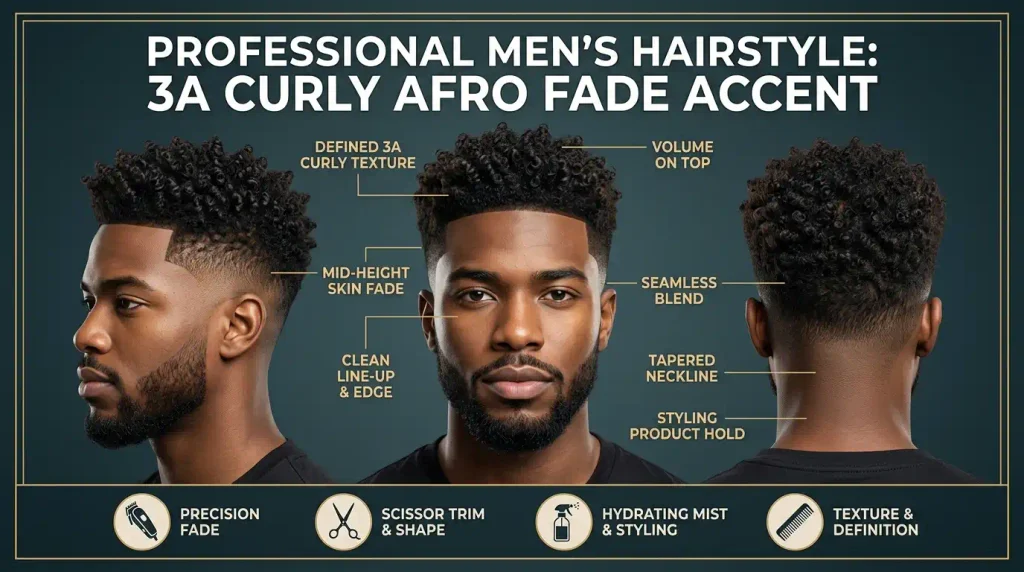
25. 3a Curly Afro Fade Accent
Voluminous 3a curls build architectural height over clean, low-tapered sideburn borders. The barber uses clipper-over-comb techniques along the upper sides to blend ringlets into a #1.5 guard base. Fits long and oval face shapes. Keep curls plump by palm-rolling with curl gel.
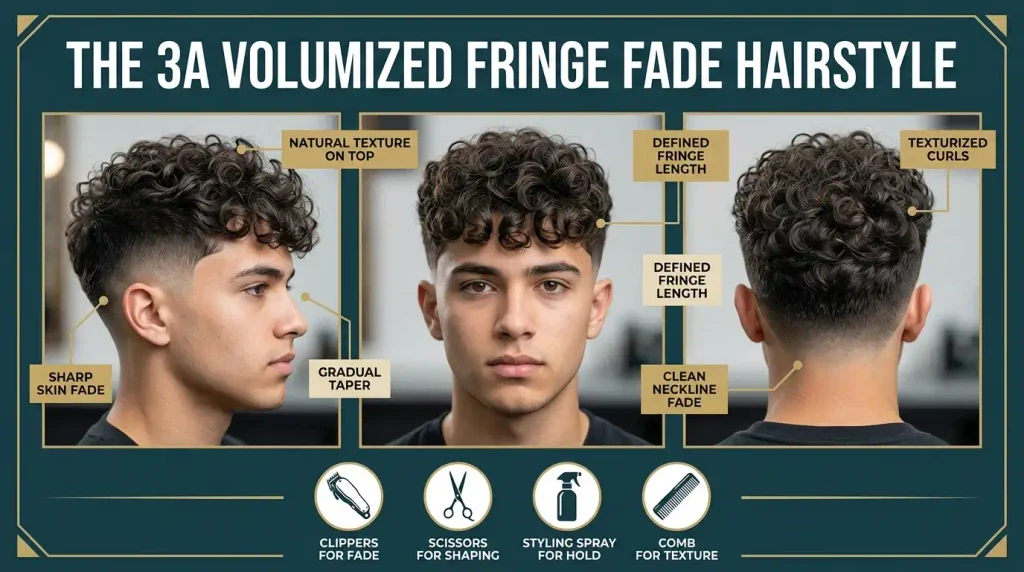
26. 3a Volumized Fringe Fade
Longer 3a ringlets cascade forward over the brow line, underlaid by a crisp mid skin fade. Setting a #0 guard baseline highlights the contrast between curly top layers and clean side skin. Perfect for heart face shapes wanting forehead coverage. Define individual ringlets using light curl paste.
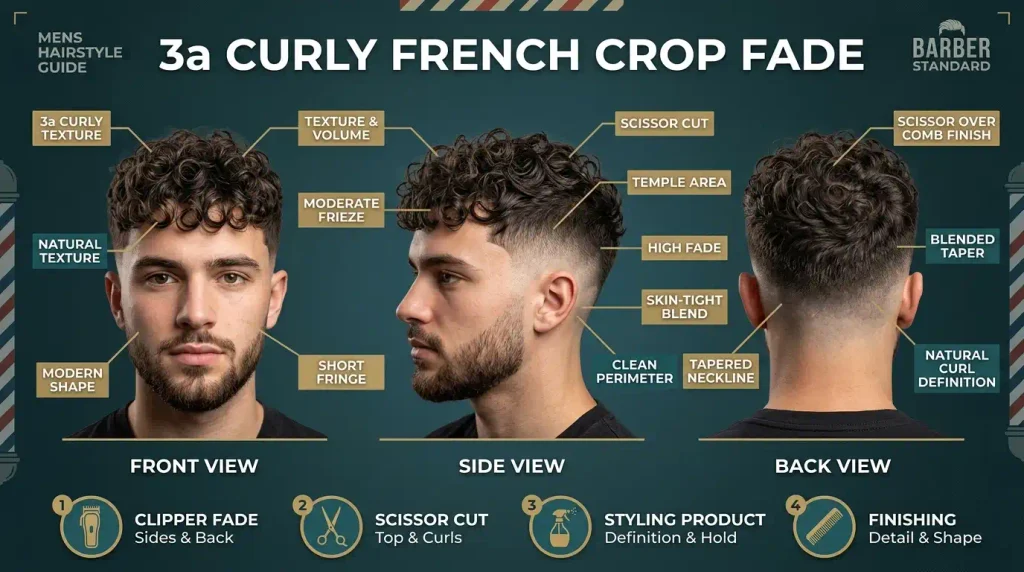
27. 3a Curly French Crop Fade
Short, compact 3a curls form a neat horizontal fringe line over low-tapered sideburns. The barber clips lower edges using a #1 guard to keep the perimeter tidy without disrupting curl clusters. Fits thick, stubborn curl types requiring easy control. Apply a dab of curl butter to damp tips.
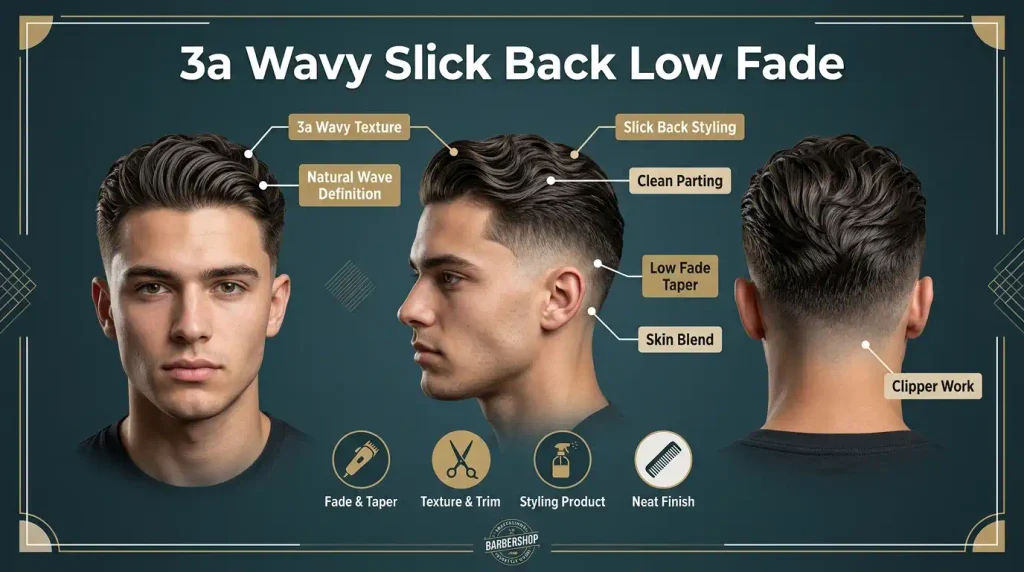
28. 3a Wavy Slick Back Low Fade
Looser 3a waves are combed back over a subtle low taper around the ears. Running a #1.5 guard along lower edges preserves side hair weight for a classic, wave-textured flow. Fits oblong face shapes wanting slick texture without flat sides. Secure with flexible styling cream applied to damp hair.
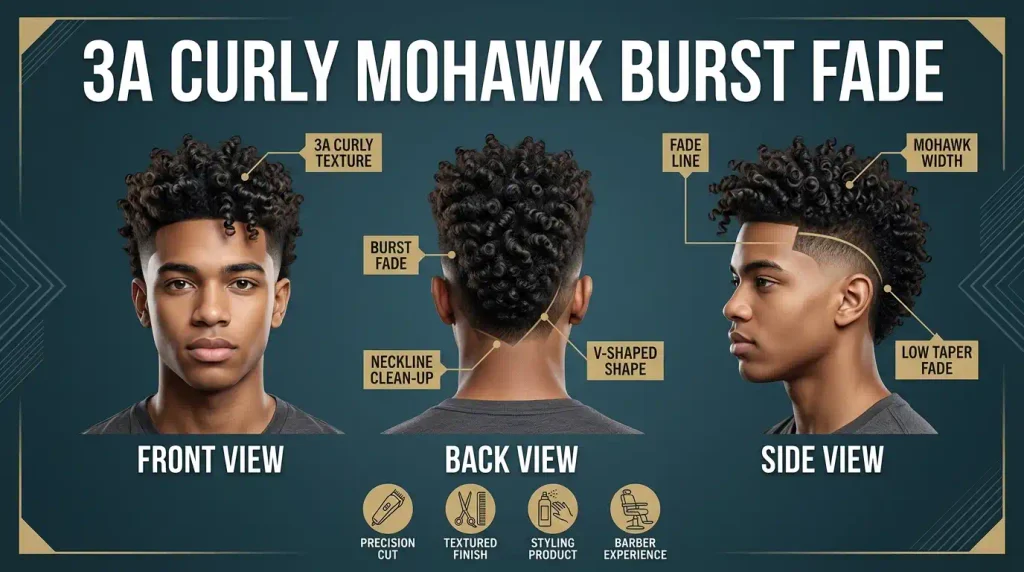
29. 3a Curly Mohawk Burst Fade
A wide strip of 3a ringlets runs from forehead to nape, flanked by clean burst fades on both sides. Clipping side curves down to a #0 guard isolates central curl density for a bold visual statement. Excellent for oval and diamond face shapes. Scrunch styling gel into wet ringlets for high hold.
30. 3a Curly Sponge Twist Drop Fade
Twisted 3a curl clusters form a structured silhouette over a smoothly curved drop fade. Setting a #0.5 guard at the nape baseline creates clean lines around the neck and ears. Ideal for low-maintenance coily hair care. Hydrate daily with lightweight sheen spray.
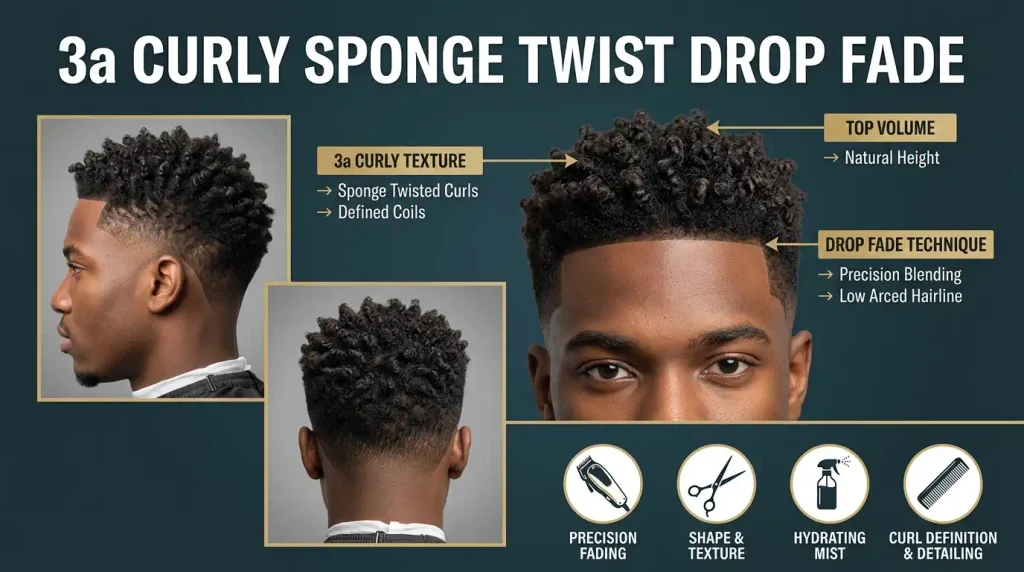
Category 4: High Contrast, Skin & Edgy Modern Fades
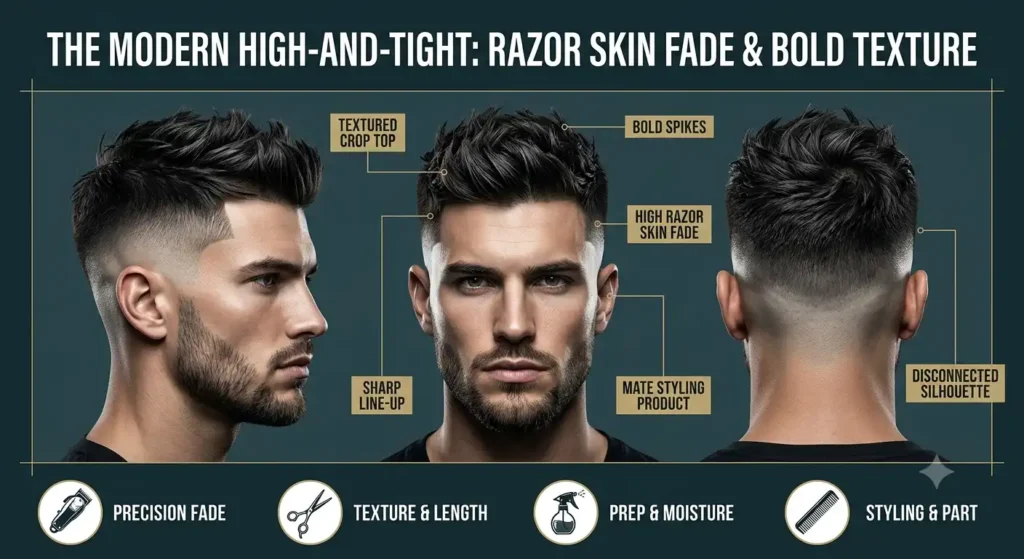
31. High Skin Fade Buzz Cut
A short #2 guard top length contrasts sharply against sides shaved down to bare skin high near the crown. Fading with a #0 guard baseline creates an ultra-clean, low-maintenance aesthetic. Ideal for square and oval faces wanting zero daily styling effort. Keep scalp hydrated using daily moisturizing lotion.
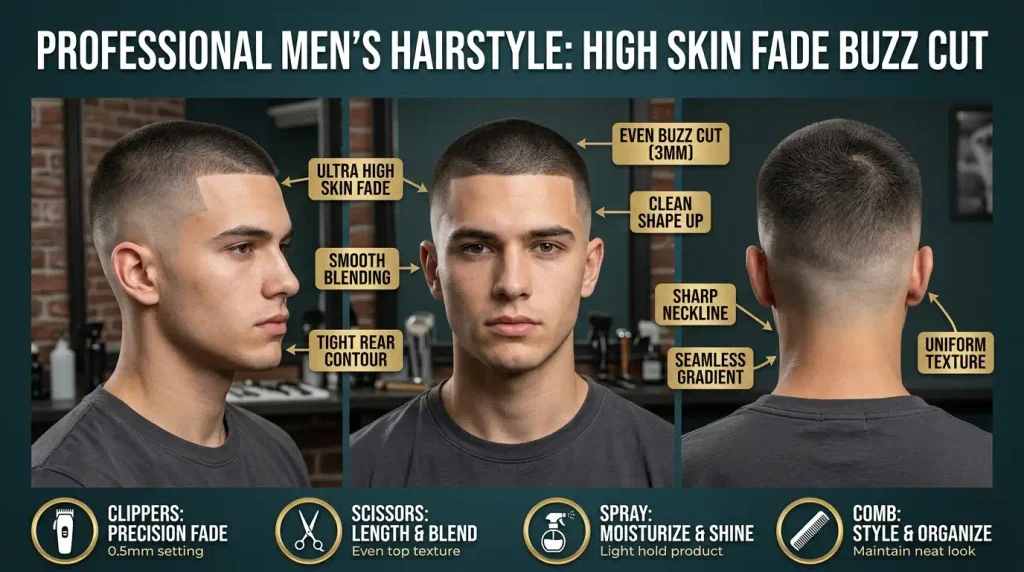
32. High Bald Fade High & Tight
A narrow strip of short top hair sits atop high skin-faded sides that reach near the parietal ridge. The barber shaves lower boundaries down to bare scalp with a straight razor. Excellent for military-style precision and hot summer months. Requires bi-weekly barber visits to maintain sharp contrast.
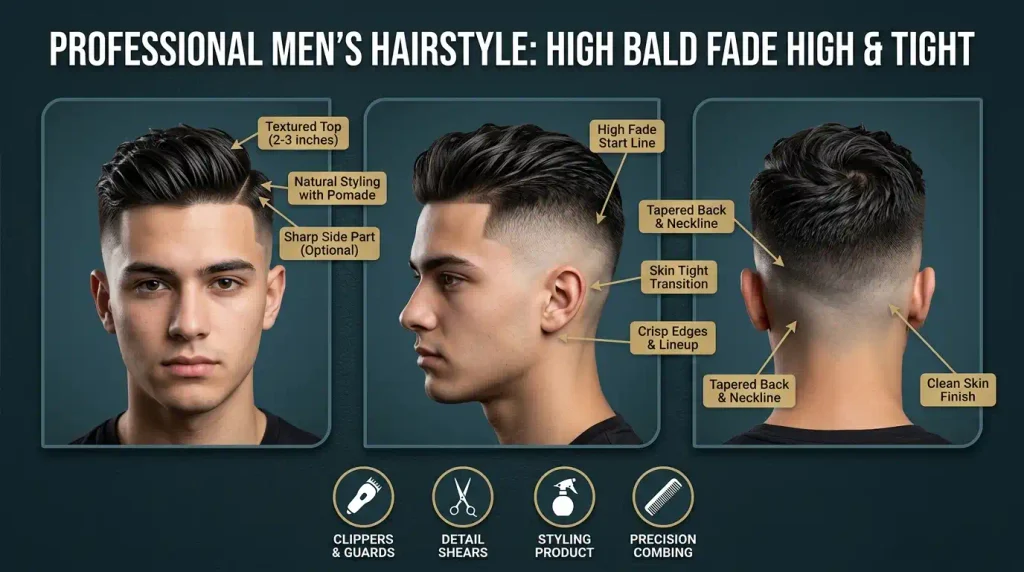
33. High Drop Fade Textured Spikes
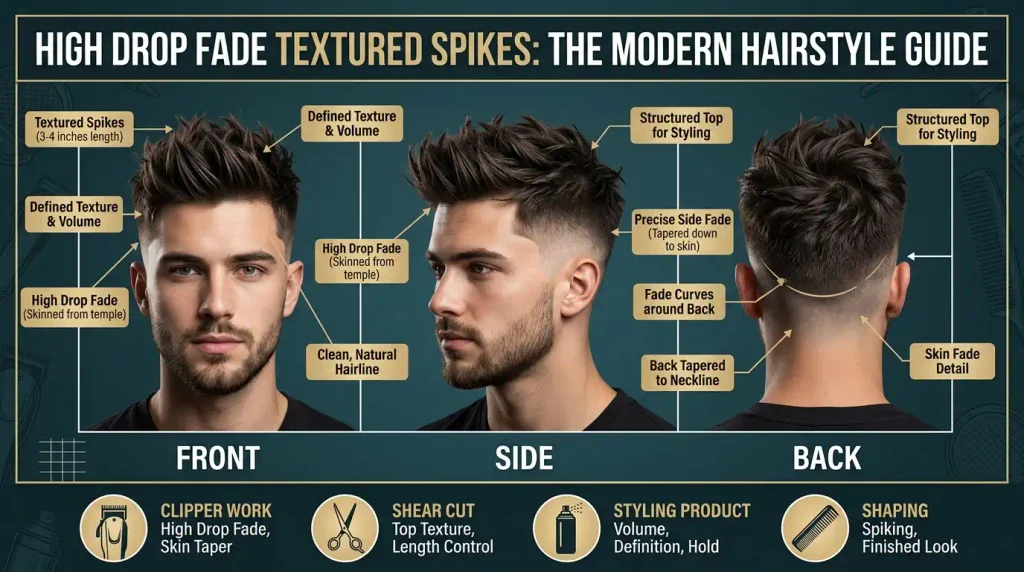
Piecey top spikes point upward as the high fade line curves dramatically down toward the rear neck. Utilizing a #0.5 guard baseline keeps the perimeter skin-tight while preserving rear volume. Round face shapes gain flattering vertical length. Work firm matte wax through dry ends to sculpt spikes.
34. High Skin Fade Modern Pompadour
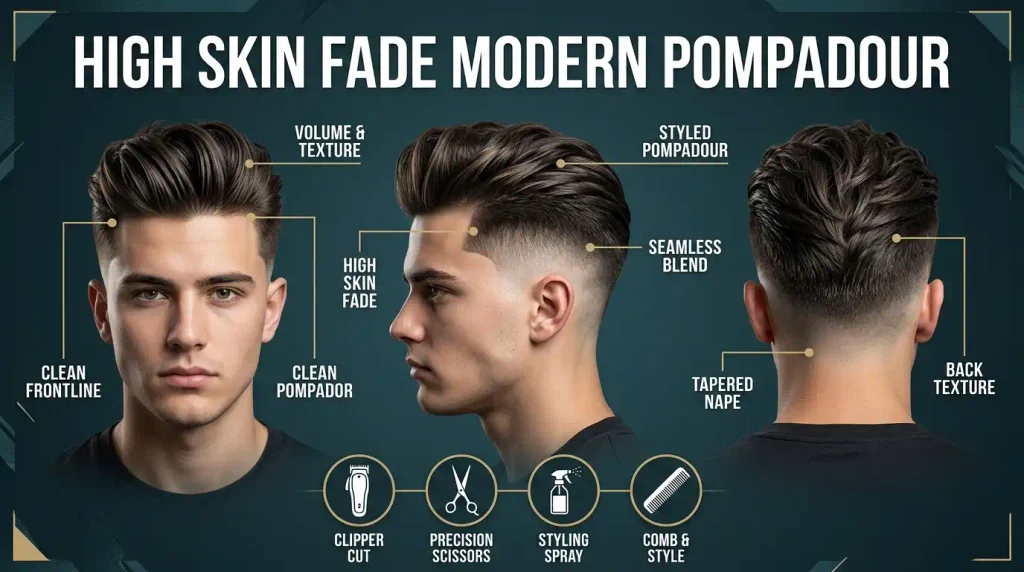
Full top volume rolls back over sides faded to bare skin up to the upper temple line. Clipping lower sides down to a #0 level concentrates visual focus entirely on top hair height. Recommended for square jawlines wanting bold presence. Blow-dry upward and set with strong-hold pomade.
35. High Temple Fade Slicked Quiff
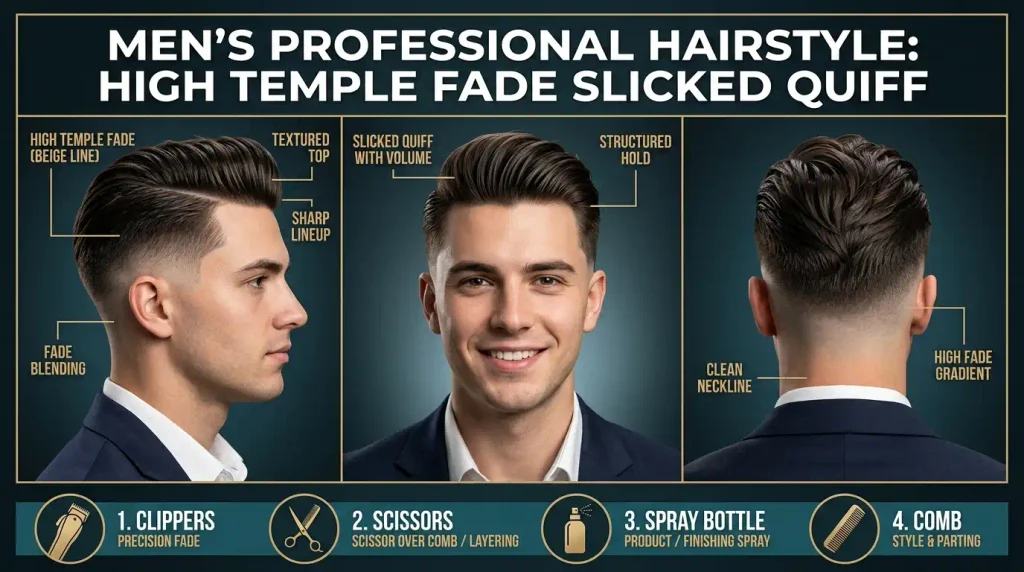
Front hair sweeps upward and back while sides fade rapidly into skin near the upper temples. Setting a #0 guard baseline creates high visual impact across the lateral profile. Fits oval and diamond face shapes. Lock in shape using high-shine styling paste applied to towel-dried hair.
36. High Skin Fade Angular Fringe
Choppy top layers angle diagonally across the forehead, underlaid by high skin-faded sides. The barber uses point-cutting on top and a #0 guard on sides to create raw texture contrast. Fits heart face shapes needing brow definition. Apply texturizing dust at roots for lasting separation.
37. Razor Line-Up High Skin Fade
Sharp geometric edge-ups frame short top layers over sides faded seamlessly into bare skin. The barber uses a straight razor along front corners and a #0 guard across the sides. Perfect for crisp, structured grooming preferences. Touch up line-up edges every 10–14 days.
38. High Fade Mohawk Ridge
A central ridge of hair runs down the crown over sides faded down to skin high up the head. Setting a #0 guard baseline creates distinct lateral separation for an edgy silhouette. Fits round face shapes seeking linear definition. Sculpt the center seam with strong-hold hair gel.
39. High Drop Fade Wave Cut
Deep 360 waves on top transition into a high drop fade that curves cleanly around the head. The barber clips the lower perimeter with a #0.5 guard to keep wave lines prominent on top. Great for coarse hair textures. Maintain wave clarity with a durag and daily brushing.
40. High Skin Fade Disconnected Top
Long top hair hangs loosely over sides shaved down to bare skin high on the head. Using a #0 guard baseline eliminates side density, maximizing top contrast. Fits bold fashion-forward personal styles. Style top hair using lightweight molding paste for natural drape.
Category 5: Specialized Drop, Burst & Beard-Integrated Fades
41. Beard-Integrated Low Shadow Fade
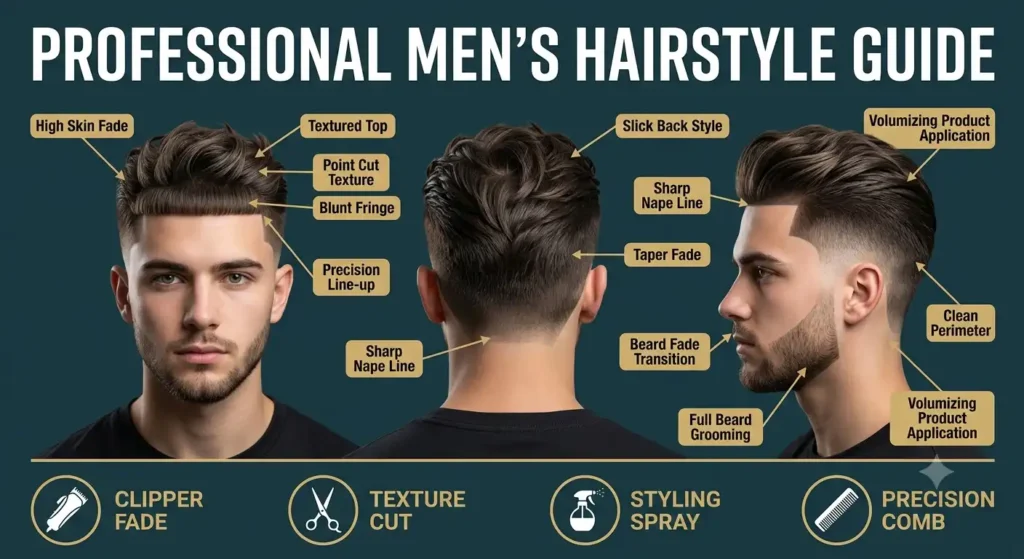
Low sideburn tapers drop down to bare skin before reverse-fading smoothly into full facial hair. The barber uses a #1 guard at mid-sideburn to construct a seamless bridge between hair and beard. Fits bearded men seeking polished facial symmetry. Keep beard edges sharp with daily oil and comb touch-ups.
42. Temple Burst Fade Micro-Coils
Compact micro-coils cover the crown while rounded burst tapers fade to skin around both ears. Fading with a #0 guard baseline prevents side puffiness while maintaining top coil height. Ideal for Type 4 natural hair textures. Apply leave-in curl cream to keep coils soft.
43. Curved Drop Fade Textured Top
Top layers sweep forward while the fade line swoops low around the back of the neck. Setting a #0.5 guard baseline creates an elegant, organic contour following the natural skull shape. Suits oblong and oval face shapes. Style top strands using lightweight texturizing clay.
44. V-Neckline Low Drop Fade
Rear hair tapers down into a sharp V-shaped point along the spine, flanked by clean drop-faded sides. The barber uses a #0 guard on side perimeter boundaries while preserving central length at the nape base. Great for accentuating athletic necklines. Requires bi-weekly perimeter touch-ups.
45. Hard Part Drop Fade Brush Up
A shaved part line guides upward-brushed top volume, framed by a curved drop fade behind ears. Utilizing a #1 guard baseline ensures clean visual separation between top hair and fade gradient. Fits square face shapes wanting crisp lines. Set shape with a blow-dryer and matte paste.
46. Beard-Blended Mid Skin Fade
Mid-temple side fades drop down to skin before blending back up into a sculpted beard line. Setting a #0 guard baseline at the cheekbone intersection unifies head and facial grooming. Excellent for round faces wanting slimmer cheeks. Trim beard hair weekly to match fade density.
47. Etched Line Burst Fade
A razor-carved accent line slices horizontally across a circular burst fade behind the ear. The barber tapers lower edges with a #0.5 guard around the custom geometric accent. Fits youthful, creative styling preferences. Keep top hair styled forward using root texturizing dust.
48. Disconnected Drop Fade Crop
Textured crop bangs overhang a curved drop fade without a continuous shear transition. Using a #1 guard baseline along lower sides maintains clean edges while emphasizing top overhang. Fits thick straight hair types. Work matte clay through top layers for piecey separation.
49. Square Nape Low Shadow Fade
A clean, squared-off lower nape line grounds a soft shadow taper along the lower ears. The barber clips lower boundaries with a #1.5 guard to retain dark hair weight around the neck base. Recommended for men with long necks seeking visual width. Finish with flexible styling lotion.
50. Full Beard Burst Fade Pompadour
A high-volume pompadour pairs with circular burst tapers that blend seamlessly into a full, long beard. Setting a #0 guard baseline creates focal contrast around ears while keeping beard density intact. Suits square jawlines wanting strong presence. Apply beard balm and pomade for complete control.
This Style vs. Other Taper/Fade Options Comparison Matrix
| Haircut Feature | Low Fade | Mid Fade | High Skin Fade | Drop Fade | Burst Fade |
|---|---|---|---|---|---|
| Fade Baseline Point | 0.5–1 inch above ear | Mid-temple level | Upper temple / crown | Curves down behind ear | Semicircular around ear |
| Guard Range Used | #1 to #3 Guard | #0.5 to #2 Guard | #0 (Skin) to #1 Guard | #0 to #2 Guard | #0 to #2 Guard |
| Side Scalp Visibility | Minimal (Dark framing) | Moderate (Balanced) | High (Dramatic contrast) | Selective rear exposure | Spot ear exposure |
| Best Face Shapes | Oval, Heart, Rectangular | Round, Oval, Square | Square, Oval, Round | Oblong, Oval, Diamond | Diamond, Round, Oval |
| Barber Visit Frequency | Every 3–4 weeks | Every 2–3 weeks | Every 1–2 weeks | Every 2–3 weeks | Every 2–3 weeks |
| Styling Versatility | High (Business to Casual) | High (Everyday Modern) | High (Edgy & Athletic) | High (Textured & Wavy) | High (Afro, Faux Hawk) |
Why This Style Works & Who It Suits
Modern fade techniques succeed across diverse demographics because they manipulate visual weight. By trimming lower side bulk, clippers create an optical illusion that elongates round face shapes and sharpens soft jawlines.
      [ OVAL HEAD SHAPE ]        [ SQUARE HEAD SHAPE ]       [ ROUND HEAD SHAPE ]
     Balanced Proportions         Strong Jawline Focus        Soften Width Focus
     └─ Compatible with All      └─ Complements Hard Cuts    └─ Needs Top Volume
Hair Texture Compatibility
- Straight Hair (Type 1): Point-cutting top layers creates piecey separation that prevents straight strands from laying flat.
- Wavy Hair (Type 2): Mid and drop fades clean up stubborn side wings while letting natural waves cascade smoothly across the top.
- Curly Hair (3a Hair Male): Tapering sideburns eliminates lateral puffiness, allowing 3a ringlets to spring upward into structured coils.
- Coily Hair (Type 4): Precise line-ups and high skin fades deliver sharp geometric contrast against dense afro tops and micro-twists.
How to Style Modern Fade Cuts
Follow these four steps every morning for consistent hold, shape, and volume:
- Prep & Wash: Wash hair 2–3 times weekly using a sulfate-free shampoo. On towel-dried damp hair, apply a light heat protectant or leave-in conditioner.
- Apply Pre-Styler: Mist 3–4 spritzes of sea salt spray across top strands to build root traction and lightweight volume.
- Blow-Dry for Direction: Use a hairdryer on medium heat. Direct airflow upward for quiffs/pompadours, or forward toward the brow for textured crops.
- Apply Finishing Product: Warm a dime-sized amount of matte clay, pomade, or curl cream between your palms. Work thoroughly from roots to tips, shaping perimeter edges flat against the head.
Step-by-Step Tutorial for Styling Fade Cuts
Achieving salon-quality results at home requires the right tools and systematic application.
[Required Tools & Grooming Checklist]
├── Professional Clipper Set (Guards #0.5 to #4)
├── Japanese Steel Barber Shears (For Point-Cutting)
├── Detail Trimmer & Straight Razor (For Edging)
├── Wild Boar Hair Paddle Brush & Fine-Tooth Comb
├── Sea Salt Spray (Pre-Styling Volume)
└── Matte Bentonite Clay or Hydrating Curl Cream
Daily Styling Steps
- Start with clean, slightly damp hair after towel drying.
- Spray pre-styler evenly from front hairline to crown.
- Blow-dry while brushing strands in your desired flow direction.
- Distribute styling clay or curl cream using open fingers to separate locks.
- Smooth down short sideburn hair flat against your temples for a clean silhouette.
Best Styling Products Chemistry
Selecting products based on chemical formulation ensures lasting hold without greasy residue or flakes:
[Hair Product Chemistry Selection Guide]
│
├── Matte Clay (Bentonite / Kaolin Clay Base)
│   ├── Best For: Straight to Wavy Hair (Types 1–2)
│   └── Result: High Separation, Zero Shine, Absorbs Scalp Oils
│
├── Sea Salt Spray (Saline Solution + Magnesium)
│   ├── Best For: Fine, Flat, or Medium Textures
│   └── Result: Instant Root Lift, Lightweight Texture, Natural Grip
│
└── Hydrating Curl Cream (Shea Butter + Water-Soluble Polymers)
    ├── Best For: 3a Curly Hair Male & Coily Textures
    └── Result: Moisture Lock, Frizz Reduction, Soft Coil Definition
- Matte Clay: Absorbs natural oils while binding hair fibers together for pliable, low-shine hold.
- Sea Salt Spray: Salt crystals expand the hair shaft, adding natural friction and root lift.
- Curl Cream: Fatty acids seal moisture inside curly cuticles, preventing humidity-induced frizz.
Best Hair Types & Face Shapes
Matching your haircut to your facial geometry ensures flattering proportions:
Face Shape Breakdown
- Oval Head Shape Hairstyles Male: Highly versatile; pairs effortlessly with quiffs, crops, side parts, and 3a ringlets.
- Square Face Shape: Complements sharp skin fades, hard parts, and angular crops that highlight strong jawlines.
- Round Face Shape: Benefits from high top volume (such as quiffs or pompadours) paired with tight side fades to slim facial width.
- Heart & Oblong Shapes: Softened best by forward-swept crops and low drop fades that reduce visible forehead height.
Step-by-Step Barbering & Upkeep Maintenance Guide
To keep your fade looking sharp between barbershop visits:
- Schedule Regular Trims: Skin fades require touch-ups every 1–2 weeks; low and mid fades grow out neatly across 3–4 weeks.
- Wash Correctly: Avoid daily harsh shampooing. Use hydrating conditioner on alternate days to preserve scalp moisture.
- Neckline Touch-Ups: Use an electric detail trimmer once a week to remove stray neck hairs below your fade baseline.
- Scalp Care: Apply a lightweight scalp lotion or sun protection oil if your skin fade exposes bare scalp to outdoor sunlight.
Common Mistakes to Avoid
- Cutting the Fade Line Too High: Pushing a low fade above mid-temple strips away essential side volume.
- Ignoring Head Shape Curves: Failing to drop the fade behind the ear can create an unbalanced, boxy rear profile.
- Using Heavy Hair Oils: Applying heavy petroleum products on fine or light hair causes greasy flat strands.
- Brushing Dry 3a Curls: Combing dry curly hair breaks natural ringlet clumps, causing immediate frizz.
Frequently Asked Questions
1. What is the main difference between a low fade and a high fade?
A low fade starts roughly 0.5 to 1 inch above the ear, creating a subtle side blend. A high fade starts near the upper temples or crown, exposing more scalp for high contrast.
2. How often do fade hairstyles for men require maintenance?
Skin fades require barber touch-ups every 1 to 2 weeks to stay sharp. Conservative low shadow fades retain clean framing for 3 to 4 weeks before needing a trim.
3. Which fade option works best for an oval head shape hairstyles male profile?
Men with an oval head shape can wear almost any variation. Style 13 (Mid Skin Fade Modern Quiff) and Style 3 (Low Taper Fade Executive Pompadour) offer exceptionally balanced framing.
4. How should I style 3a hair male textures with a fade?
Apply curl-defining cream or hydrating mousse to damp 3a ringlets, then diffuse or air-dry. Styles like Style 21 (3a Curly High Drop Fade) keep sides clean while letting top coils bounce naturally.
5. Can I get a low fade if I have fine or thinning hair?
Yes. Low shadow fades preserve side density around the upper temples, making fine top hair appear fuller by comparison.
6. Will Style 31 (High Skin Fade Buzz Cut) suit a round face shape?
A high skin fade can suit a round face if slight length is kept on top, but adding vertical height (like Style 12 or 15) is even more flattering for slimming cheeks.
7. What is the difference between a taper and a fade?
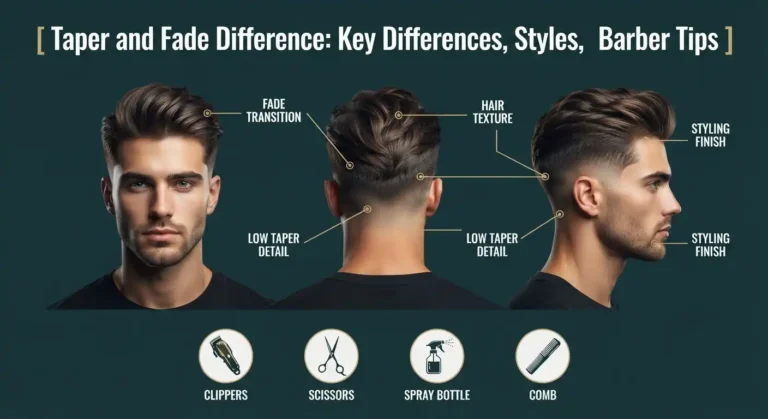
A taper gradually shortens hair along the sideburns and nape while leaving length around the ears. A fade shortens hair uniformly around the entire head perimeter, often down to bare skin.
8. How do I stop my scalp from getting irritated after a skin fade?
Apply an alcohol-free, soothing aftershave balm or tea tree oil serum immediately after your haircut to calm bare scalp skin.
Conclusion
Whether you prefer a subtle low taper for professional settings, a dramatic high skin fade, or bouncy 3a curly ringlets, modern fade cuts offer unmatched versatility. Select your favorite style from this guide, save the consultation script, and discuss the exact guard settings with your barber during your next appointment.
Related Reading: low taper fade blonde hair
Name: Ryan Cole
Role: Lead Grooming Editor, TaperHaircutGuide.com
Bio angle: Men’s grooming/style content researcher — 4+ years covering barbering trends, hairstyling terminology, and men’s style content for US audience. Cross-checks every guide with practicing barbers before publishing.