Perm With Low Taper: 36 Modern Styles for Waves, Curls & Clean Sides

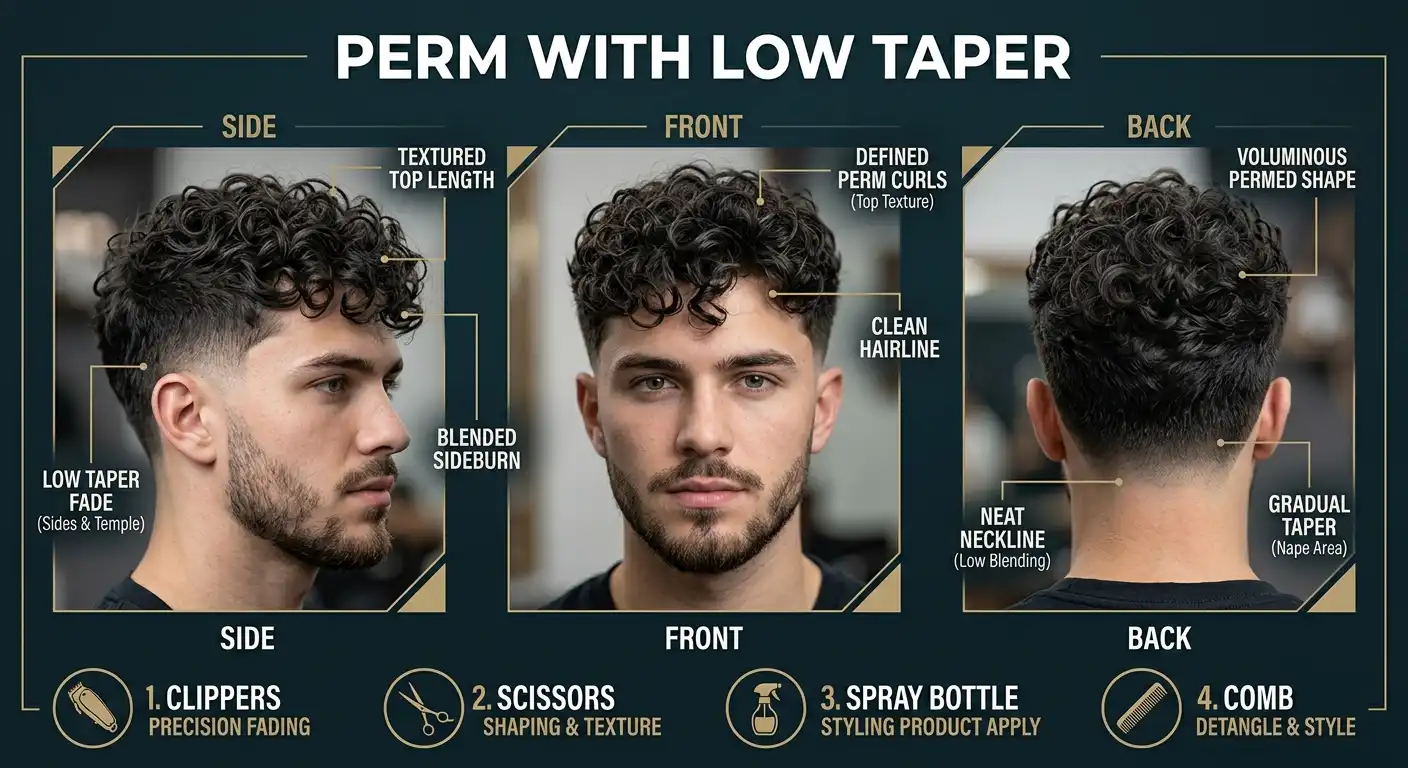
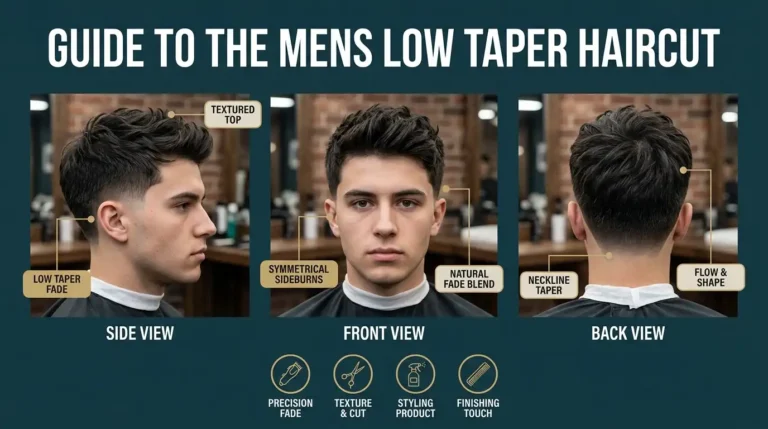
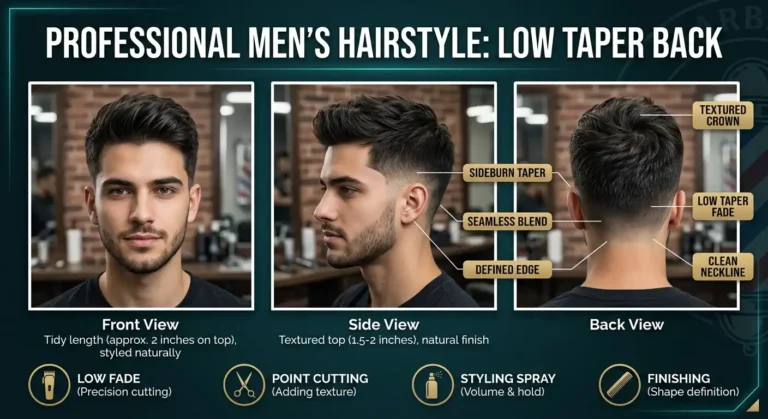
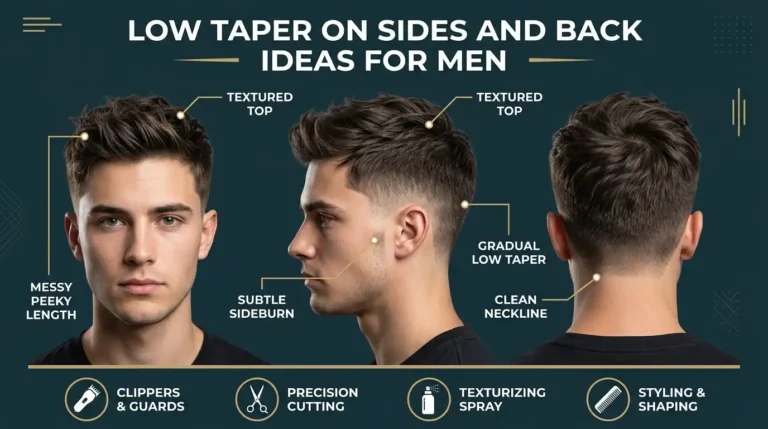
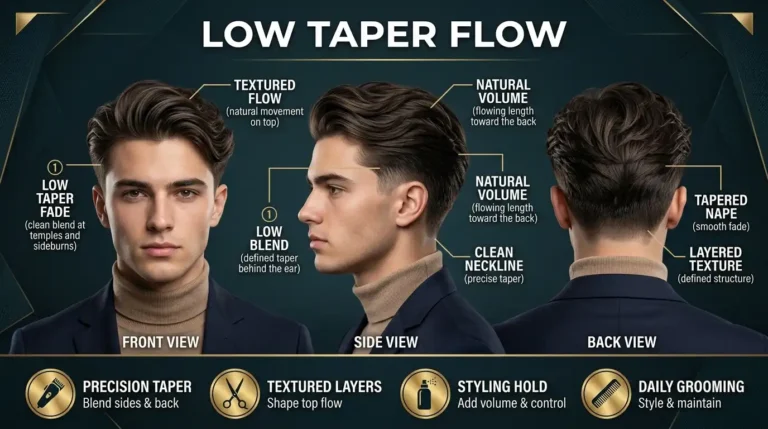
A perm with low taper combines chemically created waves or curls on top with a controlled taper around the sideburns and neckline. The top provides texture and volume, while the low taper removes excess bulk around the edges without pushing the haircut too high. The result can range from soft, loose waves to defined curls depending on rod size, hair length, and styling technique.
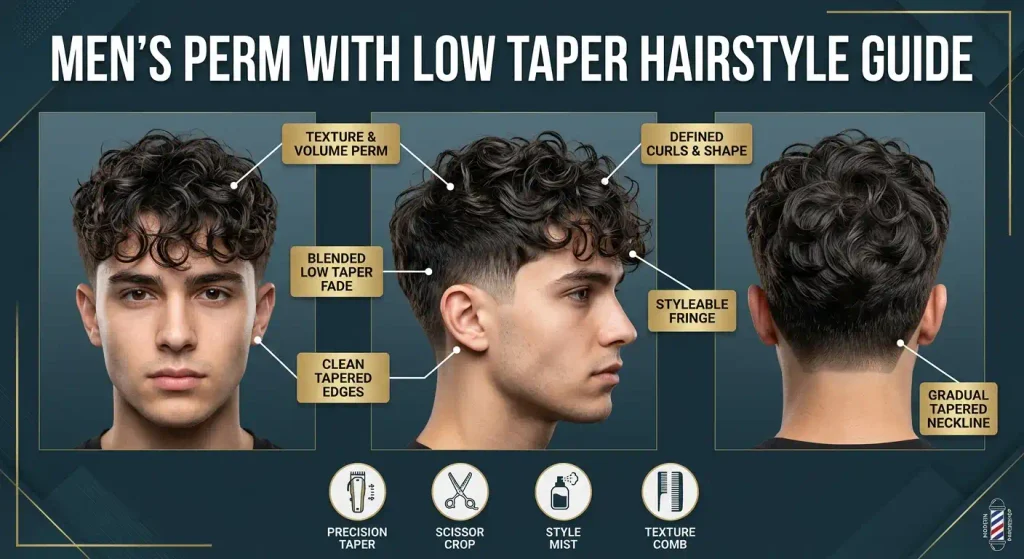
The combination is increasingly visible across men’s hairstyle galleries, with variations including loose waves, Korean-inspired texture, curly crops, middle parts, and low-taper blowouts.
The important distinction is that the perm determines much of the top’s texture, while the taper determines how cleanly the haircut frames the head. That means the same perm can look completely different when paired with a subtle taper, a stronger fade, a fringe, or a longer layered top.
Quick Overview: 5 Styles to Consider First
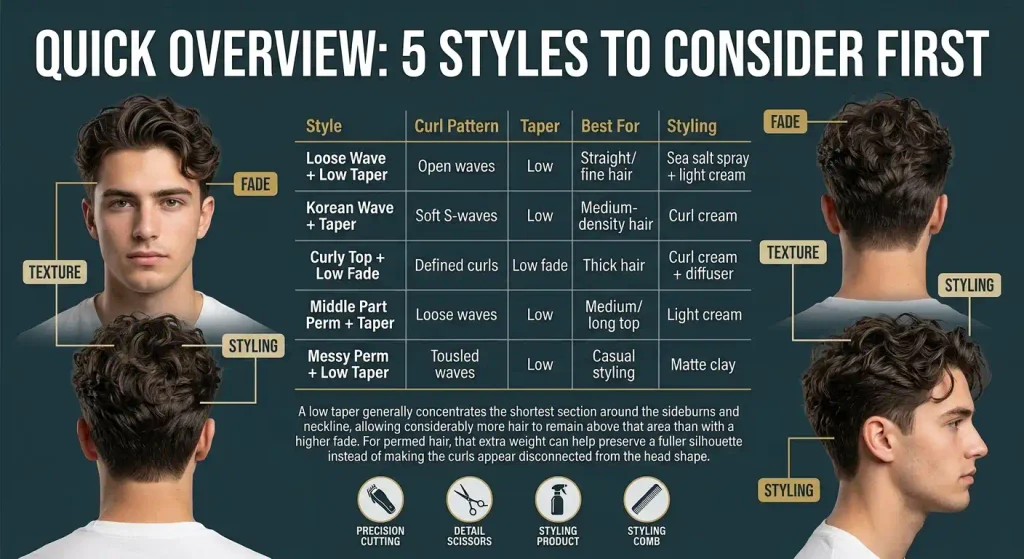
| Style | Curl Pattern | Taper | Best For | Styling |
| Loose Wave + Low Taper | Open waves | Low | Straight/fine hair | Sea salt spray + light cream |
| Korean Wave + Taper | Soft S-waves | Low | Medium-density hair | Curl cream |
| Curly Top + Low Fade | Defined curls | Low fade | Thick hair | Curl cream + diffuser |
| Middle Part Perm + Taper | Loose waves | Low | Medium/long top | Light cream |
| Messy Perm + Low Taper | Tousled waves | Low | Casual styling | Matte clay |
A low taper generally concentrates the shortest section around the sideburns and neckline, allowing considerably more hair to remain above that area than with a higher fade. For permed hair, that extra weight can help preserve a fuller silhouette instead of making the curls appear disconnected from the head shape.
What Makes This Combination Work?
The appeal comes from contrast.
The top can be soft, curly, loose, messy, or heavily textured, while the edges remain controlled. This gives permed hair a deliberate shape rather than allowing the additional volume to spread equally across the entire head.
A taper also gives the barber room to preserve length where the curl pattern needs it. With a very high fade, too much side weight may disappear, while a low taper can leave enough surrounding hair to connect naturally with the permed top.
Another advantage is flexibility. The same haircut can be worn forward, parted, pushed back, loosely swept sideways, or allowed to fall naturally over the forehead.
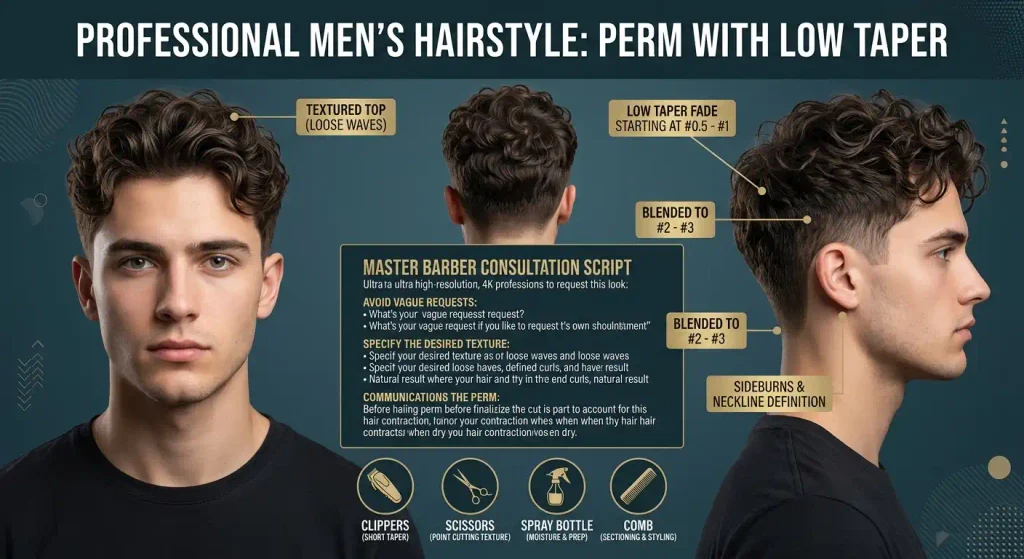
Master Barber Consultation Script
If you’re sitting in the barber chair, avoid simply saying, “Give me a perm with a low taper.” That leaves several important decisions unanswered.
Instead, use a more specific request:
“I want the perm mainly through the top, with enough length left for the curl pattern to develop. Keep the taper low around the sideburns and neckline. Start around a #0.5 or #1 where the taper is shortest and blend gradually into about a #2 or #3. Don’t take the taper too high into the sides.”
Then add the texture you want:
“I want loose waves rather than tight curls, so use a larger rod and keep the top long enough for movement.”
For stronger curls:
“I want defined curls with volume, but I don’t want the sides taken high. Keep the taper low and preserve the weight above it.”
For a natural result:
“Keep the taper subtle and leave the top layered and textured. I want the perm to look like natural movement rather than uniform curls.”
One particularly important point is communicating the perm before the haircut is finalized. Permed hair can contract when dry, so the barber needs to understand how much length is being preserved and how the finished texture will behave. Current barber guides similarly emphasize keeping additional top length and accounting for shrinkage when working with permed texture.
36 Perm and Taper Styles
1. Loose Waves & Natural Movement
1. Loose Perm With Low Taper
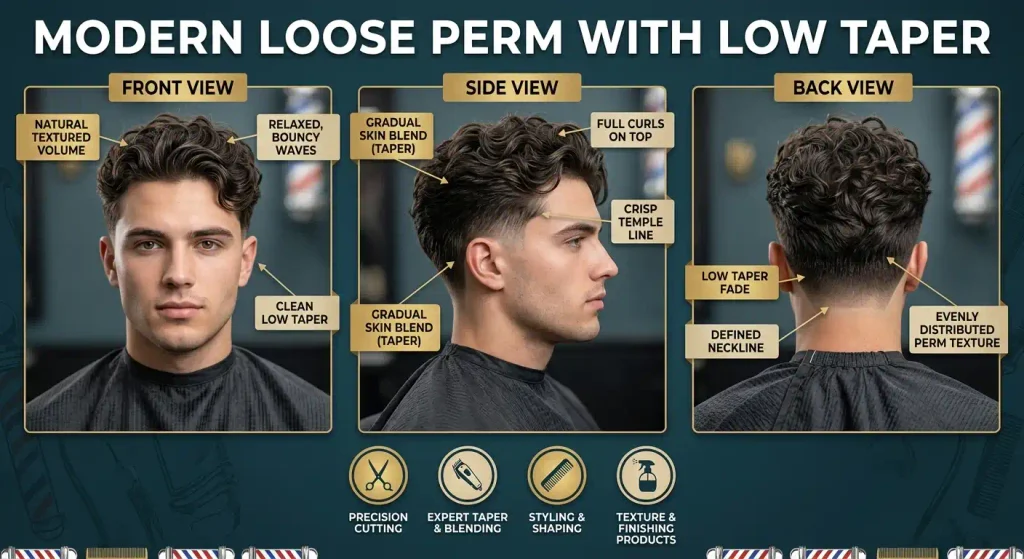
A loose perm creates broad waves rather than compact curls, making it one of the easiest versions to wear casually. Keep the taper around a #0.5–#1 at its shortest point and blend toward #2–#3 without taking the transition high. Oval and rectangular faces suit the added movement particularly well. Use sea salt spray for separation followed by a small amount of lightweight curl cream.
2. Loose Perm With Taper Fade
This variation gives the loose perm a slightly stronger side transition. The top should remain long enough for the waves to retain their shape, while the sides can move from approximately #1 into #2 and #3. It works particularly well on medium-density straight hair. Style with a lightweight cream and diffuse on low heat rather than aggressively brushing the waves apart.
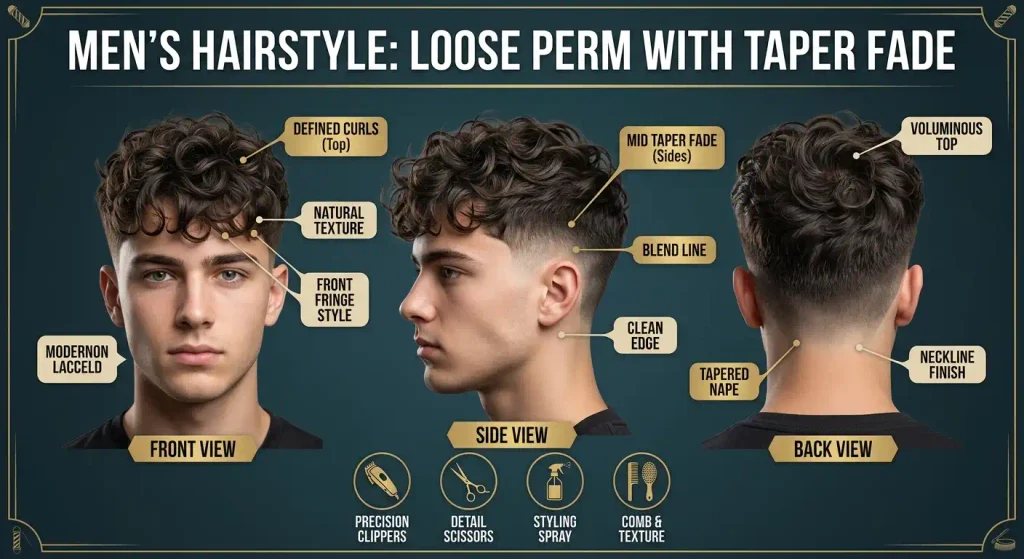
3. Loose Perm With Taper
A subtle taper is ideal when you want the permed texture to remain the main feature. The barber can clean the sideburns and neckline while preserving most of the side weight. A #1 around the lowest area blended toward #3 creates a conservative finish. This version works especially well for oval and heart-shaped faces. Use a soft curl cream and let the hair air-dry.
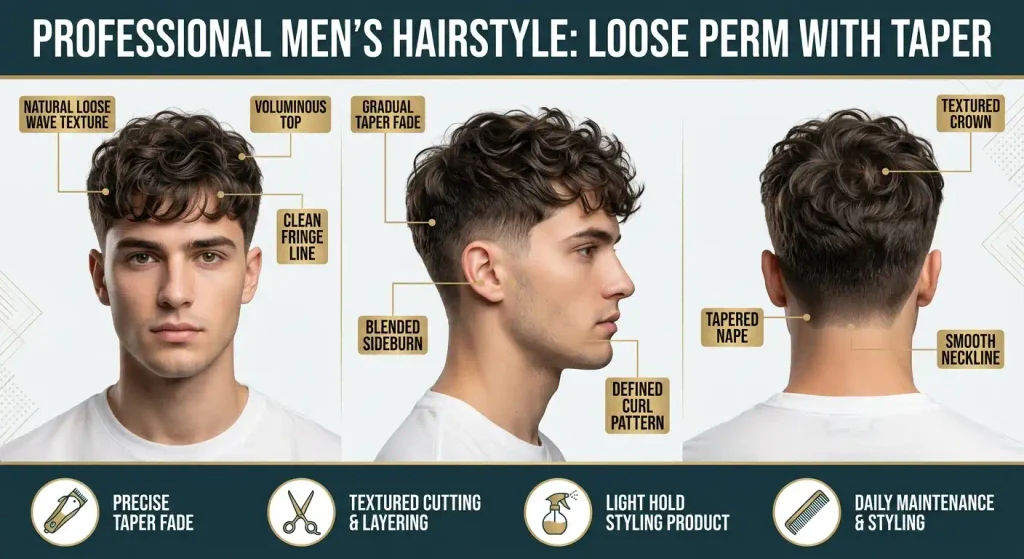
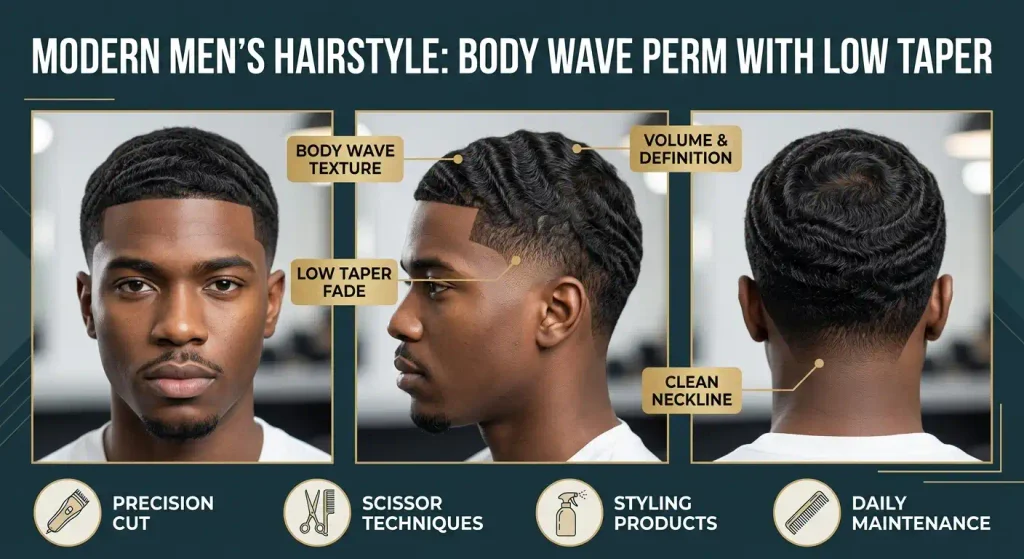
4. Body Wave Perm With Low Taper
A body-wave approach produces broader, softer movement than a traditional curl-focused perm. Pair it with a low taper that cleans around the ears without dramatically reducing the side profile. Medium and thick hair can carry the shape particularly well. A lightweight leave-in conditioner helps maintain softness, while a diffuser can add volume without making the waves look overly structured.
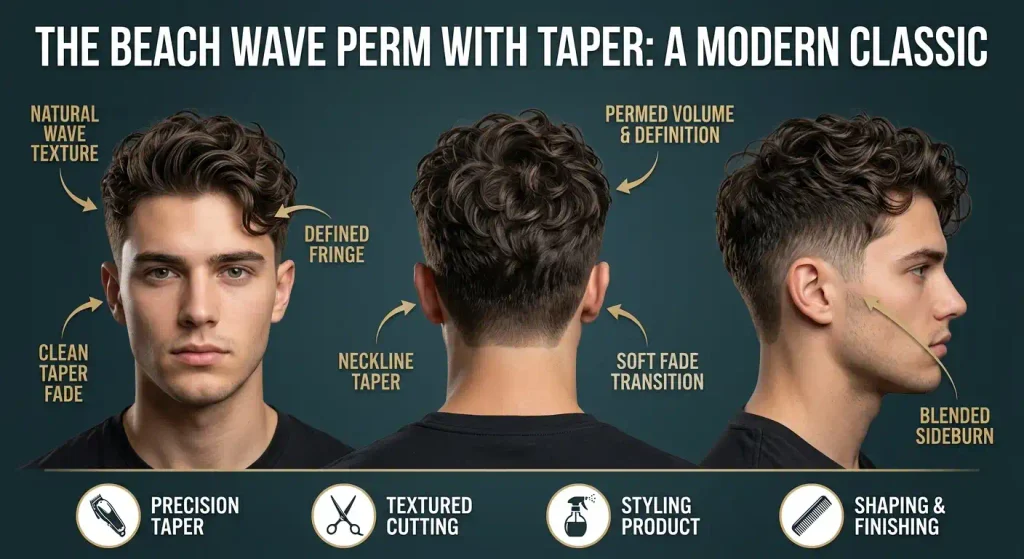
5. Beach Wave Perm With Taper
Beach-wave texture works when the goal is deliberately imperfect movement. Keep the taper narrow around the ear and neckline, with a #1 or #1.5 as the lowest section before transitioning upward. The top can be point-cut lightly to break up a solid shape. Use sea salt spray followed by a small amount of matte styling cream for separation.
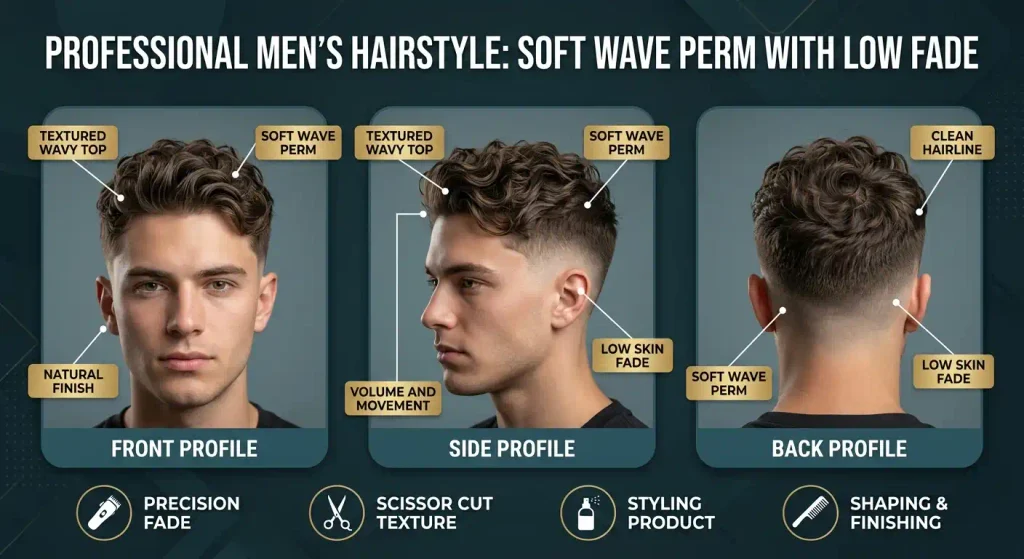
6. Soft Wave Perm With Low Fade
A soft wave can also be paired with a low fade when you want greater contrast between the top and sides. Keep the fade low rather than allowing it to climb toward the parietal ridge. This works well for round faces because controlled height on top can visually lengthen the profile. Use lightweight curl cream and a diffuser to maintain the wave pattern.
2. Korean-Inspired & Parted Perms
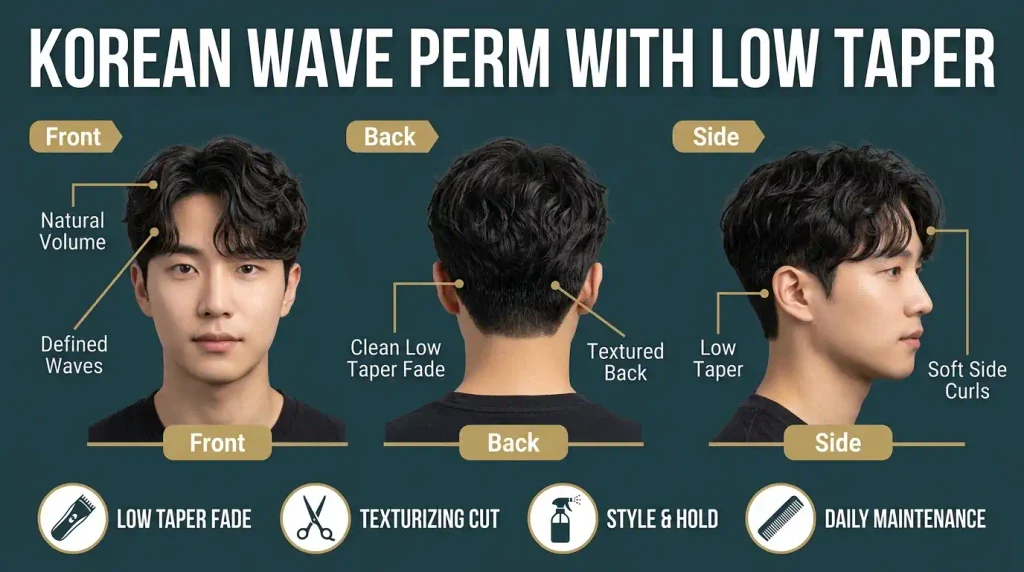
7. Korean Wave Perm With Low Taper
The Korean-inspired version focuses on soft, organized waves instead of tight curls. Leave approximately 3–5 inches on top depending on the desired part and wave pattern, then taper the sideburns and neckline conservatively. A #1–#2 transition keeps the silhouette clean without overpowering the top. Use a lightweight curl cream and finger-style the waves into place.
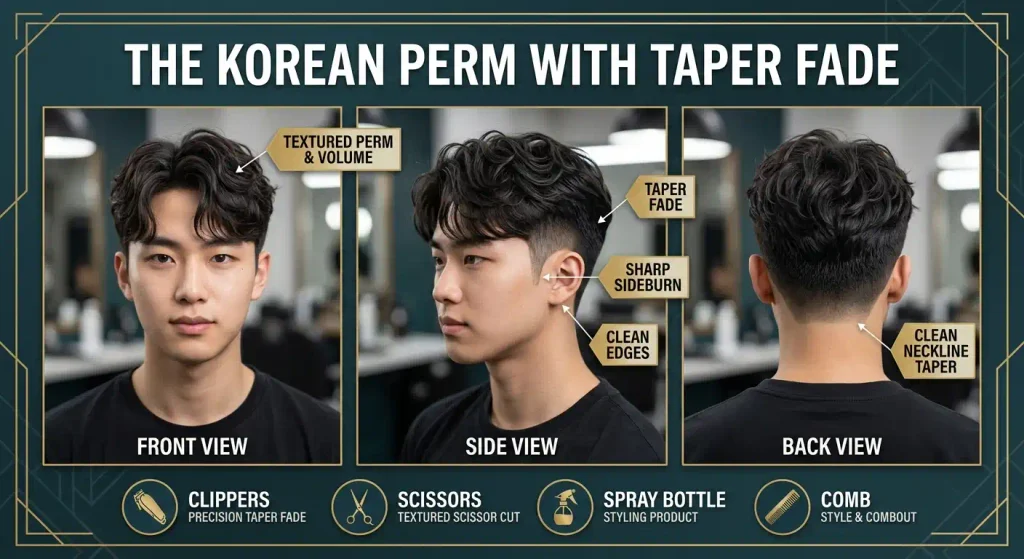
8. Korean Perm With Taper Fade
A stronger taper fade creates a more obvious contrast with the soft Korean-style texture. The barber should avoid removing too much weight above the taper because the top needs a balanced transition. This style can complement oval, heart, and diamond face shapes. Blow-dry with fingers while directing the fringe slightly away from the face, then finish with light styling cream.
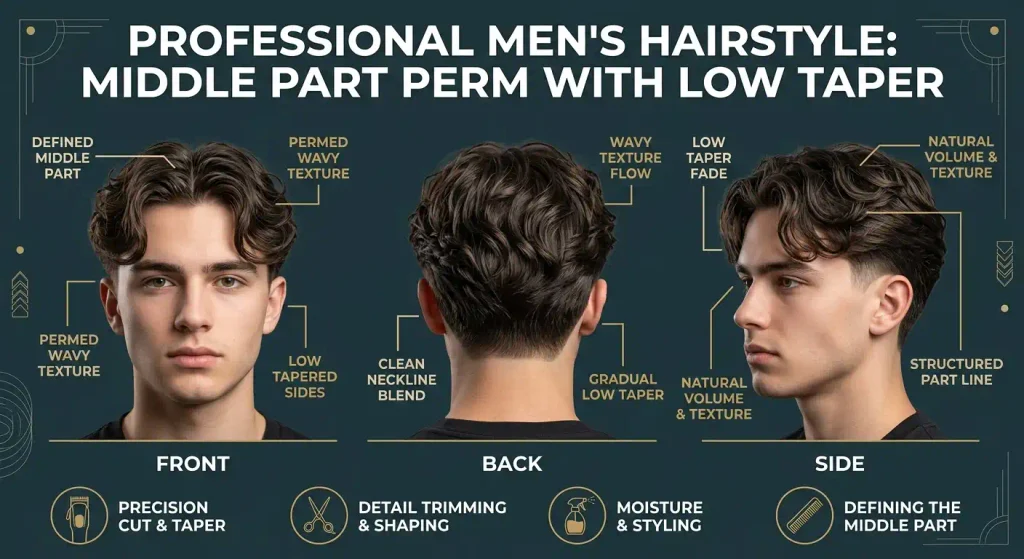
9. Middle Part Perm With Low Taper
A middle part gives permed hair a symmetrical frame around the forehead and cheekbones. Keep the taper low so the sides retain enough weight to connect with the longer top. A #1.5 around the lowest taper section can transition toward #3. This works especially well on oval and longer faces. Use curl cream on damp hair and separate the two sections with your fingers.
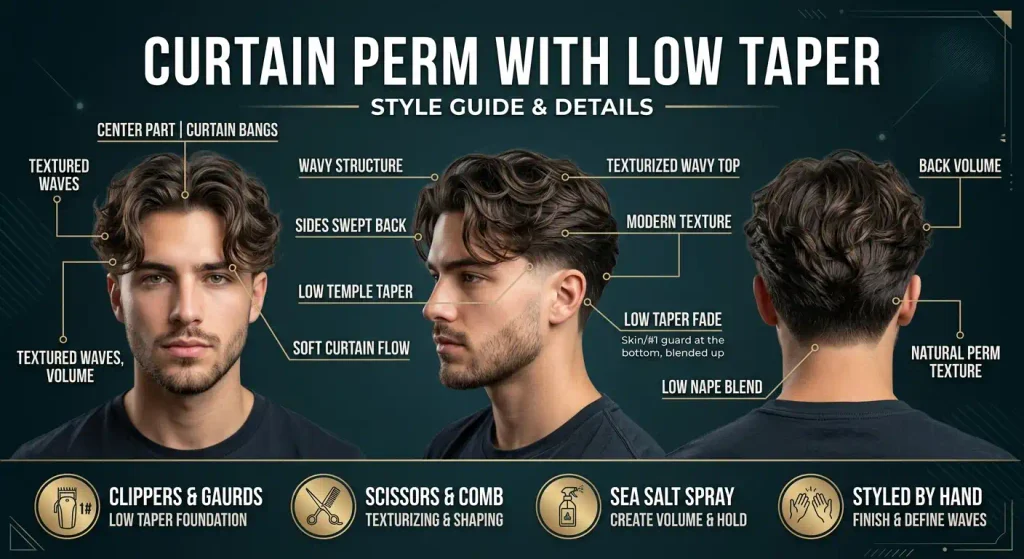
10. Curtain Perm With Low Taper
Curtain bangs and a loose perm create movement that falls naturally on both sides of the forehead. The taper should remain subtle around the ears so the longer curtain sections do not appear disconnected. This shape can soften angular jawlines and suit oval faces particularly well. Apply a lightweight cream, create the center split while damp, and diffuse gently.
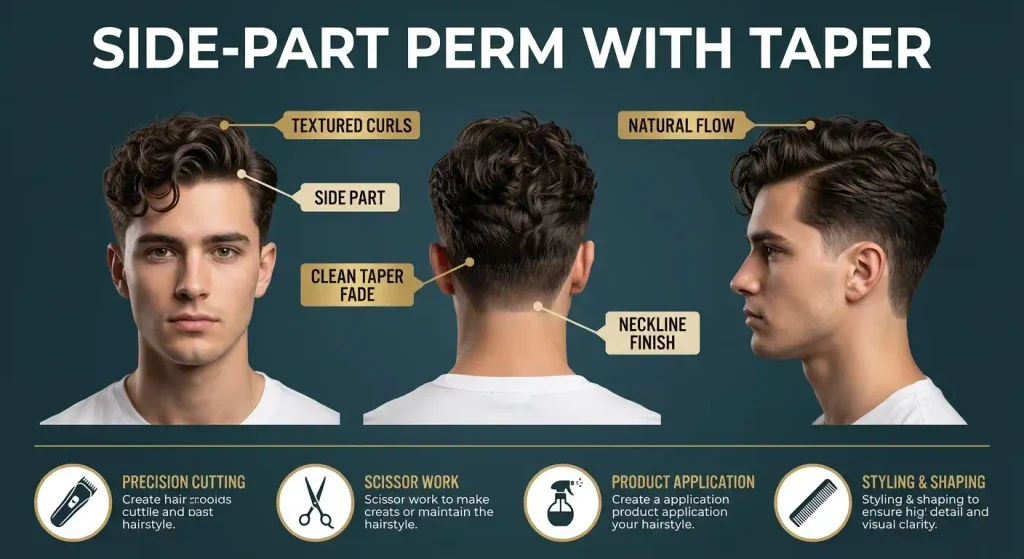
11. Side-Part Perm With Taper
A side part makes a permed haircut feel more polished without eliminating its texture. Keep the taper low, approximately #1 at the edges and gradually increasing into #2–#3. The part can be natural rather than razor-defined for a softer appearance. This is a useful option for work-friendly styling. Use a lightweight matte cream and direct the front diagonally during drying.
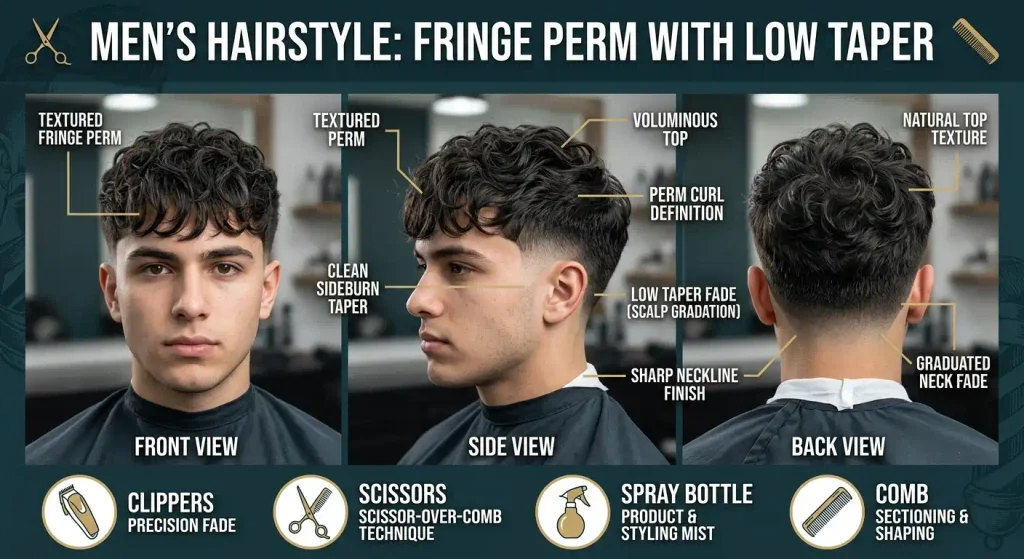
12. Fringe Perm With Low Taper
A permed fringe places most of the movement toward the forehead instead of distributing it evenly backward. Keep the taper below the temples and avoid removing too much side weight. The style can balance longer or angular faces because the fringe visually reduces forehead height. Apply curl cream to damp hair and use finger scrunching rather than a comb.
3. Curly, Defined & High-Texture Versions
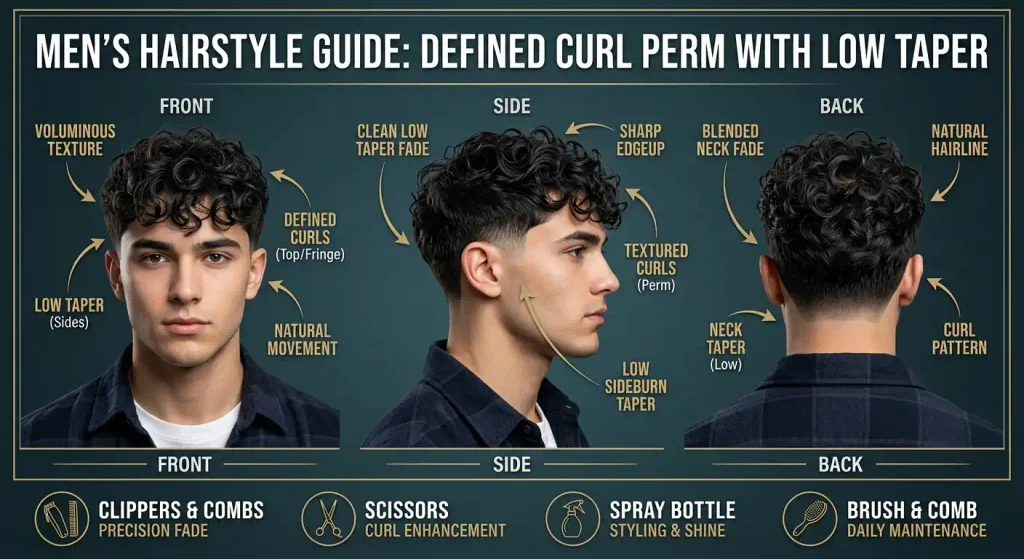
13. Defined Curl Perm With Low Taper
Defined curls create a stronger contrast against a clean low taper. The top should generally remain long enough for the curls to form without becoming a short, compact mass. A #0.5–#1 taper at the lowest section can transition into #2–#3. Square and oval faces often work well with the added volume. Use curl cream and a diffuser on low heat.
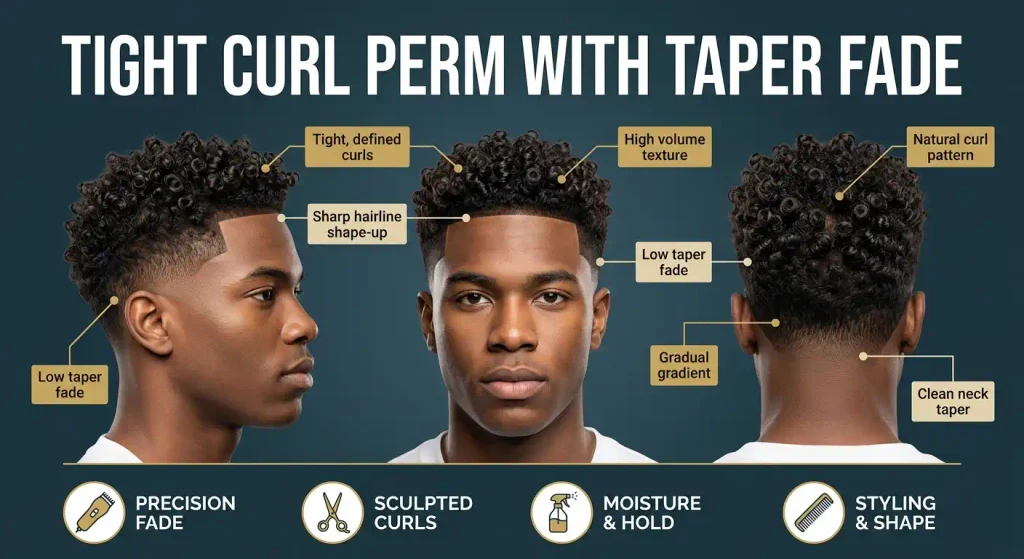
14. Tight Curl Perm With Taper Fade
For a tighter curl pattern, the taper provides necessary visual control around the edges. Keep the fade low to prevent the sides from looking disproportionately narrow compared with the curly top. The barber should also check the curl pattern while cutting rather than relying entirely on stretched length. Apply leave-in conditioner and curl cream, then diffuse without excessive manipulation.
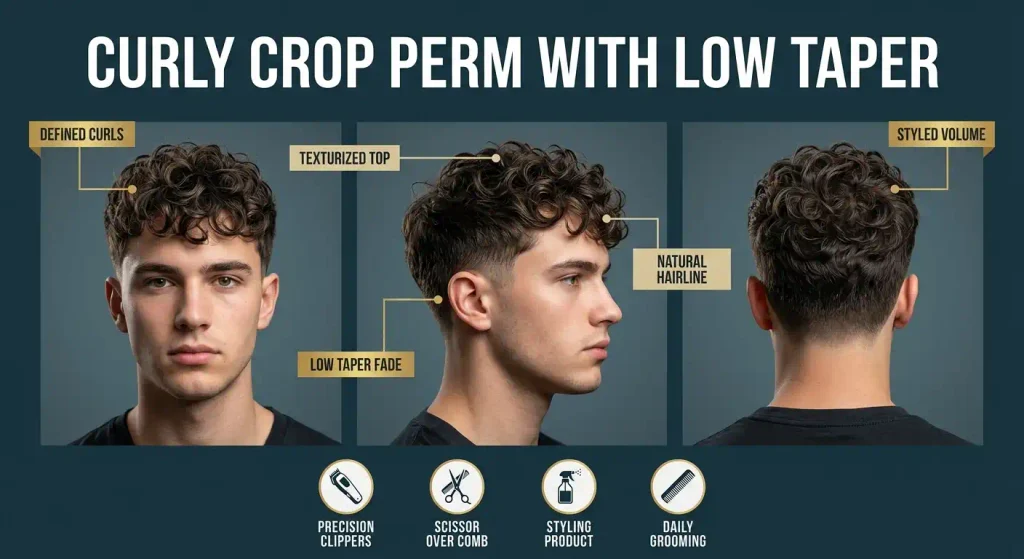
15. Curly Crop Perm With Low Taper
A curly crop keeps the permed top shorter and more controlled than a traditional loose perm. Leave enough length for visible curl formation, then use point cutting to create separation rather than bluntly removing large sections. The low taper can begin around #0.5–#1. This style suits oval and square faces. Finish with lightweight curl cream and scrunch upward.
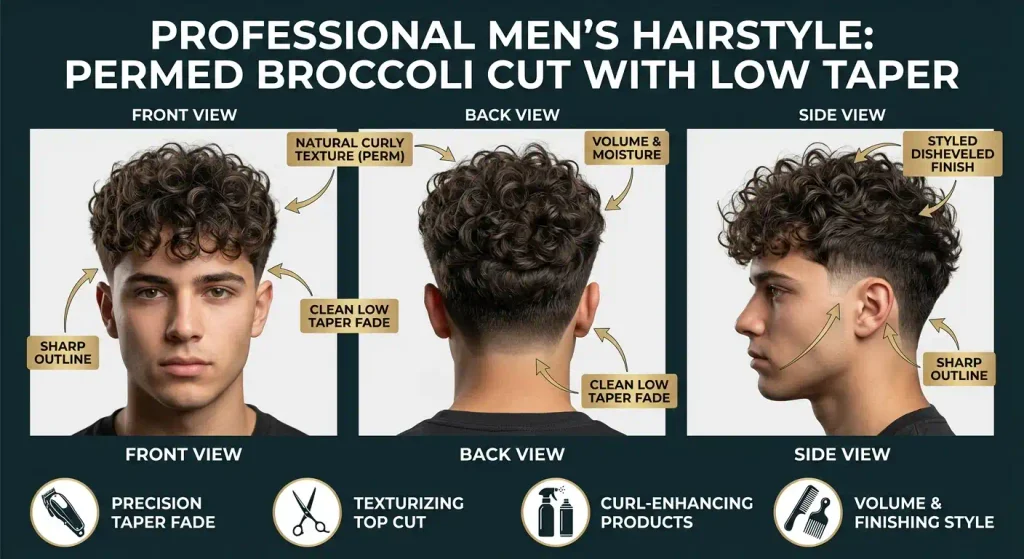
16. Permed Broccoli Cut With Low Taper
The rounded curly-top silhouette can be created with a perm when natural hair lacks sufficient curl. Keep the taper concentrated below the ears and around the neckline so the top remains visually full. The top should be shaped to follow the natural curl expansion rather than forcing a perfectly symmetrical dome. Curl cream and a diffuser provide controlled volume.
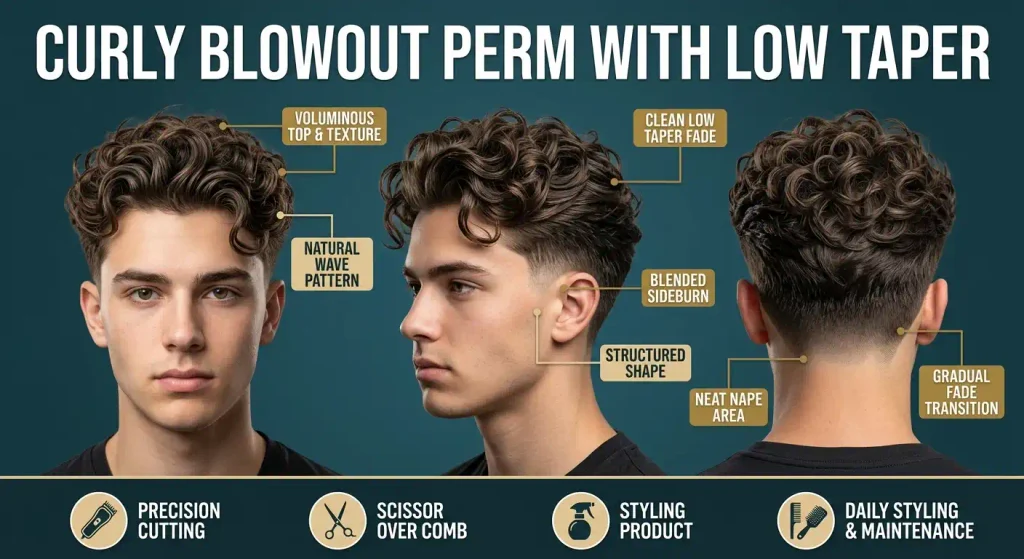
17. Curly Blowout Perm With Low Taper
This version combines permed texture with a deliberately lifted blowout shape. Keep the top around 3–5 inches or longer depending on the desired height, while the taper remains narrow around the lower sides. Round and oval faces can handle the added vertical volume especially well. Apply curl cream, lift the roots with fingers, and diffuse from underneath.
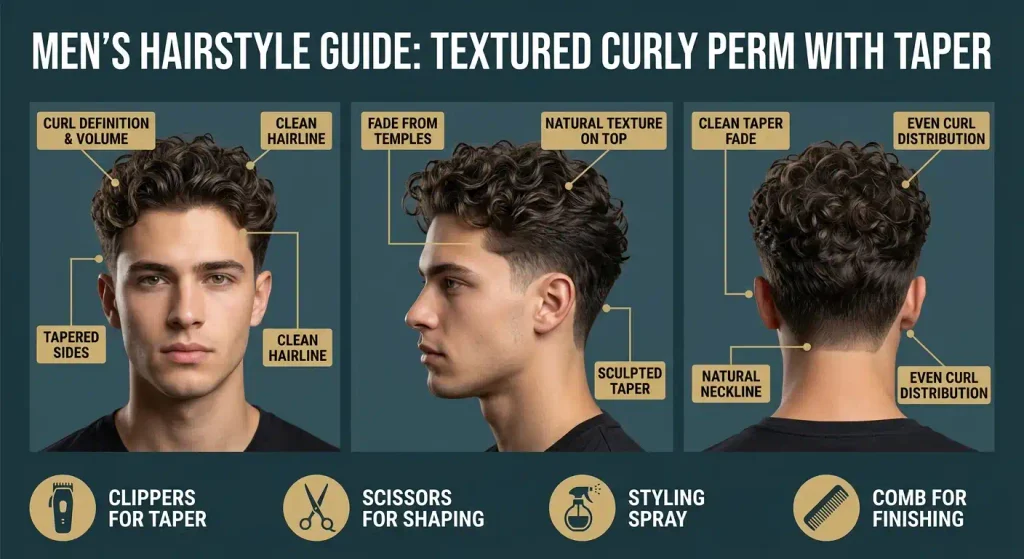
18. Textured Curly Perm With Taper
Instead of creating uniform curls, this haircut emphasizes separation between curl groups. The barber can use point cutting carefully after assessing the dry curl pattern, avoiding excessive thinning that could increase frizz. A #1–#2 low taper keeps the edges controlled. This option works well with thick hair. Use a lightweight cream rather than heavy wax or pomade.
4. Messy, Textured & Casual Styles
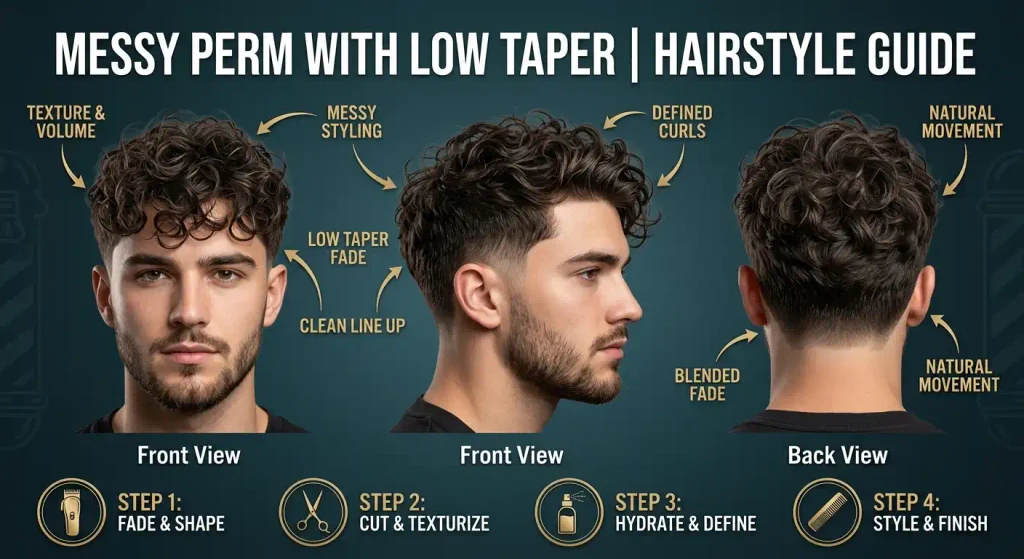
19. Messy Perm With Low Taper
The messy version intentionally avoids a perfectly arranged curl pattern. The taper stays clean around the edges while the top is left irregular and separated. Ask for light point cutting rather than aggressive thinning, particularly if the hair is already porous from chemical processing. Matte cream provides natural control without flattening the texture.
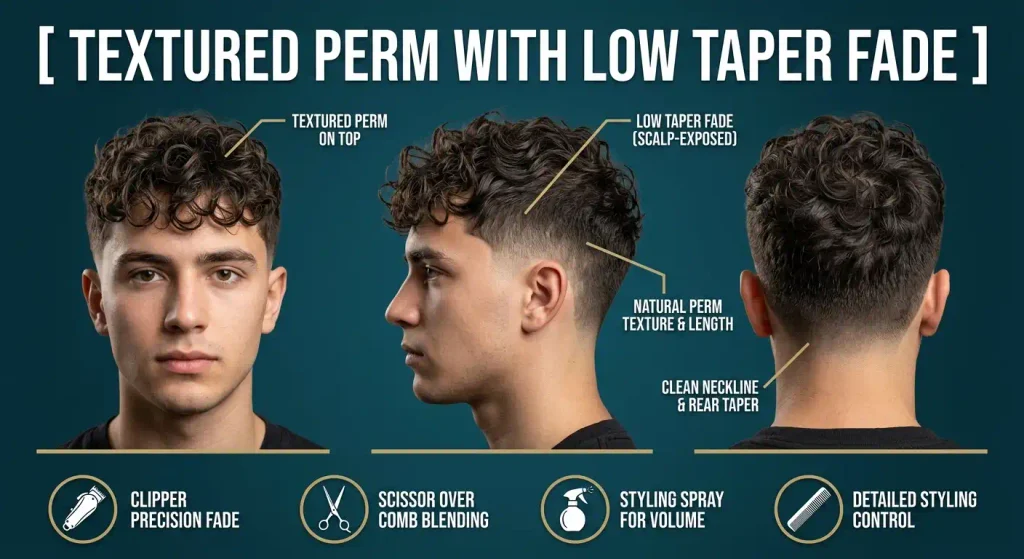
20. Textured Perm With Low Taper Fade
This style combines visible curl separation with a slightly stronger taper. The lowest section can begin around #0.5–#1, transitioning through #2 before connecting with the longer sides. It suits men who want the haircut to look structured from the sides but relaxed on top. Use a small amount of matte clay on dry hair to emphasize individual sections.
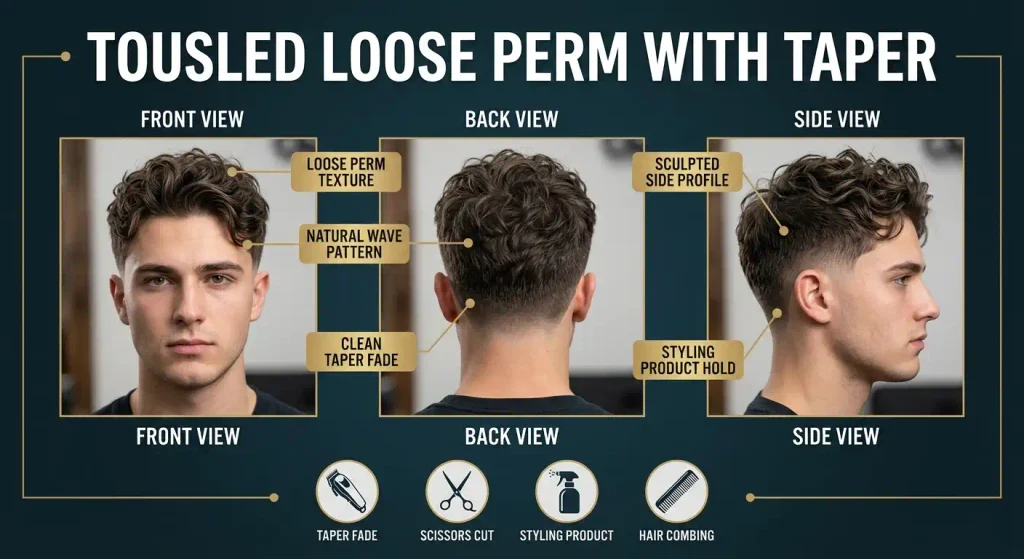
21. Tousled Loose Perm With Taper
A tousled perm looks intentionally imperfect, with waves pushed in different directions rather than arranged into a strict pattern. The taper should remain conservative so the overall silhouette does not become too disconnected. This style can soften prominent cheekbones and angular features. Use sea salt spray on damp hair, scrunch lightly, and finish with a flexible cream.
22. Messy Fringe Perm With Low Taper
The messy fringe allows curls or waves to fall forward naturally across the forehead. Keep the taper low around the sideburns and neckline while preserving the temple area. This can work particularly well for longer face shapes because the fringe visually shortens the upper face. Apply curl cream and use your fingers to separate the front rather than combing it flat.
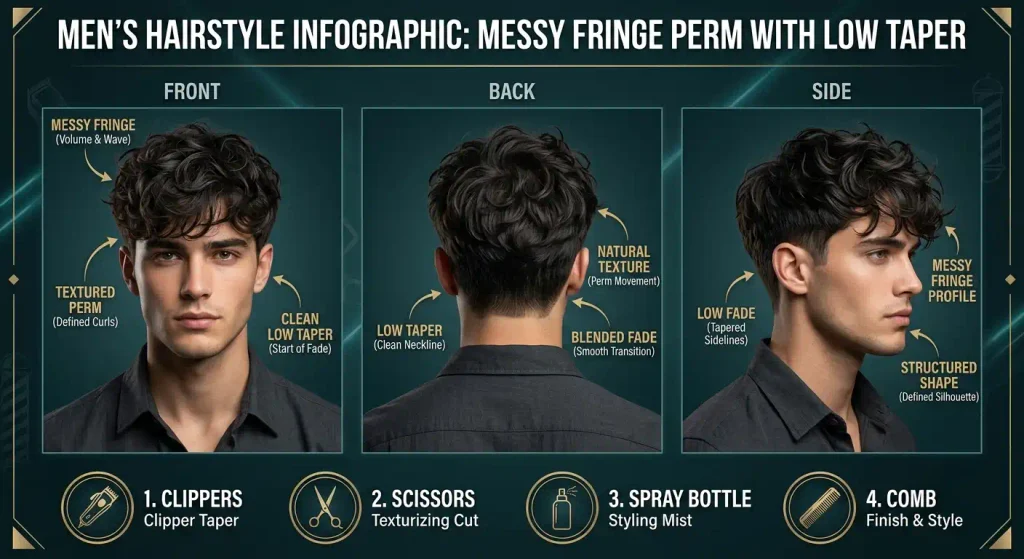
23. Shaggy Perm With Taper
A shag-inspired perm uses layers to distribute movement throughout the top and upper sides. The taper simply cleans the lowest perimeter instead of becoming the dominant feature. The result is more relaxed than a traditional fade haircut. This works well with medium to longer hair. Use sea salt spray for texture and a light cream to control flyaways.
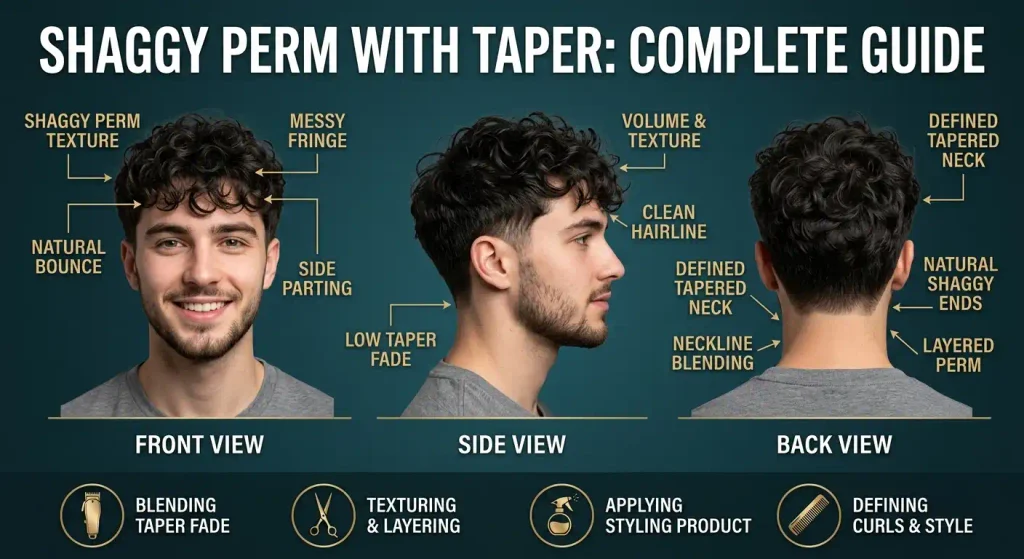
24. Permed Wolf Cut With Low Taper
A wolf cut can be paired with a low taper when you want layered length without an untidy perimeter. Keep the neckline and sideburns clean while preserving longer sections toward the back. The top should be layered according to the curl pattern. This option works best when there is sufficient length to create separation. Use curl cream and scrunch the layers.
5. Clean, Polished & Versatile Combinations
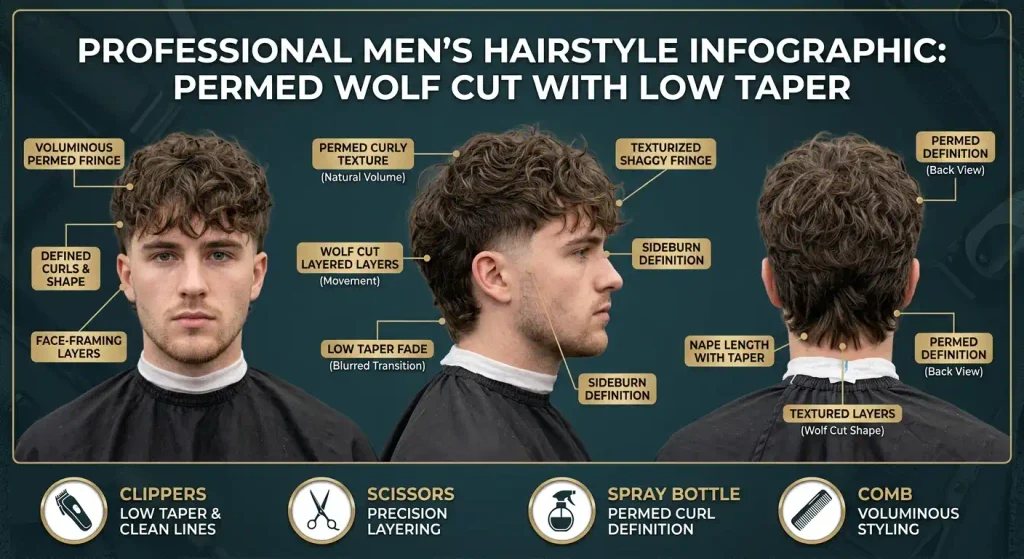
25. Perm With Low Fade
A low fade takes the clean-up slightly farther than a conventional taper while still staying relatively low. The top should retain enough length to make the curls or waves the visual focus. Start around #0 or #0.5 at the shortest point and blend smoothly upward. Use curl cream for textured hair or matte cream for a looser wave pattern.
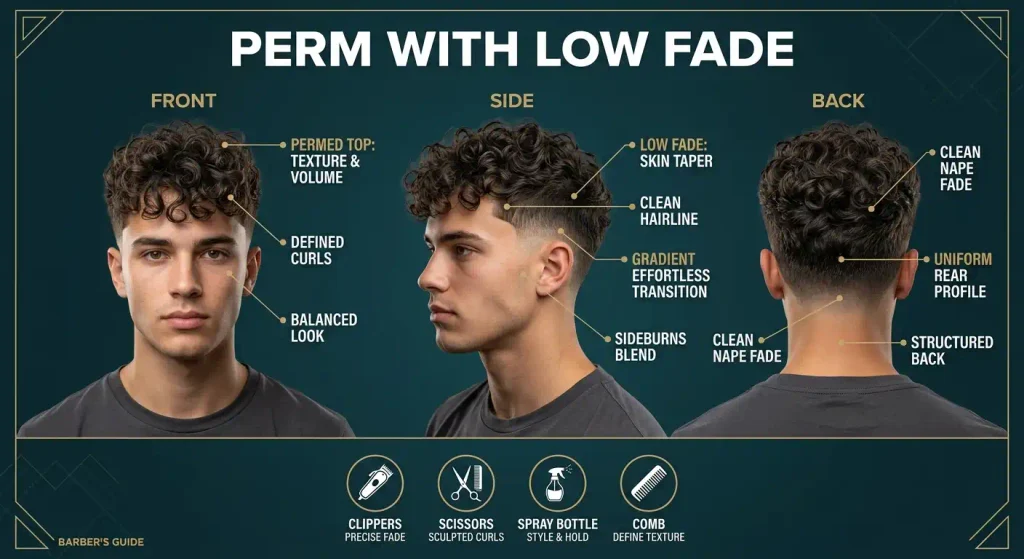
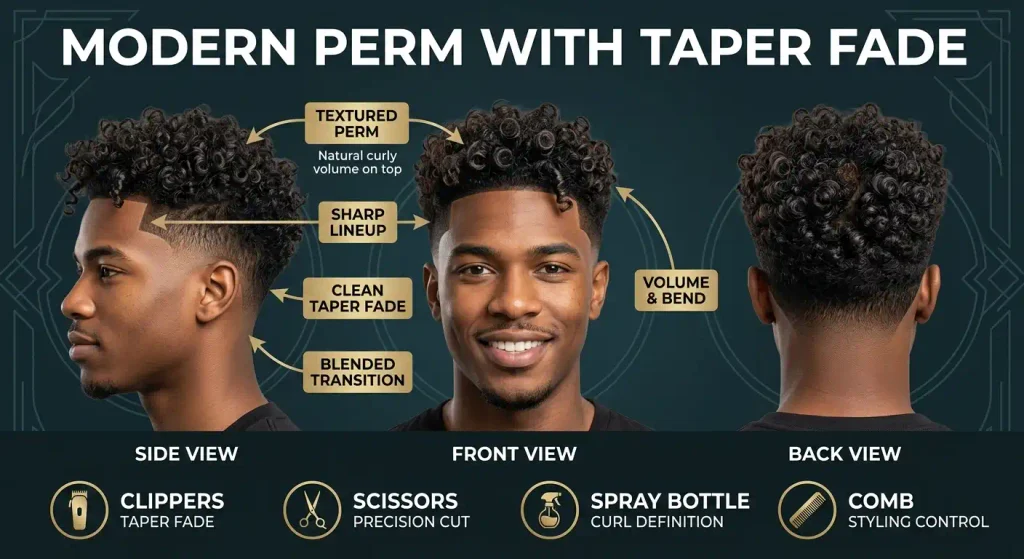
26. Perm With Taper Fade
A taper fade provides a gradual reduction through the sideburn and neckline areas while preserving the main top length. It is a useful middle ground between a subtle taper and a much stronger skin fade. Keep the transition smooth and avoid cutting too high. The finish suits many face shapes when the top volume is adjusted to the individual’s proportions.
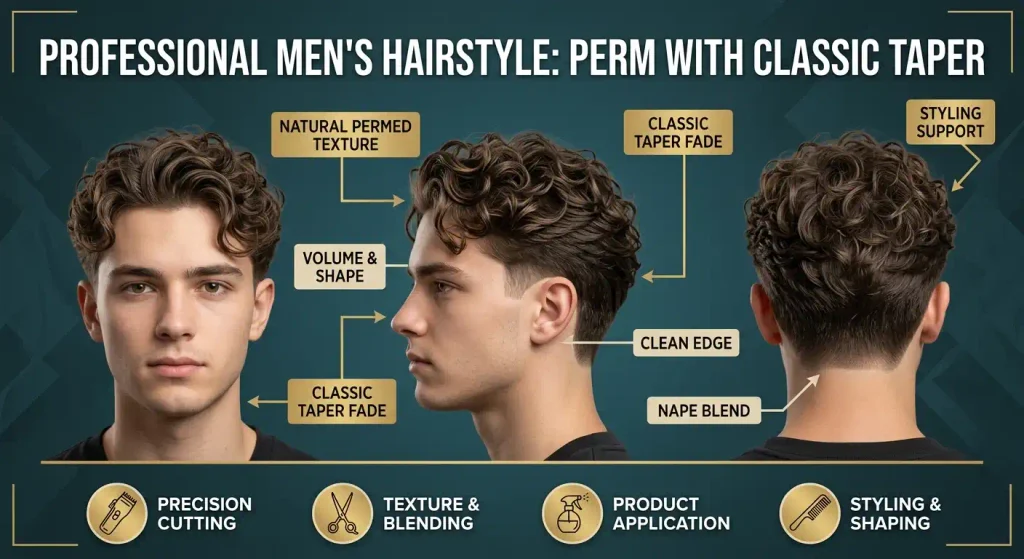
27. Perm With Classic Taper
For a conservative result, choose a classic taper rather than a dramatic fade. The barber can use scissors and clipper-over-comb higher on the sides while keeping the shortest area around the sideburn and neckline. This preserves a fuller profile. Style with a light cream and allow the natural texture to remain visible.
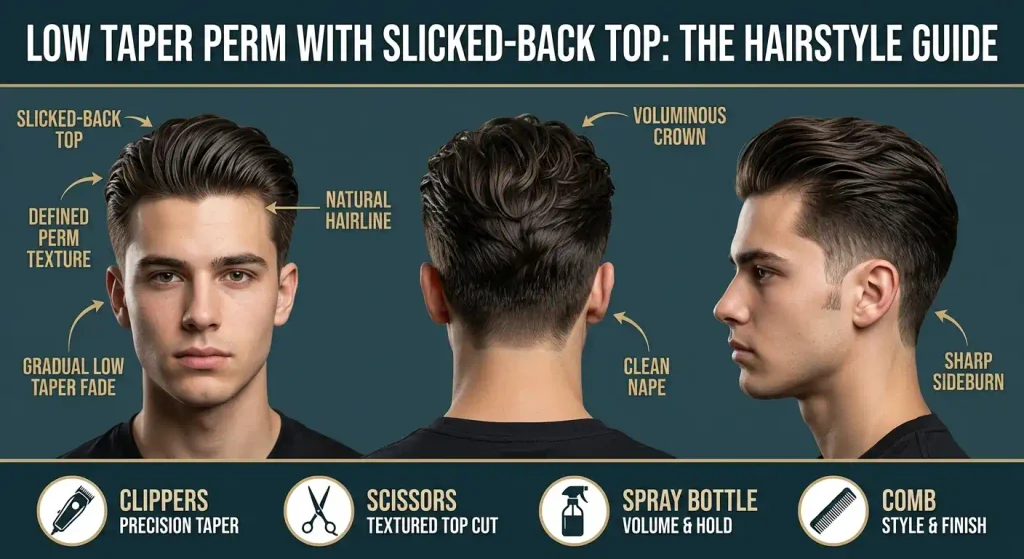
28. Low Taper Perm With Slicked-Back Top
A longer permed top can be directed backward for a relaxed version of a slicked-back style. Avoid heavy wet-look pomade because it can compress the curl pattern and make chemically processed hair appear greasy. Use a lightweight styling cream and a diffuser while directing the hair backward with your fingers. This works especially well on oval faces.
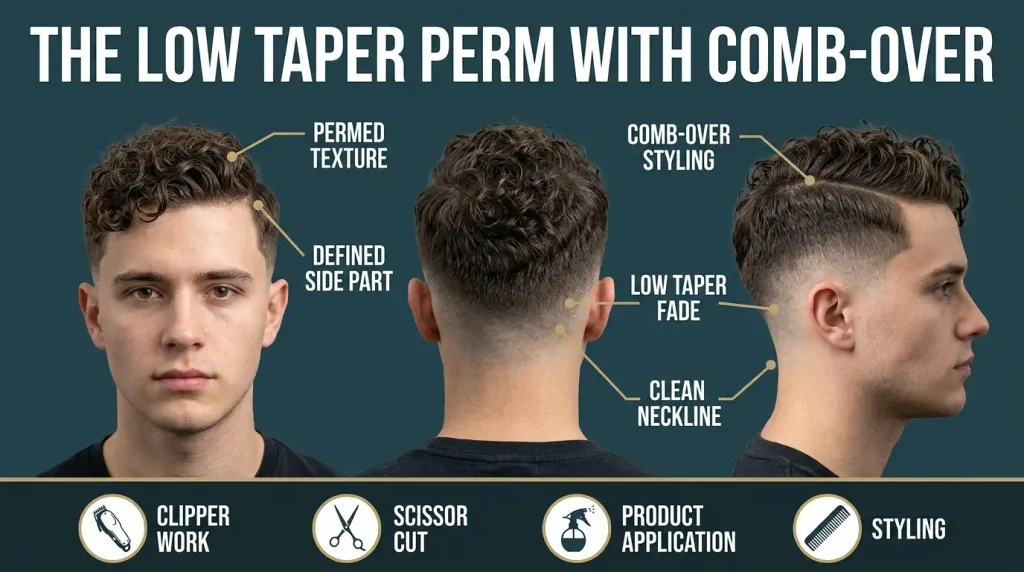
29. Low Taper Perm With Comb-Over
The comb-over version uses a natural side direction instead of a rigid part. Keep the taper low and leave sufficient length on top for the waves to cross over naturally. This can add visual height to rounder face shapes. Apply a small amount of matte cream while damp, then use your fingers to guide the top diagonally.
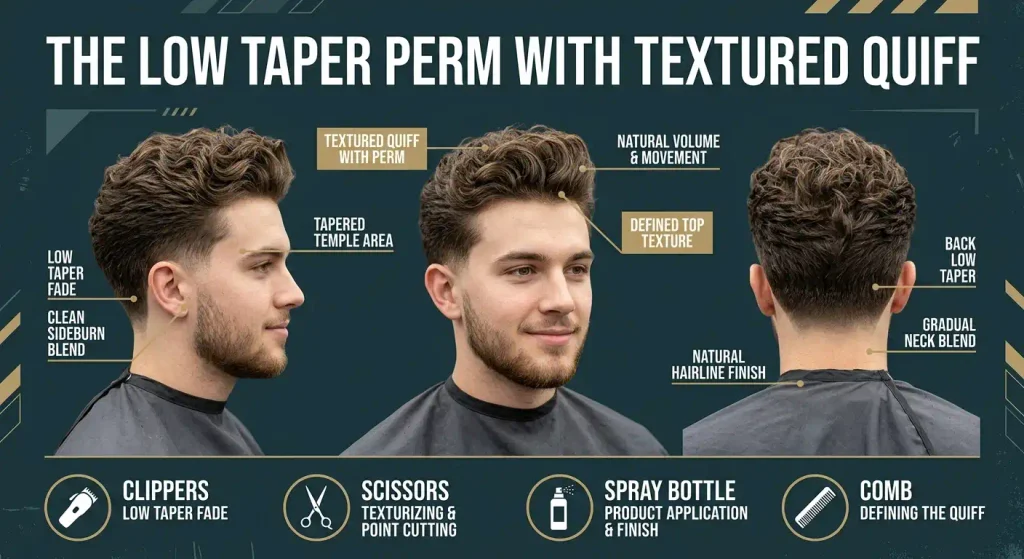
30. Low Taper Perm With Textured Quiff
The textured quiff shifts the permed volume upward and slightly backward. Keep the front longer than the crown and use point cutting to prevent the top from becoming a heavy block. A #1–#2 taper around the edges maintains contrast without taking the sides too high. Use a lightweight mousse or curl cream, then diffuse while lifting the front.
6. Longer, Flowing & Trend-Hybrid Styles
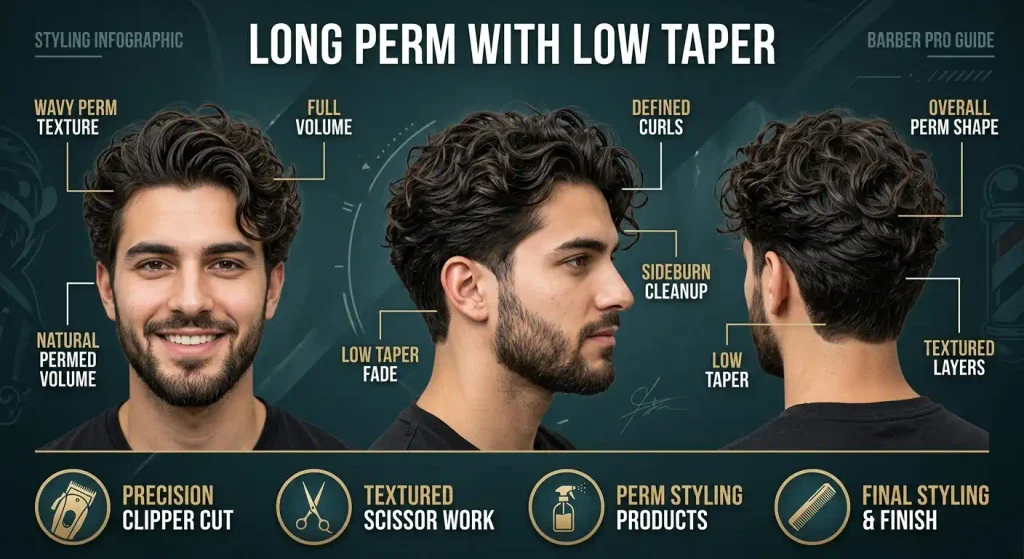
31. Long Perm With Low Taper
Longer permed hair gives the curl pattern more room to develop and creates a softer silhouette. The taper should be minimal, primarily cleaning around the ears and neckline. Avoid removing too much side weight because the longer top needs a gradual connection. This works well for oval and diamond faces. Use leave-in conditioner followed by curl cream.
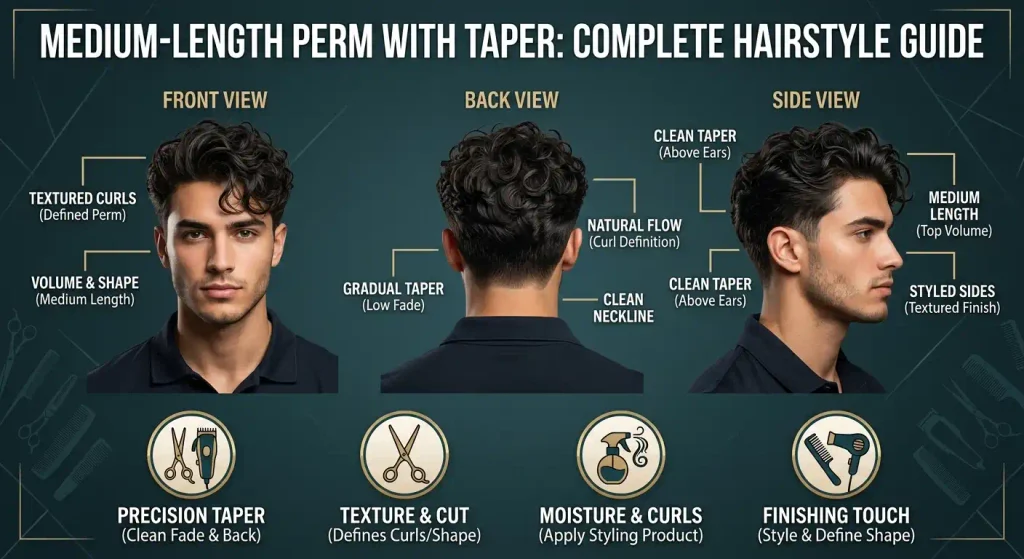
32. Medium-Length Perm With Taper
Medium-length hair offers a useful balance between manageable styling and visible movement. Keep the taper low and use layers to prevent the permed hair from becoming excessively heavy. The barber should evaluate the dry curl pattern before removing substantial length. Use curl cream after washing and diffuse on low heat when additional volume is needed.
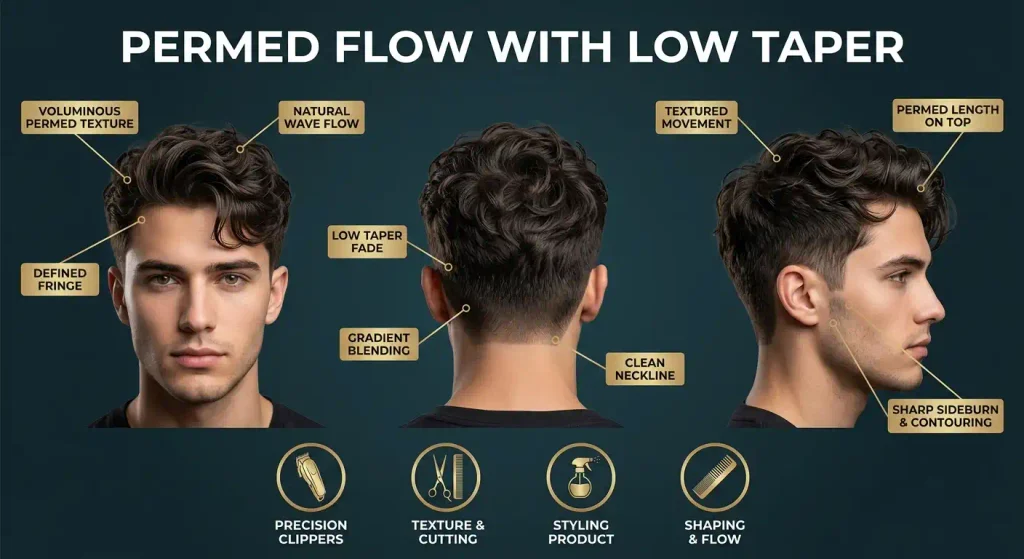
33. Permed Flow With Low Taper
A permed flow directs the textured top backward and toward the sides rather than forward across the forehead. Keep the taper limited to the lower perimeter so the flow remains full. This is particularly effective for medium and longer hair. Use a lightweight leave-in product, then finger-comb the hair backward while it dries naturally.
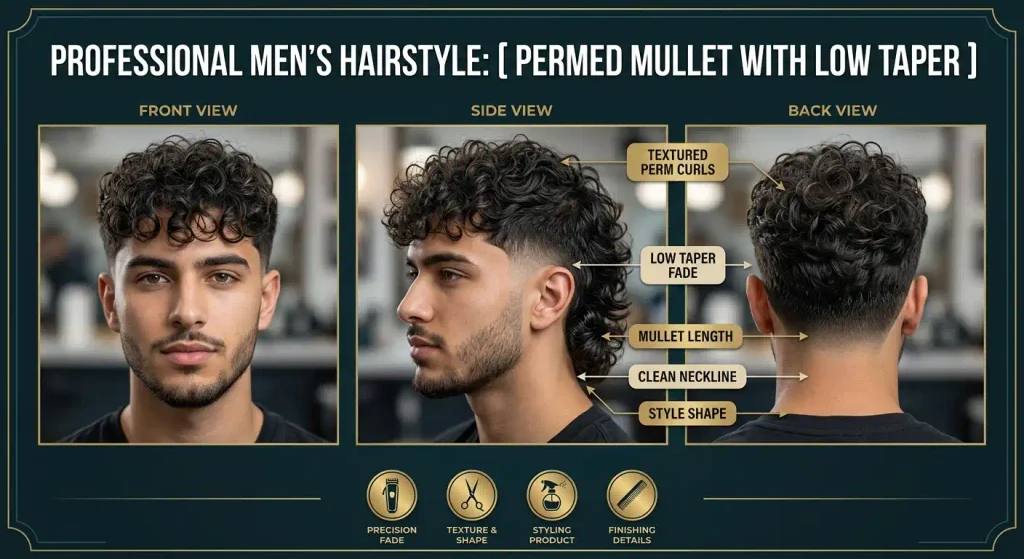
34. Permed Mullet With Low Taper
The modern permed mullet uses shorter sides with more length retained through the back. A low taper can clean the sideburns and neckline while preserving the distinctive rear length. The top should be layered so the curl pattern transitions naturally into the back. This is a stronger fashion-oriented choice. Use curl cream and scrunch the longer sections.
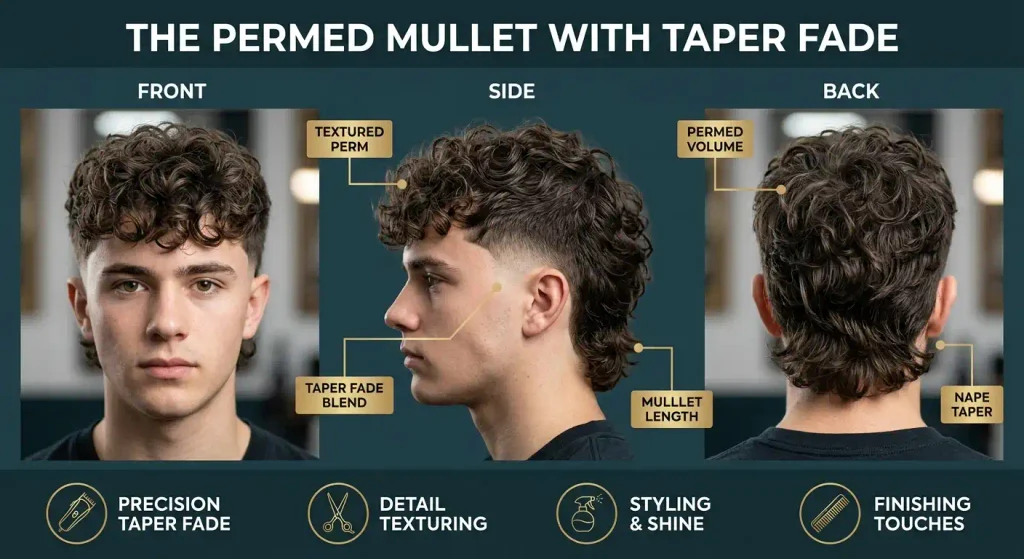
35. Permed Mullet With Taper Fade
A stronger taper fade makes the difference between the short sides and longer back more visible. Keep the fade low enough to preserve the mullet’s overall shape. The barber should work with the dry curl pattern because permed hair can change significantly once it contracts. Matte cream or curl cream works better than heavy pomade.
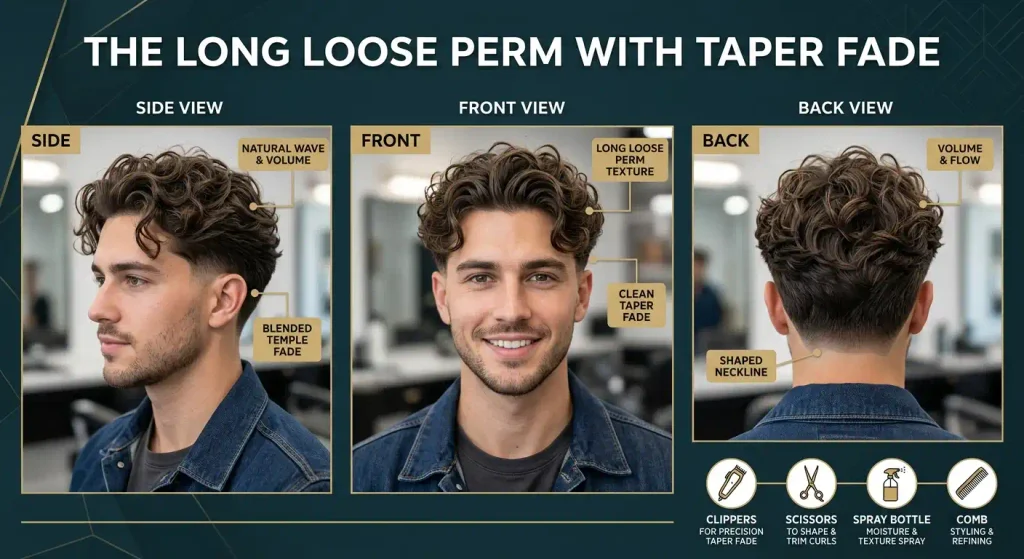
36. Long Loose Perm With Taper Fade
Long loose waves can be paired with a controlled taper fade for a high-contrast but softer-looking finish. The top and back should retain enough length for the waves to move freely, while the taper cleans the lower edges. This style works especially well for men with naturally straight or slightly wavy hair. Use sea salt spray and lightweight curl cream.
Perm With Taper Fade vs Low Taper vs Low Fade
| Feature | Low Taper | Taper Fade | Low Fade |
| Shortest area | Sideburns/neckline | Sideburns/neckline with stronger blend | Wider low-side area |
| Top preserved | High | High | Moderate to high |
| Side contrast | Subtle | Moderate | Stronger |
| Best for | Natural appearance | Modern versatility | Stronger definition |
| Perm compatibility | Excellent | Excellent | Very good |
| Styling emphasis | Texture + silhouette | Texture + contrast | Texture + contrast |
| Maintenance | About 2–4 weeks | About 2–4 weeks | About 2–4 weeks |
The terminology can overlap between barbershops, so showing a reference photograph is useful. In practical terms, the key decision is how high the shortened area travels and how much weight remains above it.
Face Shape & Hair Texture Mapping Guide
Oval Face
Oval faces can accommodate a wide range of perm shapes because the proportions are relatively balanced. Loose waves, middle parts, fringes, textured crops, and flowing styles can all work.
Avoid creating unnecessary height if you already have significant vertical length.
Round Face
For a round face, moderate height on top can create a more elongated visual profile. A textured quiff, curly blowout, or lifted loose perm can provide that effect.
Keep excessive width under control and avoid allowing dense curls to expand equally at the temples.
Square Face
Square faces can handle stronger curl definition and textured silhouettes. A curly top with a low taper can emphasize the jawline while keeping the sides controlled.
Loose waves are useful when you want a softer appearance around naturally strong facial angles.
Rectangle or Oblong Face
Longer faces often benefit from side volume and controlled fringe placement. A middle part, curtain perm, or forward fringe can reduce the appearance of excessive vertical length.
Avoid stacking too much height directly above the forehead.
Heart Face
A softer wave with moderate side weight can balance a narrower chin. Curtain-style perms and loose side-parted waves are particularly useful options.
Keep the taper low rather than aggressively removing the lower side weight.
Diamond Face
Diamond-shaped faces can benefit from textured sides and controlled top volume. A loose perm with a conservative taper can highlight the cheekbones without creating excessive width at the temples.
Hair Texture Guide
Straight Hair
Straight hair is one of the clearest candidates for a perm because the chemical service can introduce a texture that is difficult to create consistently through styling alone.
Larger rods generally produce broader movement, while smaller rods create tighter curls. Your stylist should assess density, previous chemical services, and hair condition before choosing the processing approach.
Fine Hair
A loose wave can add the appearance of volume to fine hair, but aggressive chemical processing is not appropriate for compromised strands. Keep the haircut light and avoid excessive thinning.
A lightweight mousse or sea salt spray can provide volume without weighing the hair down.
Thick Hair
Thick hair can support stronger curl patterns, but uncontrolled density can create excessive expansion. Strategic layering and point cutting can help distribute the mass.
Do not ask the barber to aggressively thin chemically treated hair simply to reduce bulk. The finished curl pattern should determine how much weight needs to be removed.
Naturally Wavy Hair
Naturally wavy hair may require less dramatic perming than completely straight hair. A softer chemical service can enhance the existing pattern rather than replacing it.
This is a strong situation for a loose perm with a low taper because the natural wave and haircut can work together.
Naturally Curly Hair
If your hair is already curly, a perm may not be necessary. The haircut can often achieve the desired effect through shape, layering, tapering, and styling.
If chemical texture modification is being considered, consult a qualified professional first, particularly if the hair has already been colored or chemically treated.
Styling Guide: What Products Actually Do
Sea Salt Spray
Sea salt spray adds texture, grip, and separation. It is especially useful for loose perms and beach-wave styles where you want the hair to feel less polished.
Apply a small amount to damp hair and scrunch from the ends upward.
Do not saturate the hair. Excessive salt-based styling can leave chemically processed hair feeling dry.
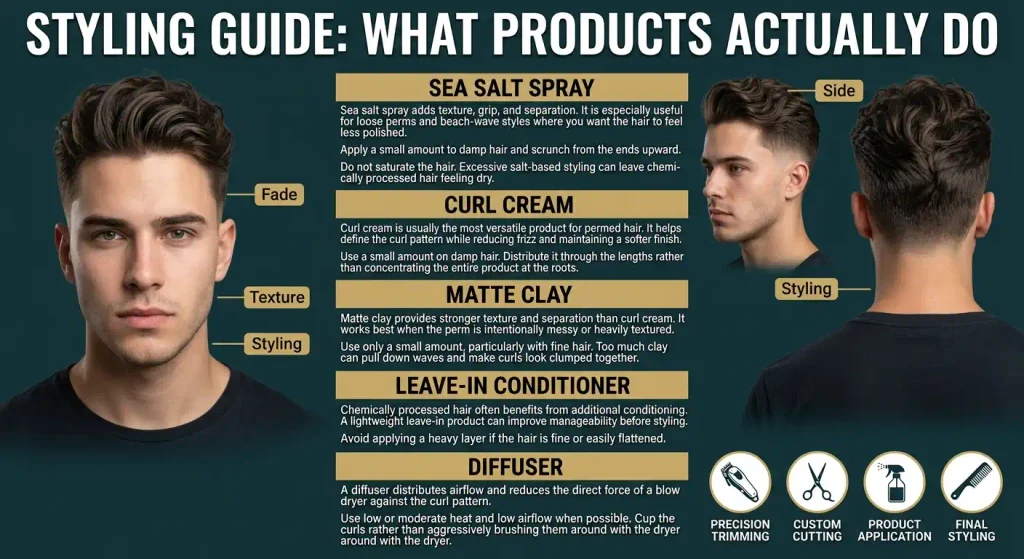
Curl Cream
Curl cream is usually the most versatile product for permed hair. It helps define the curl pattern while reducing frizz and maintaining a softer finish.
Use a small amount on damp hair. Distribute it through the lengths rather than concentrating the entire product at the roots.
Matte Clay
Matte clay provides stronger texture and separation than curl cream. It works best when the perm is intentionally messy or heavily textured.
Use only a small amount, particularly with fine hair. Too much clay can pull down waves and make curls look clumped together.
Leave-In Conditioner
Chemically processed hair often benefits from additional conditioning. A lightweight leave-in product can improve manageability before styling.
Avoid applying a heavy layer if the hair is fine or easily flattened.
Diffuser
A diffuser distributes airflow and reduces the direct force of a blow dryer against the curl pattern.
Use low or moderate heat and low airflow when possible. Cup the curls rather than aggressively brushing them around with the dryer.
How to Style a Perm With a Low Taper
Step 1: Start With Damp Hair
After washing, gently squeeze excess water from the hair.
Do not vigorously rub the hair with a towel because friction can increase frizz and disturb the curl pattern.
Step 2: Apply Your Main Product
Use curl cream for defined waves or curls.
For a loose, beachier look, use a small amount of sea salt spray first and then add a light cream.
Step 3: Shape With Your Fingers
Use your fingers to establish the direction you want.
For a middle part, separate the hair while damp. For a fringe, direct the front forward. For a flow, guide the top backward.
Step 4: Scrunch
Gently squeeze the ends upward toward the scalp.
This encourages the curl pattern without stretching the hair straight.
Step 5: Diffuse
If you need additional volume, use a diffuser.
Keep the heat controlled and avoid constantly touching the curls while they dry.
Step 6: Finish
Once the hair is mostly dry, use your fingers to separate any curls that have clumped together.
Add only a tiny amount of matte clay if you need extra definition.
Barbering Process & Technical Considerations
A successful haircut starts with understanding the relationship between the permed top and the taper.
The taper itself may begin around #0, #0.5, or #1 depending on how clean the client wants the perimeter. The barber can then graduate through #1.5, #2, and #3 before transitioning into the longer side hair.
The exact guard sequence should not be treated as a universal formula. Head shape, density, hair color, and the desired contrast all affect the appropriate transition.
For the longer top, scissors are usually more useful than relying entirely on clippers. Point cutting can introduce separation and reduce a bulky appearance, while excessive thinning can create unwanted frizz in chemically processed hair.
A particularly important rule is to assess the hair in its finished texture. Permed hair does not always behave like straight hair of the same stretched length.
How Often Should You Maintain It?
A practical maintenance cycle is approximately 2–4 weeks for the taper, depending on how quickly the edges grow and how sharp you want the perimeter to remain.
The perm itself does not need to be repeated every time you visit the barber. The chemically altered hair gradually grows out, while the new growth retains its natural texture.
For a longer-lasting result:
- Refresh the taper approximately every 2–4 weeks.
- Avoid unnecessary chemical processing.
- Keep the hair conditioned.
- Trim damaged ends when needed.
- Avoid excessive heat.
- Use a diffuser rather than high direct heat.
- Tell the barber that the top is permed before cutting.
Published men’s perm guides commonly describe the texture as lasting for several months while the taper requires substantially more frequent maintenance.
Common Mistakes to Avoid
Taking the Taper Too High
A high transition can make the permed top appear disconnected from the sides.
If you specifically want a low taper, explain that the shortened area should remain concentrated around the sideburns and neckline.
Choosing a Rod Size From a Photograph Alone
The same hairstyle photograph can look different depending on hair density, length, porosity, and natural texture.
Show the stylist the amount of curl you want rather than assuming the same rod size will reproduce the image exactly.
Cutting Too Much Length
Permed hair contracts when the curl forms.
Removing too much length beforehand can leave the finished haircut substantially shorter than expected.
Over-Thinning the Top
Thinning shears can be useful in the right situation, but excessive thinning can make chemically treated hair appear frizzy or uneven.
Point cutting and strategic layering can sometimes create the desired separation with less disruption.
Using Heavy Pomade
Heavy products can flatten loose waves and make defined curls look greasy.
Choose products according to the desired finish rather than simply selecting the strongest hold available.
Washing Too Aggressively
Permed hair benefits from gentle handling.
Use a suitable shampoo and conditioner, avoid excessive hot-water exposure, and don’t aggressively scrub or towel-dry the curls.
Ignoring Existing Chemical Damage
If your hair is bleached, heavily colored, brittle, or already chemically processed, a perm requires additional caution.
Discuss the hair’s current condition with a professional before proceeding.
Copying the Exact Curl Pattern of Someone Else
Hair density and natural growth direction vary.
Use reference photos for the overall shape, then let the barber or stylist adapt the technique to your own hair.
How to Make the Perm Look More Natural
The biggest difference between a natural-looking perm and an overly processed appearance is usually uniformity.
Natural hair rarely produces identical curls from the hairline to the crown. Asking for variation in movement can create a more believable result.
A larger rod creates broader movement. A smaller rod creates more visible curl. Combining placement, length, layering, and styling direction can produce different visual effects without changing the entire haircut.
The taper should support that texture rather than compete with it.
Frequently Asked Questions
Is a perm with a low taper good for straight hair?
Yes. Straight hair can be chemically reshaped into waves or curls, and the low taper can keep the sideburns and neckline controlled. A larger rod is generally associated with a looser wave pattern, while tighter patterns require a different approach.
How long does a men’s perm last?
A men’s perm commonly lasts for several months, although the exact duration depends on hair type, processing method, growth rate, washing routine, and the desired curl pattern. The new hair that grows afterward will have the person’s natural texture.
Should I get the taper before or after the perm?
The sequence depends on the stylist’s technique and the desired result. The important point is that the barber or stylist should know about the perm and account for the finished curl pattern when determining the final length and shape.
What guard should I ask for with a low taper?
A useful starting conversation is a #0.5 or #1 around the shortest portion, gradually blending through #1.5, #2, and potentially #3. The exact sequence should be adjusted according to hair density, desired contrast, and head shape.
Is a loose perm better than a tight perm?
They create different visual effects rather than one universally better result. A loose perm produces broader movement and a softer appearance, while a tighter perm creates stronger curl definition and more visible texture.
Can I get a low fade instead of a taper?
Yes. A low fade removes more hair across the lower sides than a subtle taper. If you want the permed top to remain the dominant feature with a relatively conservative silhouette, a low taper may preserve more surrounding weight.
What product should I use after getting a perm?
Curl cream is a useful general-purpose option because it can define texture while maintaining a softer finish. Sea salt spray works for loose, textured waves, while a small amount of matte clay can add separation to messier styles.
How often should I get the taper cleaned up?
Most people can expect to refresh the taper roughly every 2–4 weeks if they want the edges consistently sharp. You do not necessarily need to repeat the chemical perm whenever you refresh the haircut.
Final Barber Checklist
Before your appointment, decide these five things:
- Curl pattern: loose wave, medium wave, or defined curl.
- Top length: short, medium, or long enough for a flowing style.
- Taper strength: subtle taper, taper fade, or low fade.
- Front shape: fringe, middle part, side part, quiff, or flow.
- Finish: natural, messy, textured, or polished.
Then show your barber or stylist a photograph that resembles the overall silhouette, not just the curl pattern.
That gives the professional enough information to adapt the cut to your actual hair.
Conclusion
A perm can completely change the movement and texture of men’s hair, but the haircut underneath determines how that new texture is framed. A low taper keeps the sideburns and neckline controlled while allowing the permed top to remain full, making the combination adaptable to loose waves, defined curls, fringes, middle parts, textured crops, flows, and modern mullets.
The strongest approach is to choose the curl pattern and overall silhouette first, then decide how much contrast you want around the sides. Keep the taper low if preserving the fuller shape is important, and make sure your barber knows the hair has been chemically processed before removing significant length.
With the right rod size, appropriate top length, controlled taper, and lightweight styling routine, this haircut can move from soft and natural to bold and highly textured without changing its basic structure.
Name: Ryan Cole
Role: Lead Grooming Editor, TaperHaircutGuide.com
Bio angle: Men’s grooming/style content researcher — 4+ years covering barbering trends, hairstyling terminology, and men’s style content for US audience. Cross-checks every guide with practicing barbers before publishing.