Low Taper Fringe Straight Hair: 52 Modern Styles & Barber Guide

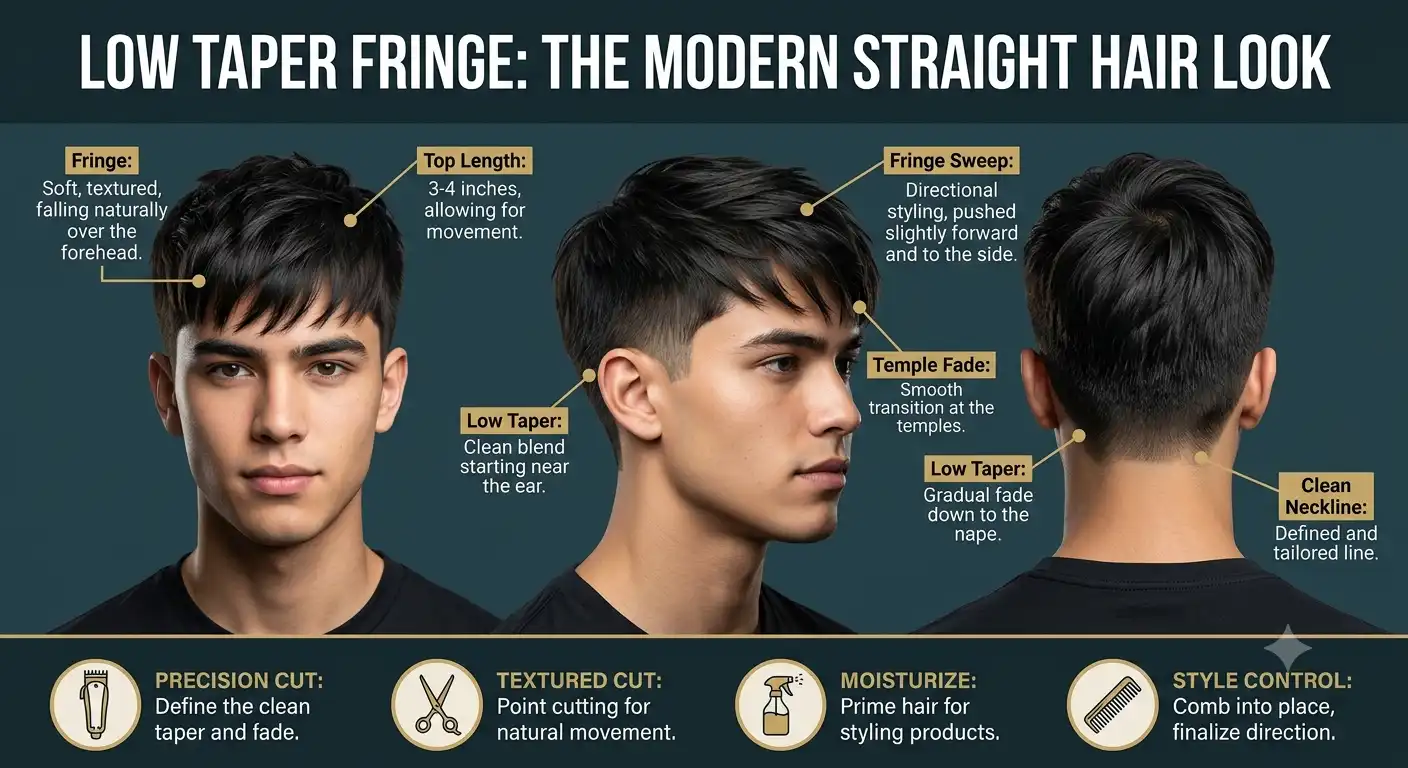
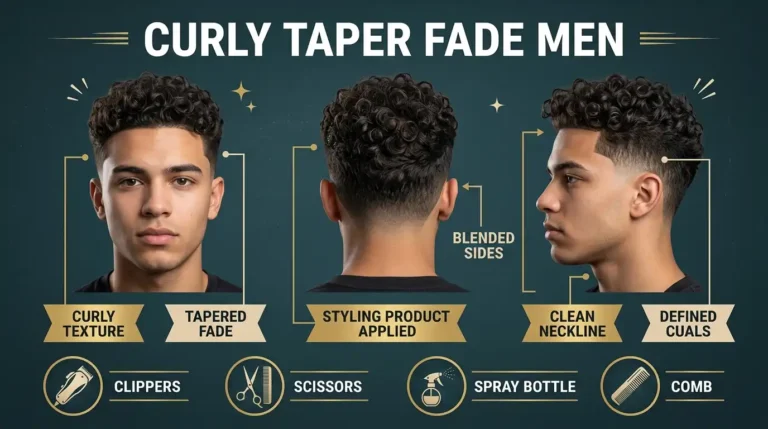
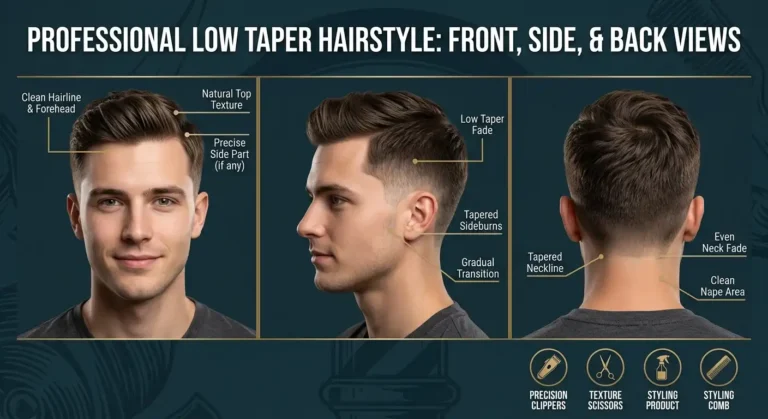
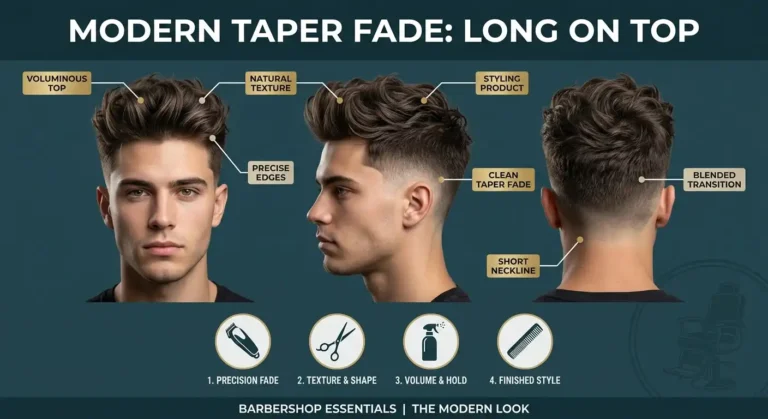
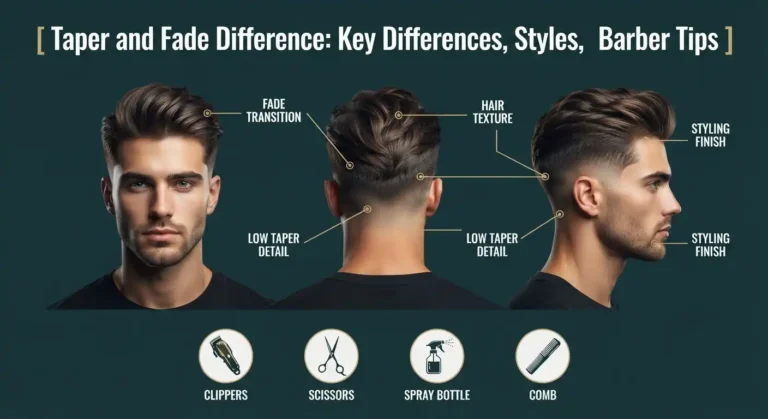
A low taper fringe straight hair haircut combines subtle clean edges around the ears and nape with a forward-falling fringe on top. The low taper cleans up the perimeter using clippers without taking off bulk higher up on the head.
Meanwhile, straight hair naturally falls forward over the forehead, creating an effortless, modern frame for the face. It is one of the most versatile hairstyles for men who want a sharp look that requires minimal daily effort.
Quick Key Takeaways & Overview Table
| Style Variation | Barber Guard Range | Best Face Shapes | Recommended Product | Key Feature |
| 01. Heavy Textured Crop Fringe | #1 to #3 lever closed | Oval, Square, Heart | Matte Clay | Thick forward layers with piecey separation |
| 02. Subtle Low Taper Textured Fringe | #2 to #4 tapered | Round, Diamond | Sea Salt Spray | Soft perimeter transition with light top movement |
| 03. Choppy Point-Cut Fringe | #1 to #3 lever open | Oval, Heart | Styling Dust / Powder | Vertical razor cuts for jagged natural texture |
| 04. Blunt Micro Fringe | #0 to #2 low blend | Square, Oval | Firm Hold Pomade | Sharp horizontal line across mid-forehead |
| 05. Mid Taper with Textured Fringe | #1 to #3 mid height | Round, Oval | Matte Paste | Slightly higher side blend to narrow full cheeks |
52 Low Taper Fringe Styles for Straight Hair
Category 1: Textured & Choppy Variations
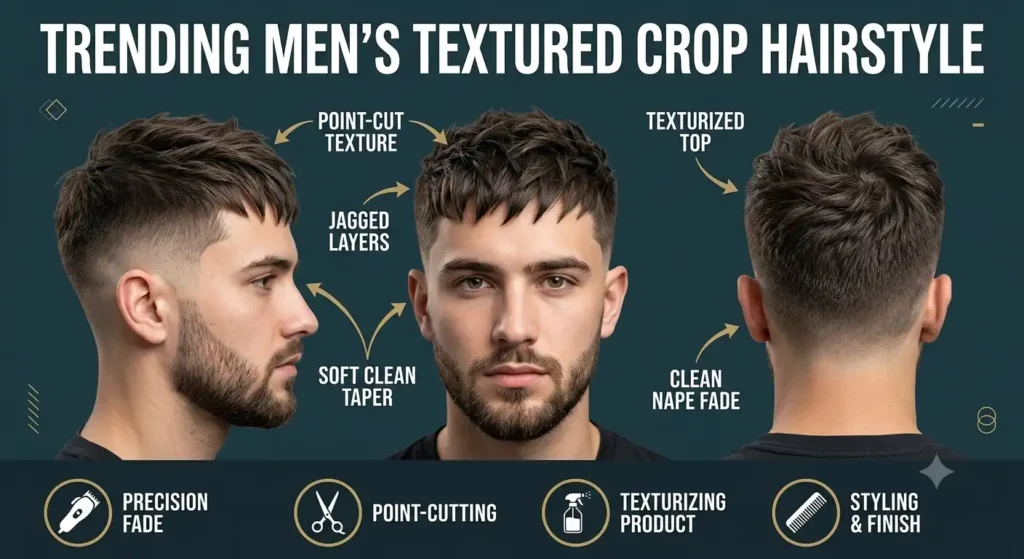
01. Heavy Textured Crop Fringe
Thick straight hair often lies flat without internal weight removal. This style uses heavy point cutting along the top to break up density while keeping the fringe falling straight down. The taper stays low around the sideburns and neckline using a #1 to #3 guard transition. Works best on oval and square faces. Apply a dime-sized amount of matte clay to dry hair to define individual strands.
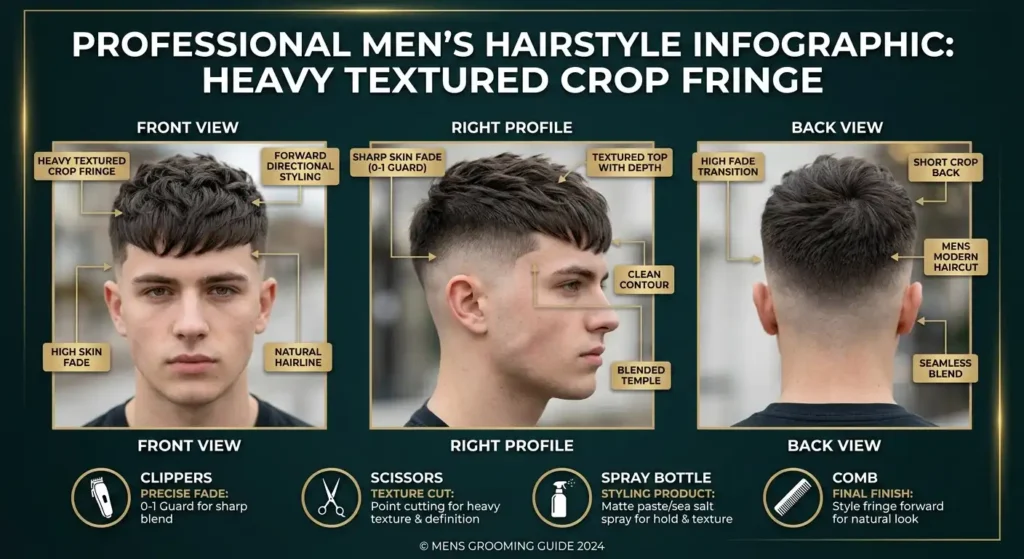
02. Soft Layered Fringe
Instead of sharp razored points, this cut relies on soft scissor layers throughout the top canopy. Straight hair cascades smoothly across the forehead without harsh horizontal lines. A clean #2 guard low taper keeps the temple areas neat without exposing skin. Suited for heart and diamond face shapes that benefit from softer forehead framing. Style with a lightweight grooming cream for flexible hold.
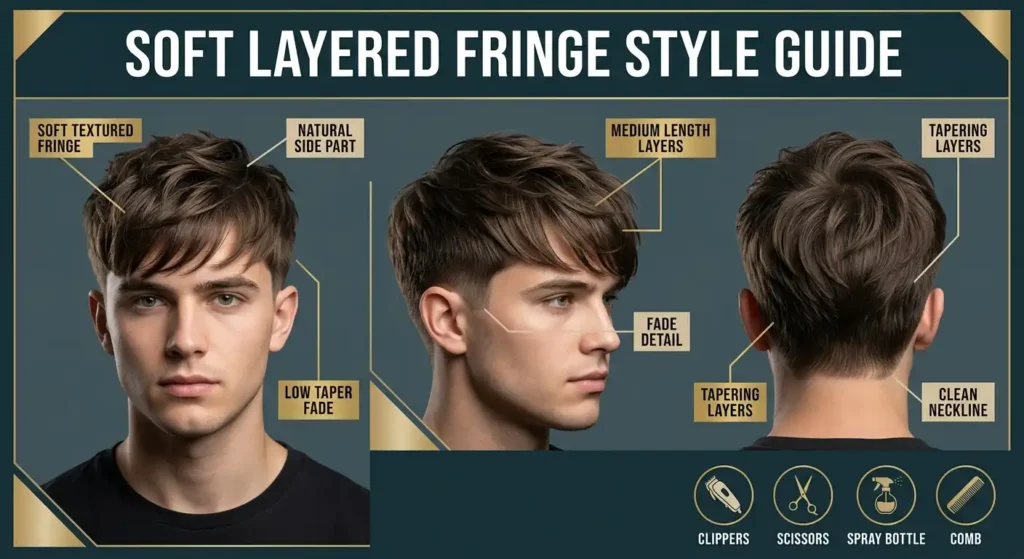
03. Choppy Point-Cut Fringe
Barbers cut vertical notches into the ends of the hair to create an intentional, jagged texture. This technique prevents straight hair from clumping into a solid wall across the brow. The low taper starts with a closed #1 guard at the bottom line and blends into a #3 near the temporal ridge. Ideal for round face shapes needing vertical visual relief. Use texturizing dust at the roots for instant separation.
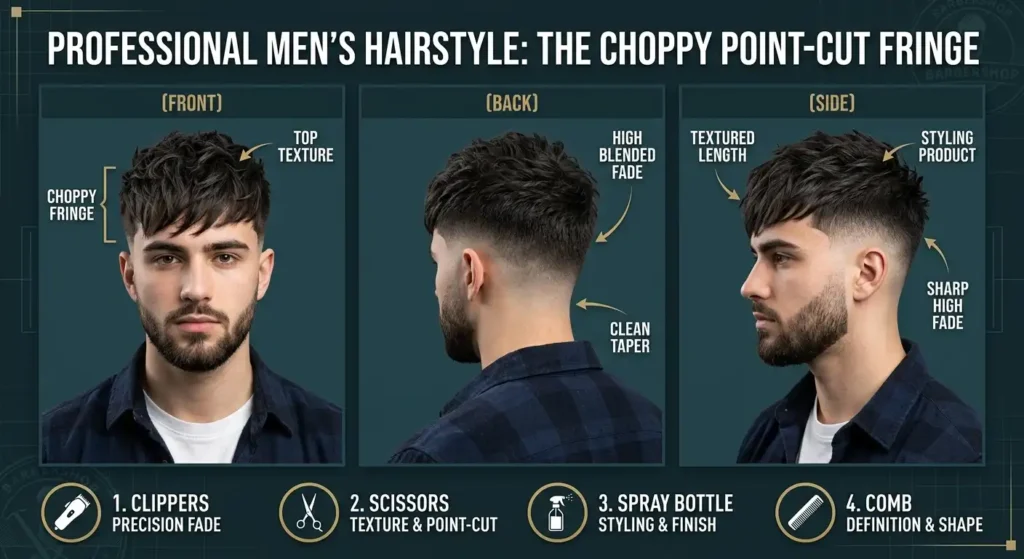
04. Low Taper Textured Fringe Straight Hair
This core variation focuses on creating defined texture along the fringe while maintaining a seamless low taper at the sideburns. Straight hair gets sliced internally to encourage piecey movement toward the front. The low taper preserves maximum hair density around the upper sides. Excellent for oval and heart-shaped faces. Work a small dab of matte paste through dry locks from back to front.
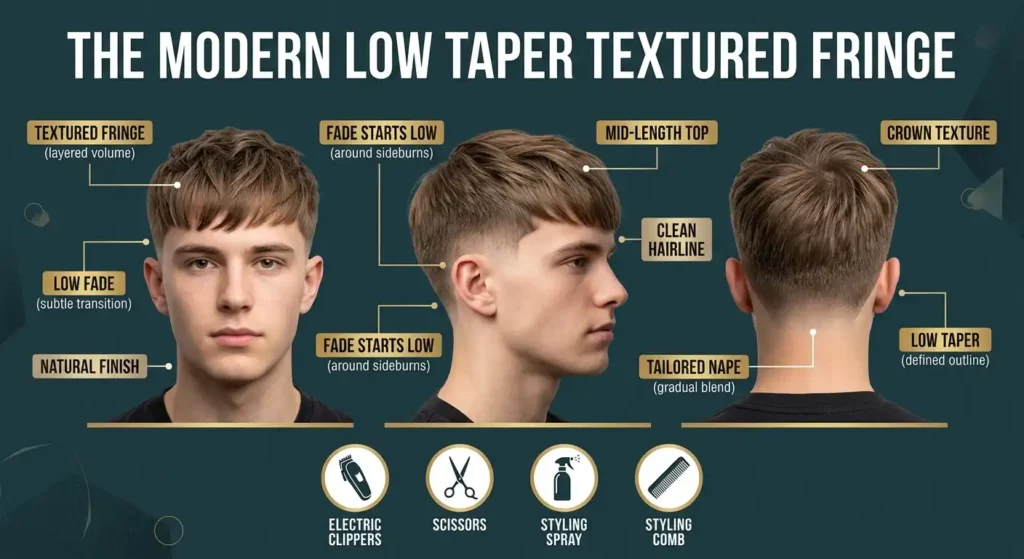
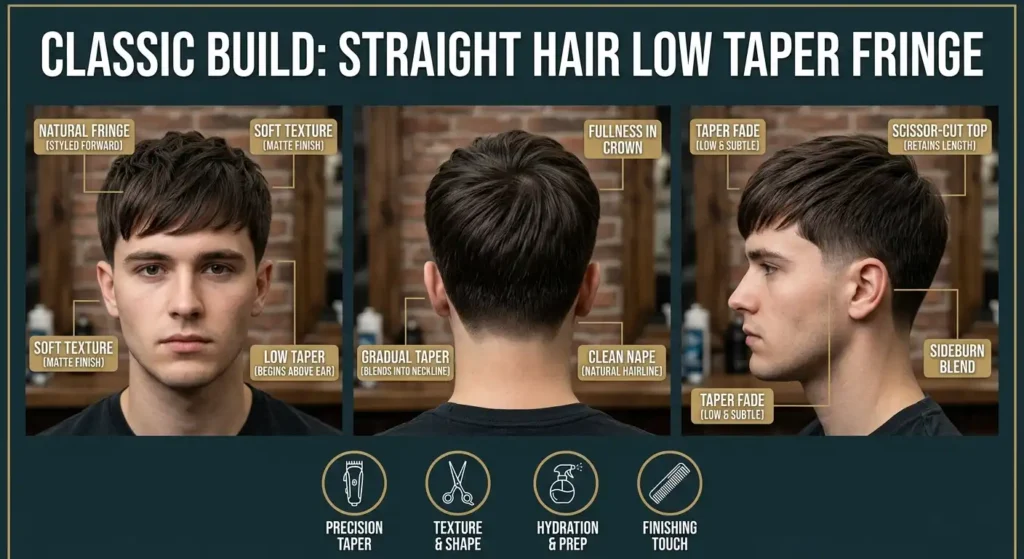
05. Straight Hair Low Taper Fringe Classic Build
A balanced approach where the top length remains uniformly 3 inches, combed directly forward over the brow line. The low taper gently fades the hairline surrounding the ears and nape using a #1.5 to #3 guard sequence. Perfect for men with straight fine hair who want to avoid over-thinning their locks. Shape with sea salt spray prior to blow-drying forward.
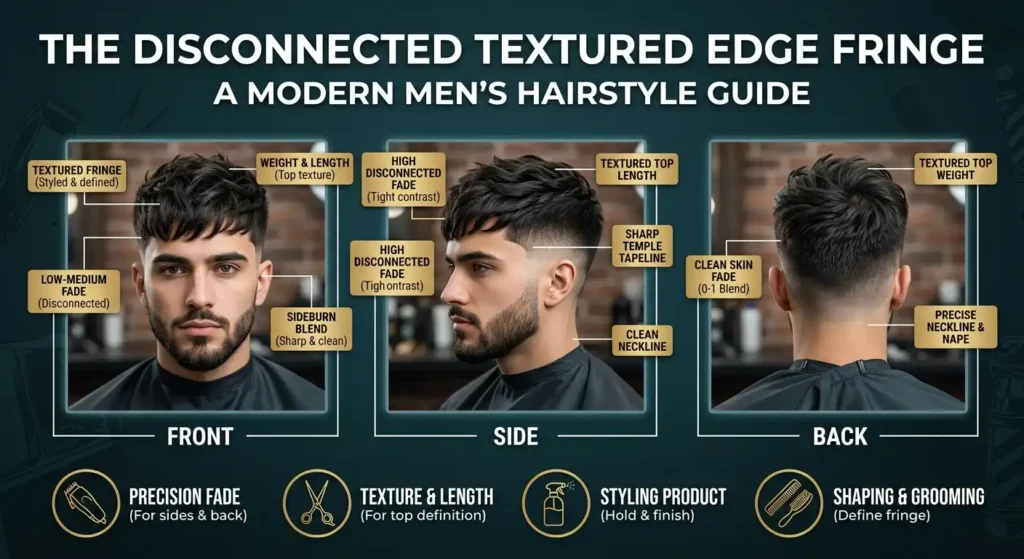
06. Disconnected Textured Edge Fringe
The forward fringe remains noticeably longer than the side sections, creating a subtle step down to the tapered temporal area. Point cutting softens the overhang so it sits naturally rather than looking like an undercut. A zero-gap clipper detail on the neckline keeps the perimeter razor-sharp. Best for oval face shapes. Style using a light clay wax to hold forward projection.
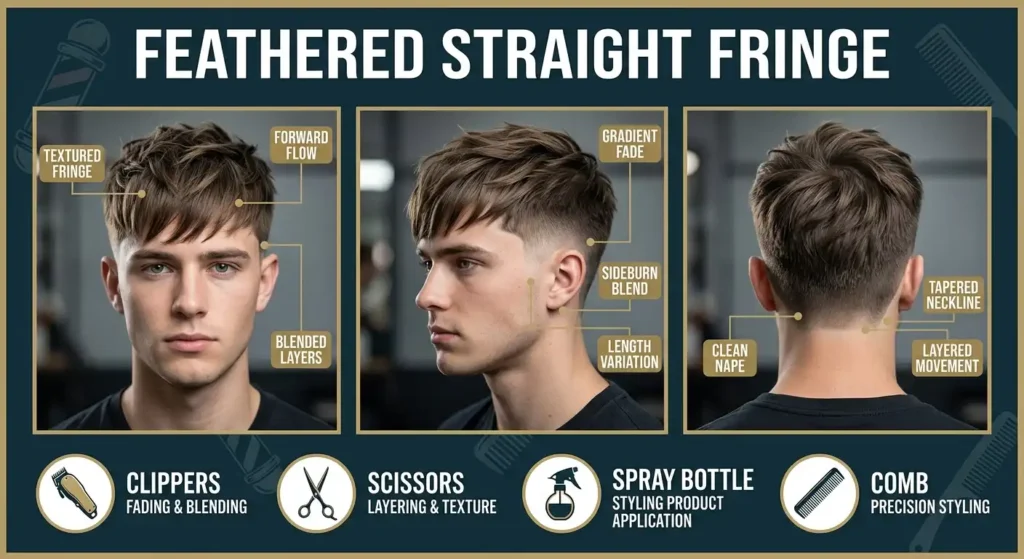
07. Feathered Straight Fringe
Scissor-over-comb techniques blend the top hair toward the front, yielding a feathered, lightweight texture that covers the forehead softly. The lower sideburns are tapered using a #2 guard lever open, ensuring a polished transition into facial hair or clean skin. Recommended for rectangular face shapes seeking to balance length. A mist of sea salt spray keeps the feathering airy.
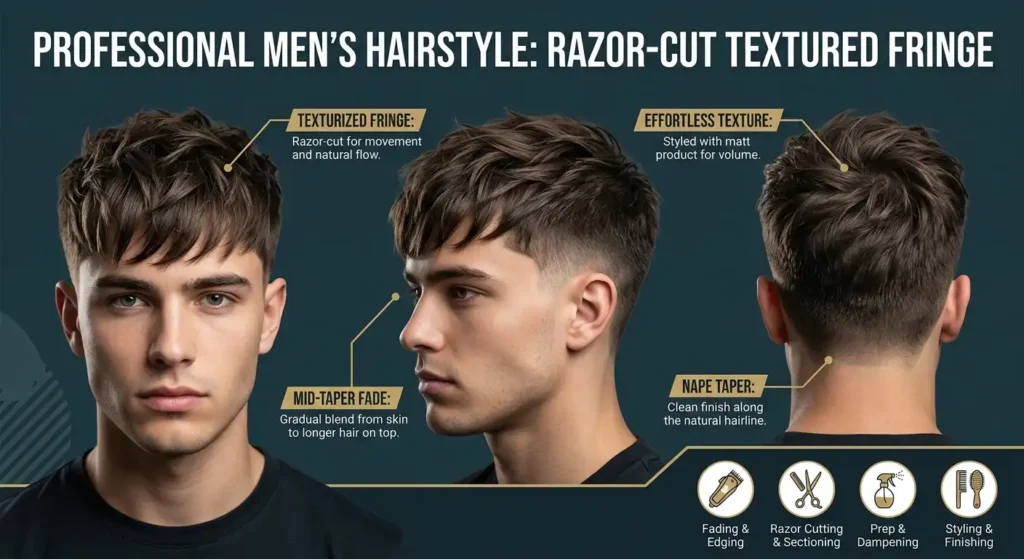
08. Razor-Cut Textured Fringe
Utilizing a straight razor on wet hair creates tapered hair ends that fall into sharp, fine-point pieces. This method gives naturally stiff straight hair a fluid, casual drop across the eyes. The lower neck and ears receive a clean #1 low taper blend. Fits square and oval bone structures. Rub a pea-sized portion of texturizing paste into the ends for grip.
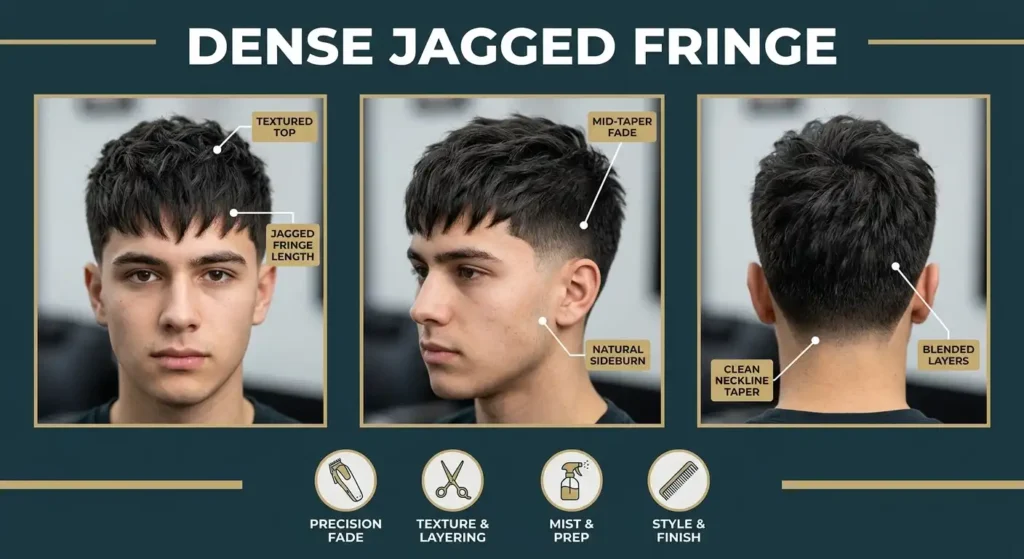
09. Dense Jagged Fringe
Designed for men with high hair density, this cut removes weight underneath while leaving a thick, choppy top overhang. The fringe lands right above the eyebrows in distinct blocky segments. The low taper stays low and tight, using guards #1 through #2. Ideal for round and heart faces. Style with high-hold matte mud to lock down stubborn straight strands.
Category 2: Classic & Clean Precision Cuts
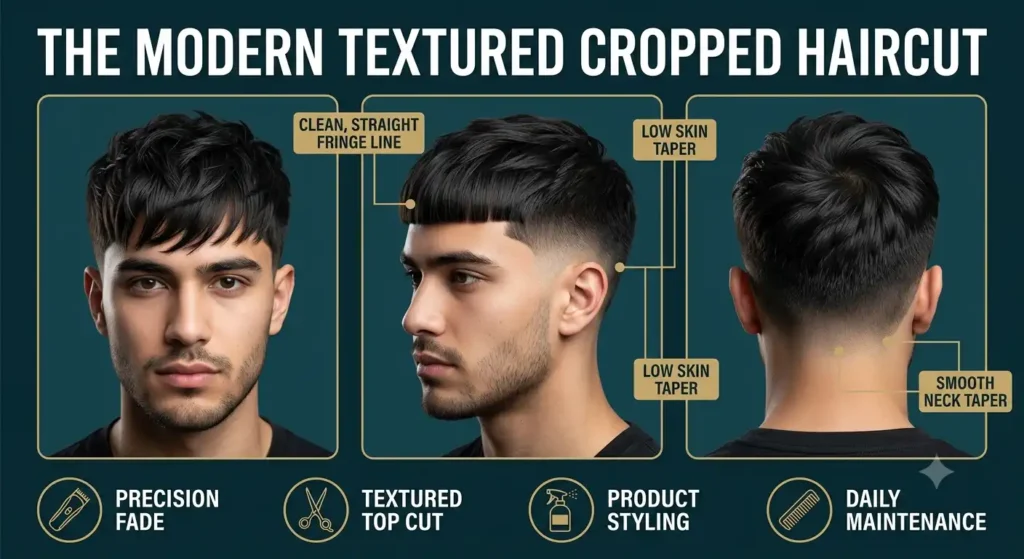
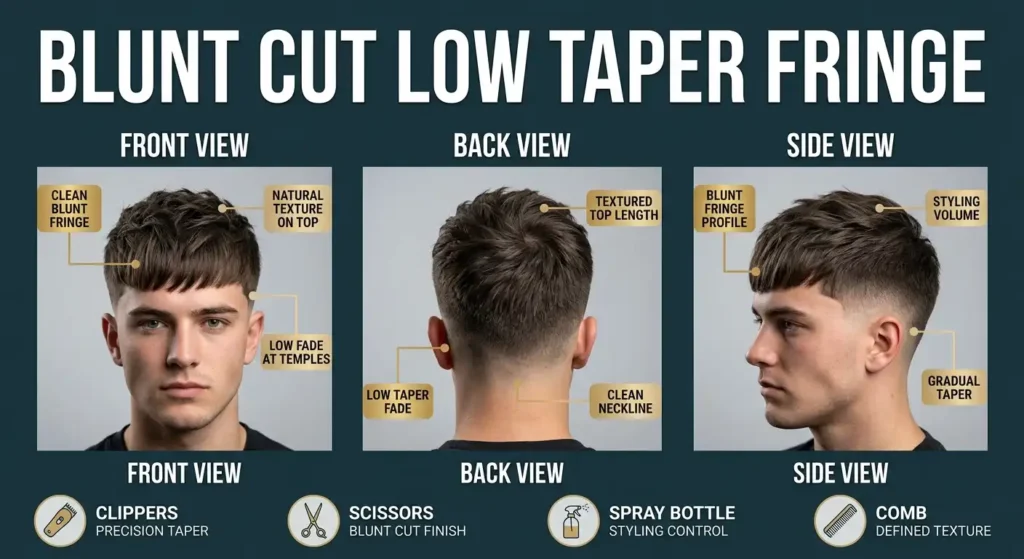
10. Blunt Cut Low Taper Fringe
A clean, straight-horizontal line defines the fringe across the forehead, contrasting sharply with the soft, faded sideburns. The low taper starts with a #0 or skin blend right at the ear notch before expanding into scissor work. Excellent for elongated or oval face shapes by visually shortening face height. Apply a light pomade for a sleek, uniform surface finish.
11. French Crop Straight Fringe
Taking inspiration from classic European cuts, the top is kept short (1.5 to 2 inches) and blunt-cut across the front. The low taper provides a subtle neck and sideburn blend with a #1 guard. Highly functional for active men and low-maintenance routines. Suits strong jawlines and square faces. Requires only a quick rub of matte paste on damp hair.
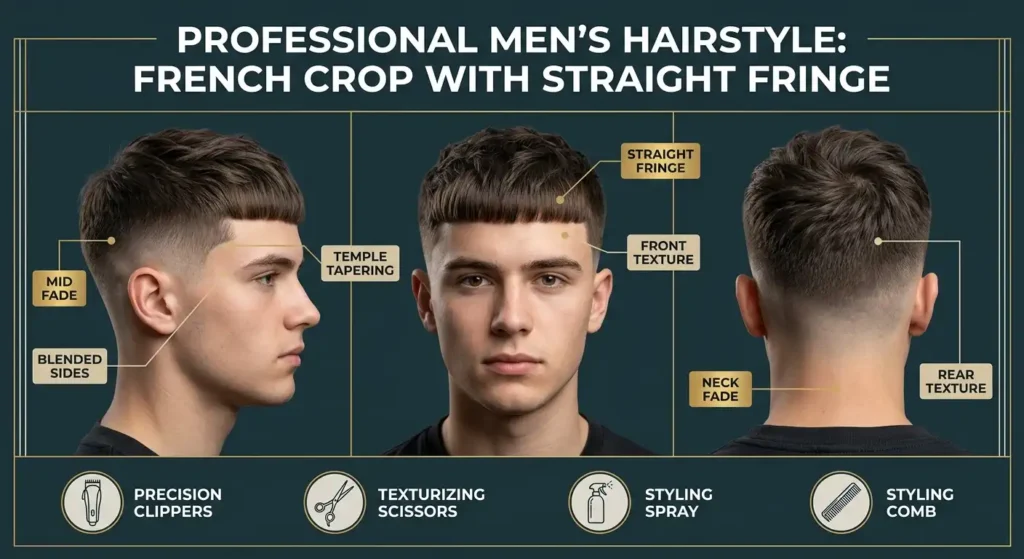
12. Taper Fringe Straight Hair Geometric Line
Precision scissors create a geometric edge along the front brow, paired with razor-lined temples that blend softly into a low taper. The contrast highlights the sharp natural straightness of the hair. Perfect for square and oval faces wanting a sharp aesthetic. Use a light grooming spray to smooth down stray hairs without adding oiliness.
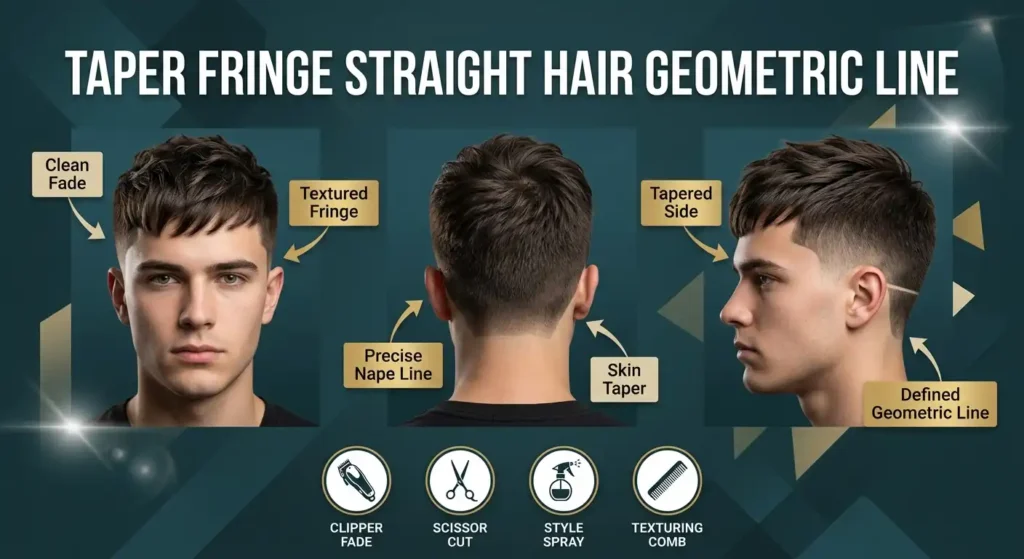
13. Minimalist Short Fringe
The fringe sits high on the forehead, roughly an inch above the eyebrows, while the sides feature a low taper blend from #1 to #3. This reduces daily styling time while keeping hair out of the eyes. Works exceptionally well on oval and diamond faces. Style with a tiny pinch of matte dust to keep the top lifted off the scalp.
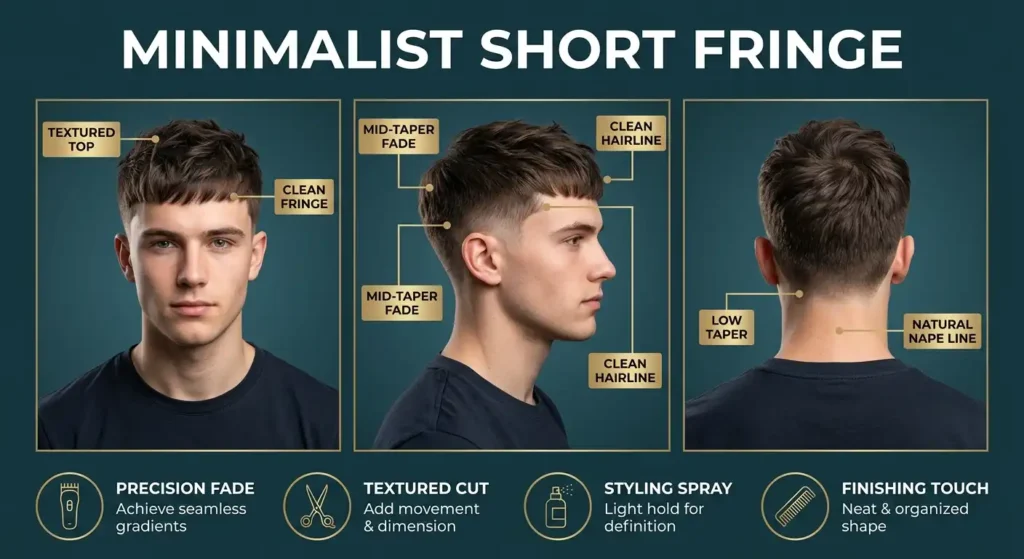
14. French Line Low Taper
A variation of the crop featuring an ultra-clean front line and a soft taper around the lower neckline. Scissor-over-comb work ensures no bulky shelf remains between the top and sides. Suited for oval and round faces that need a crisp framing effect. A light paste keeps the forward lay intact through long days.
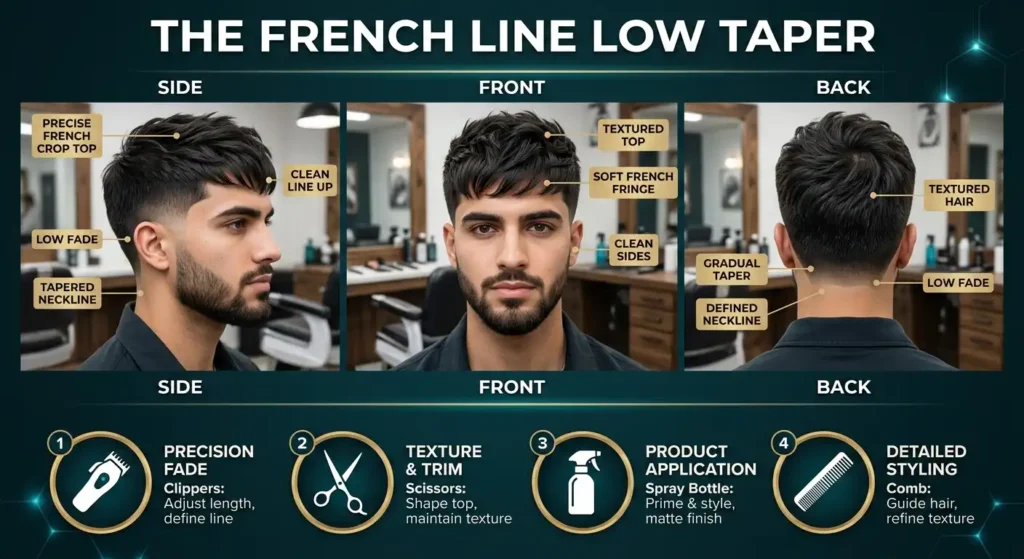
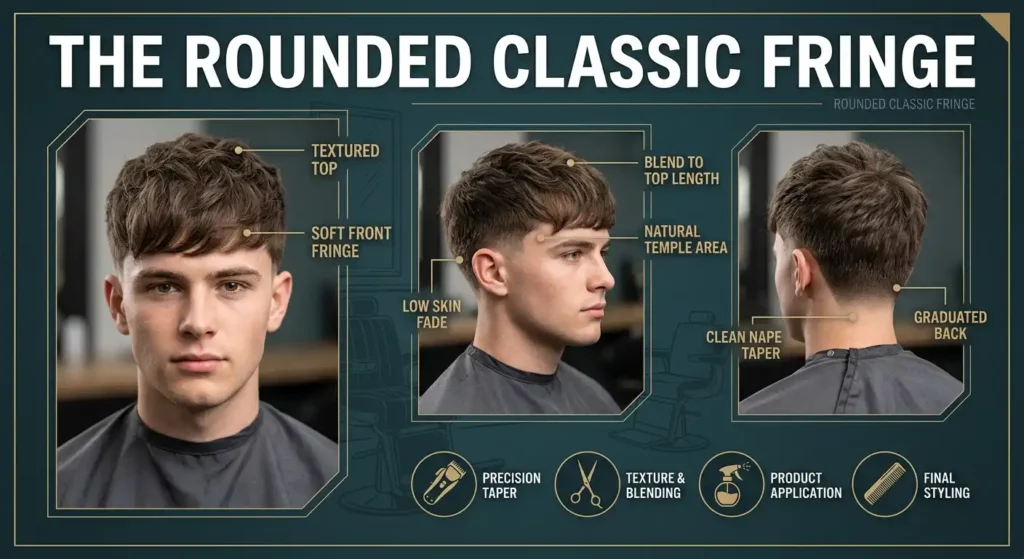
15. Rounded Classic Fringe
Instead of a sharp horizontal cut, the front fringe follows a soft parabolic curve around the brow line. The low taper cleans up the burn area with a #2 guard. Great for balancing sharp angular features on diamond or square face shapes. Style by combing forward with a wide-tooth comb and a touch of light cream.
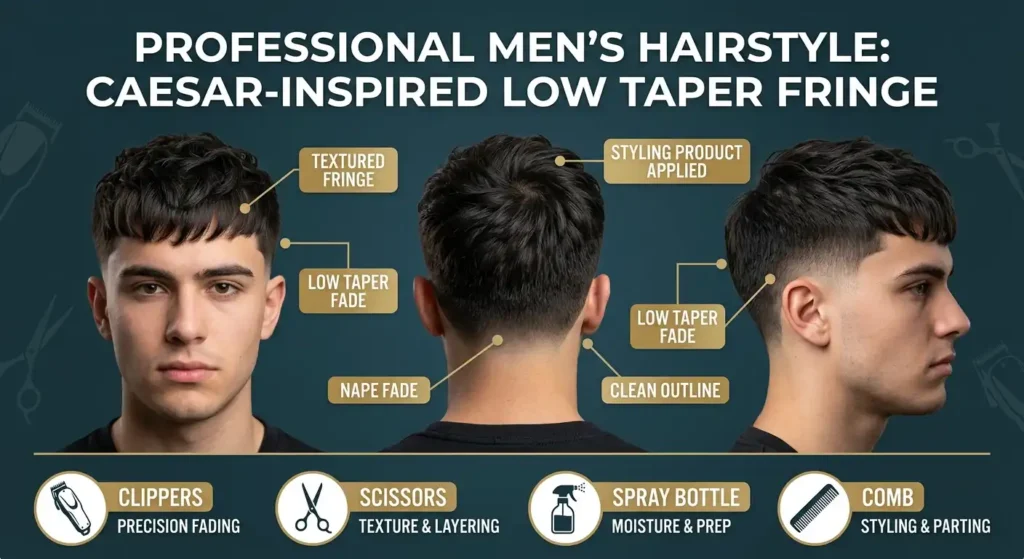
16. Caesar-Inspired Low Taper Fringe
Short, uniform layers (around 1.5 inches) sweep forward into a small horizontal fringe over the forehead. The low taper keeps the neck and temples tight using a #1 closed lever. Perfect for men with busy schedules or thinning temporal corners. Apply a small dab of matte clay to secure the forward alignment.
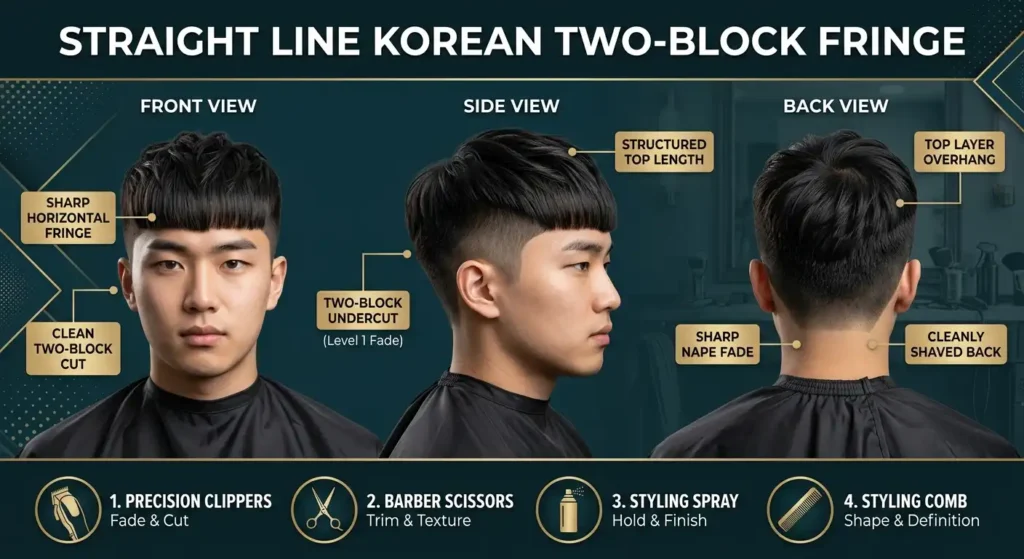
17. Straight Line Korean Two-Block Fringe
Popularized by East Asian street style, the top section hangs over a clean lower taper like a bowl, but with textured ends that soften the perimeter. The low taper uses a #2 guard underneath to reduce side volume. Ideal for oval and heart shapes. Style with a blow-dryer aimed straight down, followed by light serum.
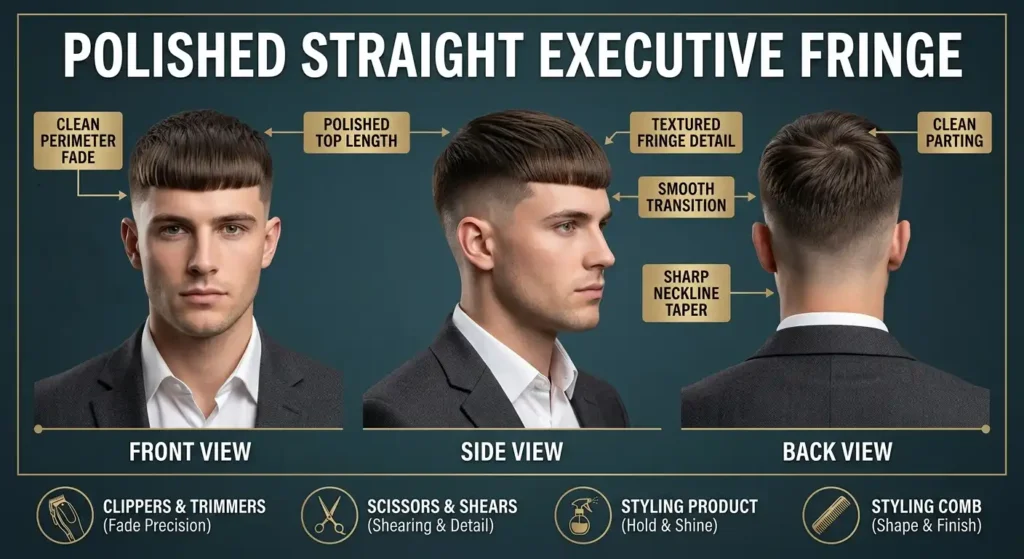
18. Polished Straight Executive Fringe
A neat, professional iteration where the fringe length is kept tidy above the brows and combed straight down with precision. The low taper uses a conservative #2 to #4 guard blend for an office-ready finish. Best for round and oval faces. A light-hold styling cream adds a subtle healthy sheen without greasy shine.
Category 3: Messy, Voluminous & Fluffy Looks
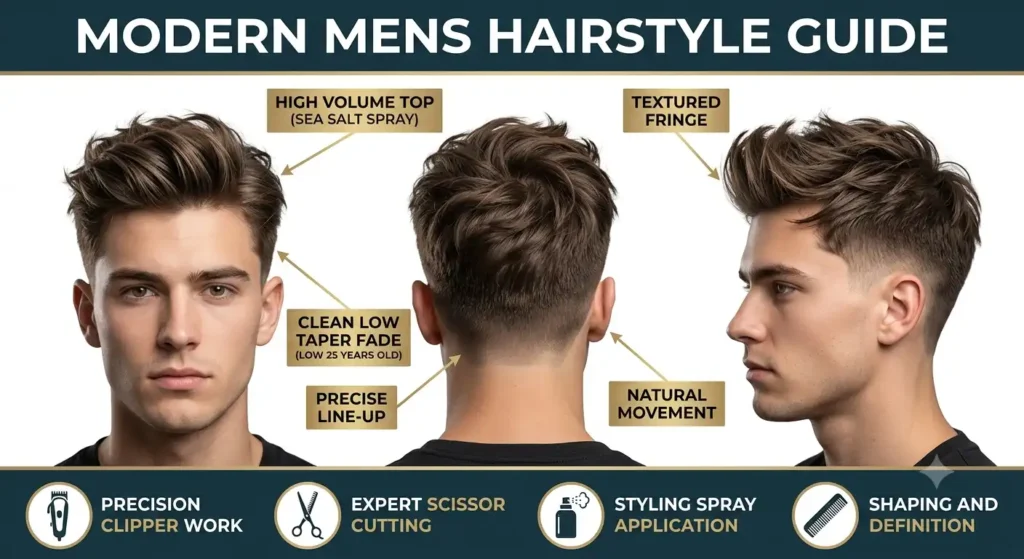
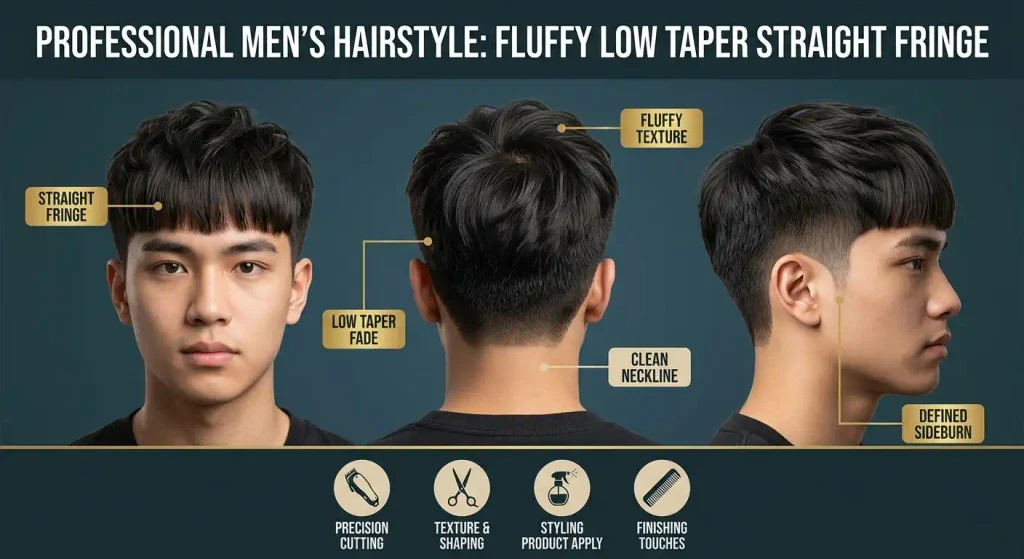
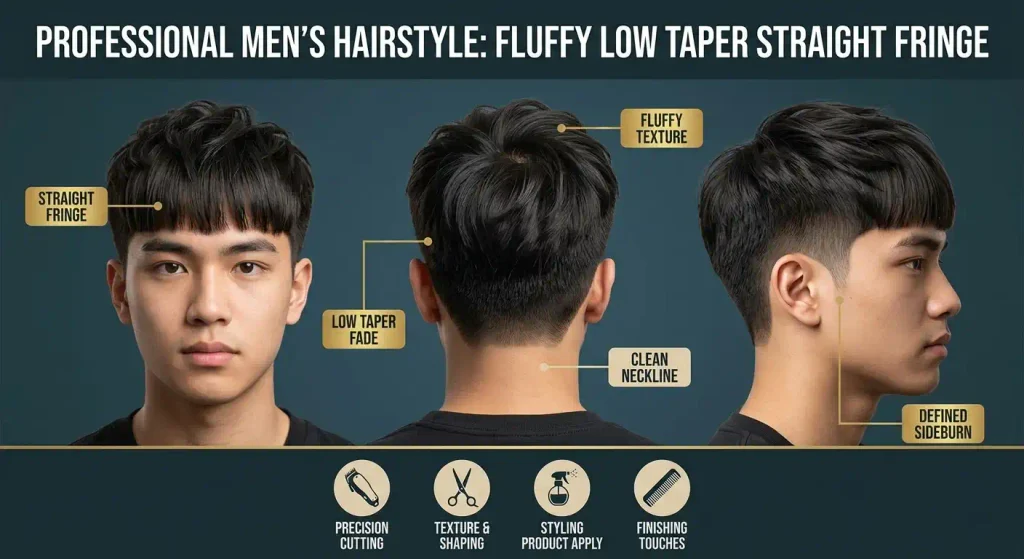
19. Fluffy Low Taper Straight Fringe
Straight hair can look flat, but blowing it dry upward with a round brush creates airy volume that cascades back down loosely. The low taper (#1 to #3) keeps the sides structured so the overall silhouette does not look mushroomed. Excellent for thin or fine straight hair on oval faces. Use sea salt spray as a pre-styler.
20. Messy Fringe Fade Straight Hair
This cut relies on slithering scissor cuts through the interior canopy to break up straight hair stiffness, allowing it to be tousled in multiple directions. The lower perimeter is faded down to skin or a #0.5 guard right around the ears. Great for square and heart faces. Work a nickel-sized amount of matte clay through dry hair.
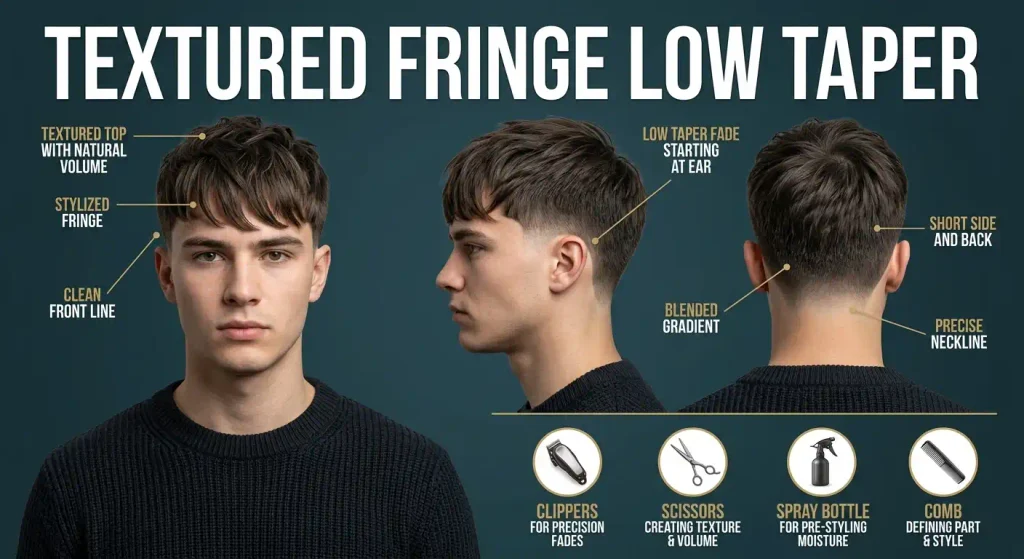
21. Textured Fringe Low Taper Straight Hair
By combining texturizing shears with forward blow-drying, this look gives straight hair an effortless bedhead appearance. The low taper cleans the neckline using a #1 guard lever open. Best suited for oval and round face shapes that want volume up top. Style with root-lifting texture powder for lasting structure.
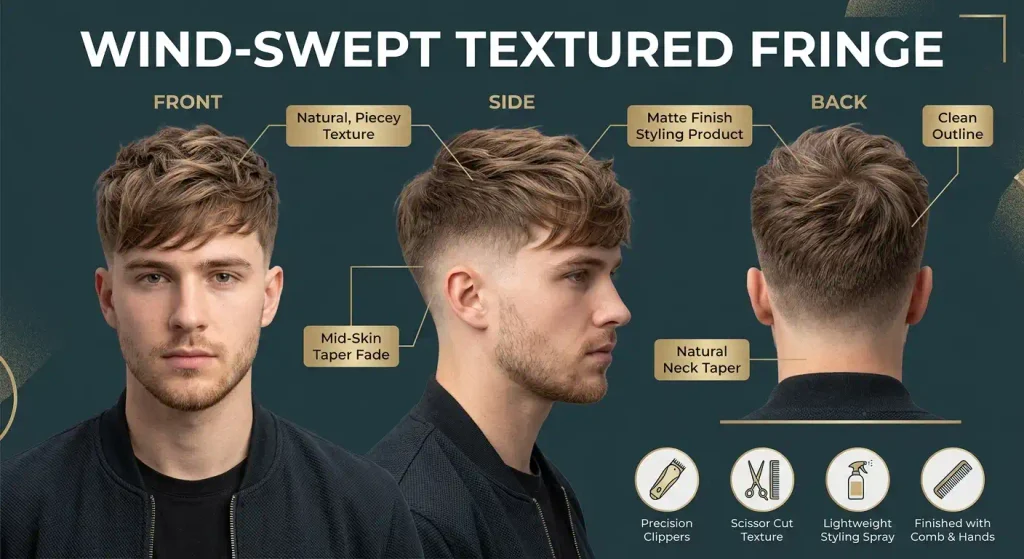
22. Wind-Swept Textured Fringe
Hair is styled forward and slightly to one side using finger-combing to create an asymmetric, wind-swept drape. The low taper keeps the temples tight with a #1.5 guard to emphasize top motion. Ideal for diamond and heart face shapes. Apply a flexible-hold wax to maintain loose, touchable shape.
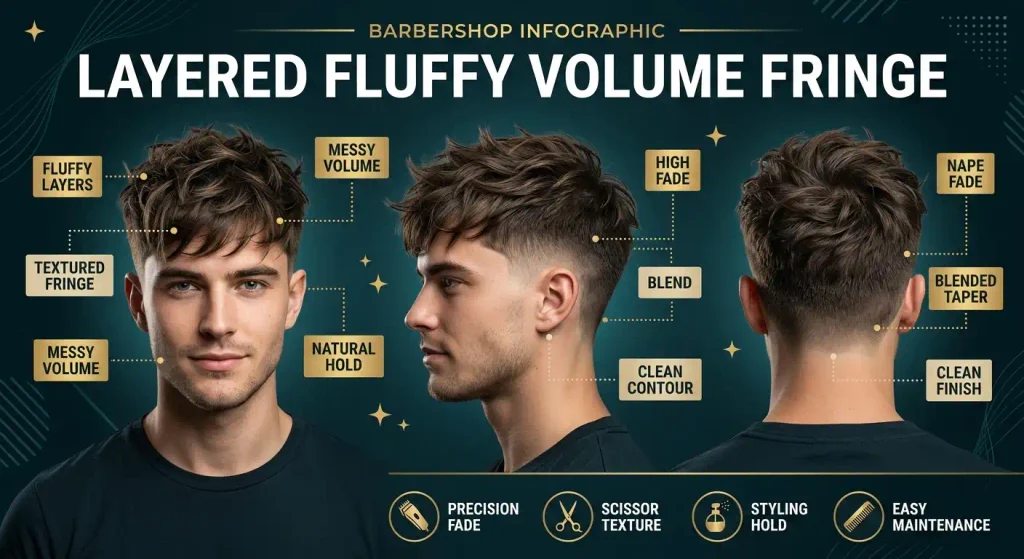
23. Layered Fluffy Volume Fringe
Deep Scissor layers created from the crown forward build natural height and fluffiness through the fringe section. A low taper using a #2 guard prevents side volume overhang. Recommended for oval faces needing balanced proportions. Pre-style with volume mousse before blow-drying forward and upward.
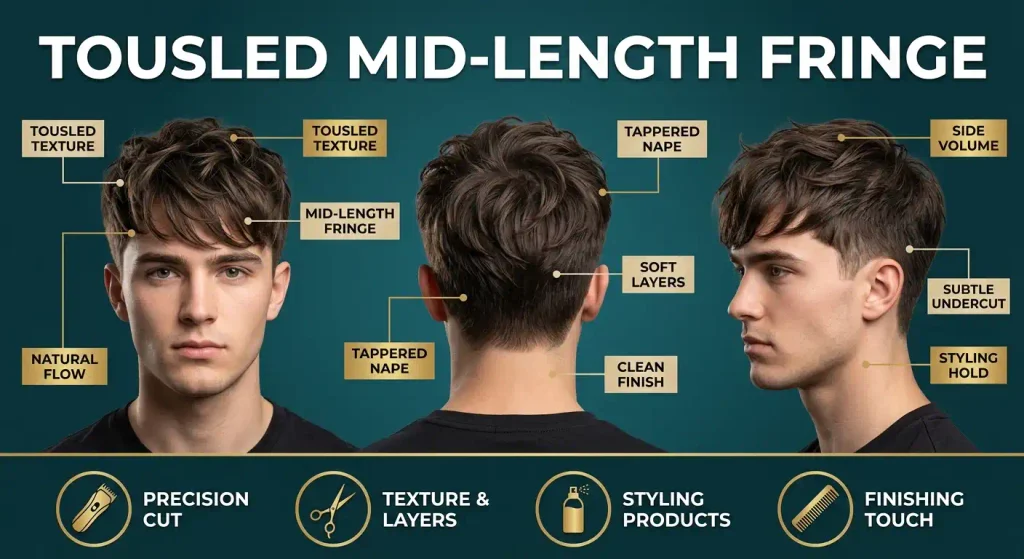
24. Tousled Mid-Length Fringe
Measuring roughly 3.5 to 4 inches up top, hair falls naturally over the eyebrows in an unstudied, casual manner. The low taper maintains clean edges along the ears without removing neck length. Perfect for square and rectangular face shapes. Use a sea salt spray and air-dry for organic texture.
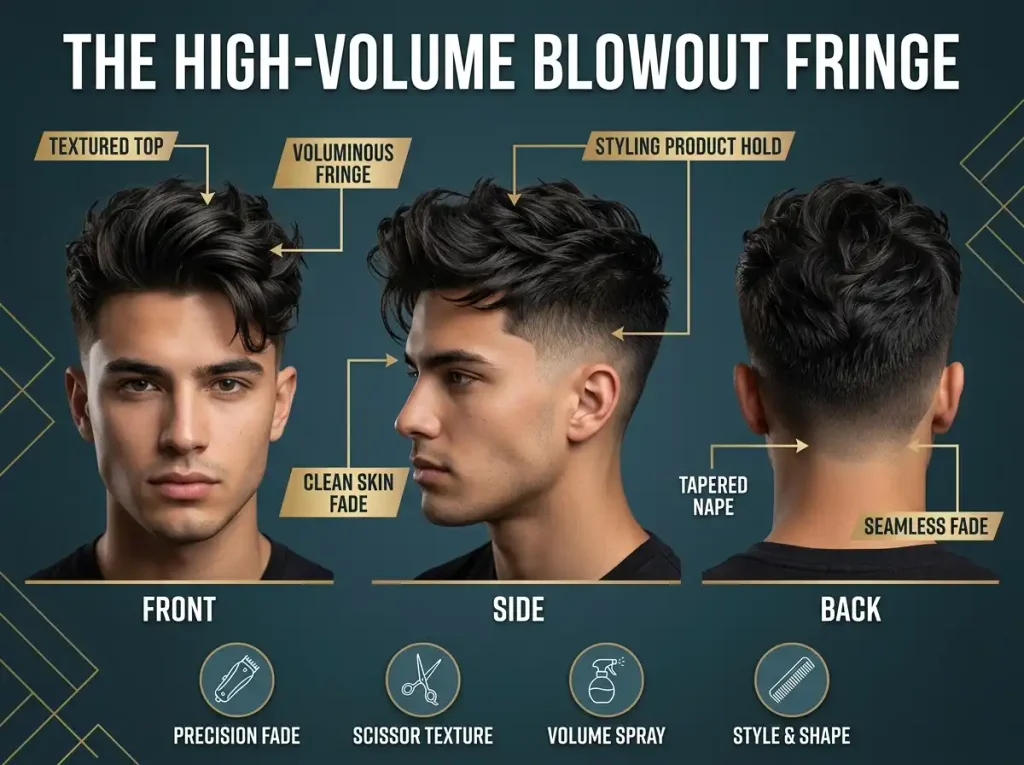
25. High-Volume Blowout Fringe
A blow-dryer with a concentrator nozzle lifts the roots straight up before letting the tips curl downward toward the forehead line. The low taper provides a crisp anchor around the perimeter using a #1 guard. Fits round and oval face shapes. Lock in the volume with a dusting of hair powder.
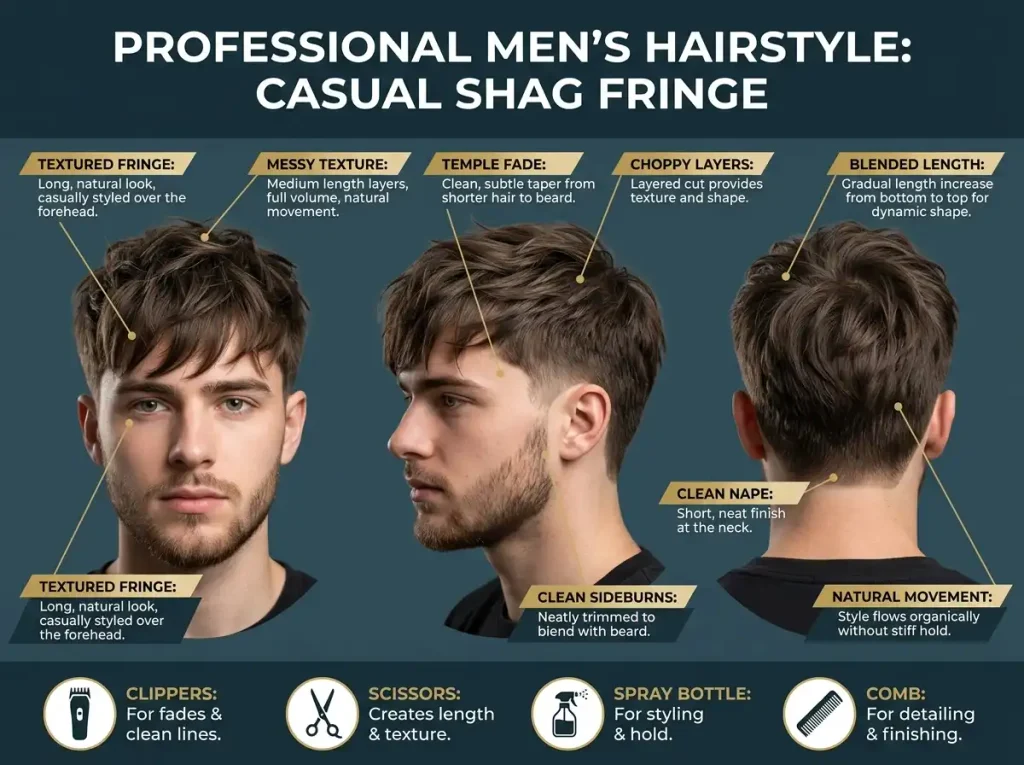
26. Casual Shag Fringe
Longer straight layers fall randomly over the forehead, creating a relaxed, grunge-inspired fringe silhouette. The low taper keeps the neckline neat using a #2 to #4 guard shift. Suited for heart and diamond face shapes. Style with a light cream paste applied through wet hair and air-dried naturally.
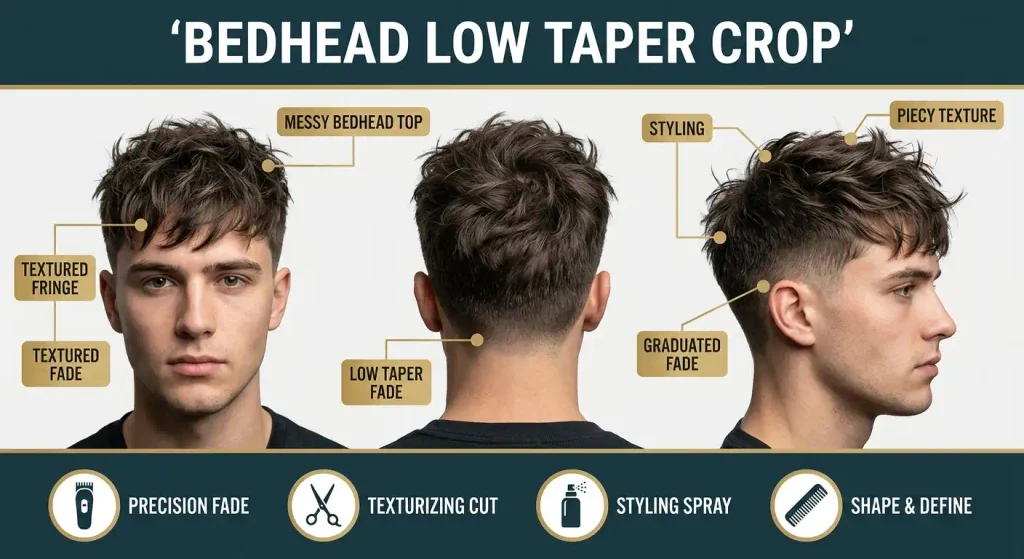
27. Bedhead Low Taper Crop
A short-to-medium choppy top layered for maximum random movement, styled forward with fingers rather than a comb. The low taper stays low around the ears using a #1 closed guard. Great for square and oval faces. Use a matte clay paste to twist small locks into defined pieces.
Category 4: Modern Hybrid & Two-Block Styles
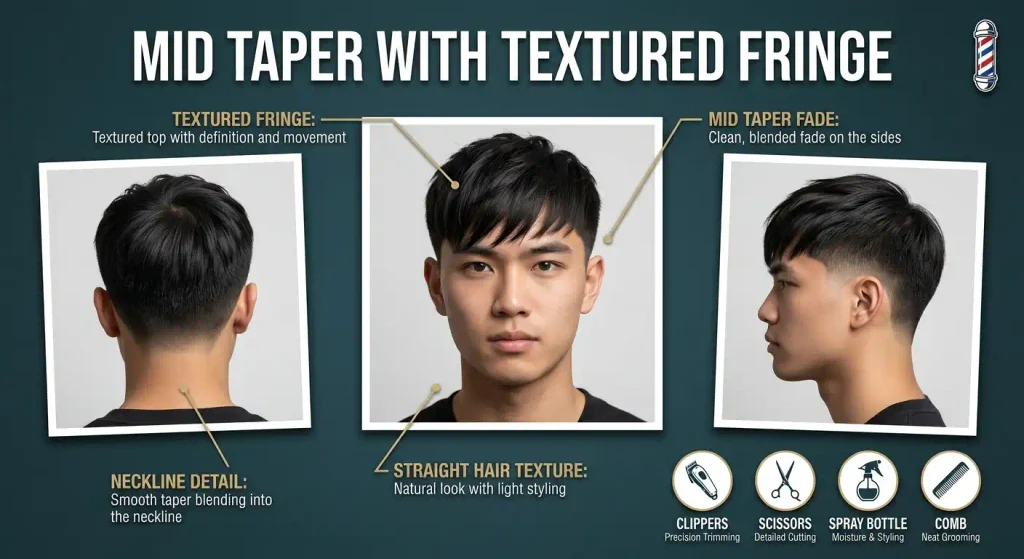
28. Mid Taper with Textured Fringe Straight Hair
Bridging classic low and mid heights, the side blend rises slightly higher above the ear while keeping the textured forward fringe as the main focal point. Scissor point-cutting breaks up top weight. Fits round and oval face shapes by streamlining side density. Apply a matte clay for structured hold.
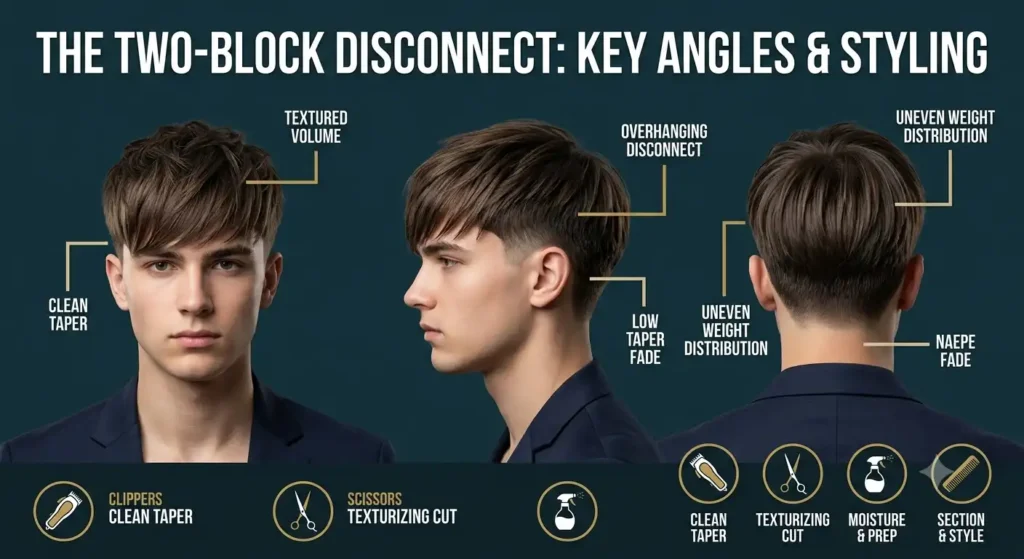
29. Two-Block Low Taper Fringe
The top canopy remains completely disconnected from the lower sides, falling freely over a short #2 guard low taper. Straight hair falls into a smooth curtain-like fringe across the forehead. Excellent for thick Asian hair types and oval faces. Style with light blow-drying and a drop of smoothing hair oil.
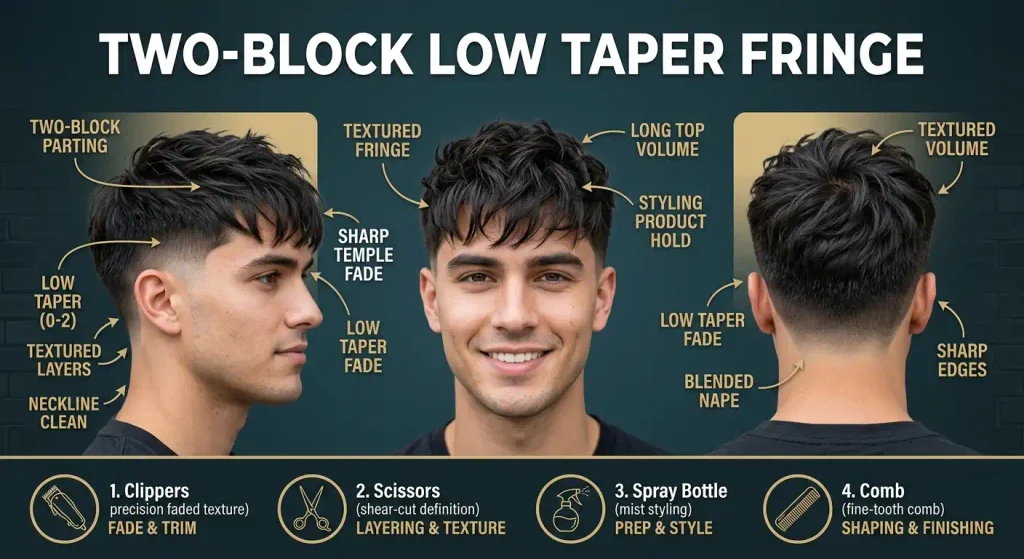
30. Taper Fade Textured Fringe Straight Hair
Combines a skin-level low taper fade at the lower neckline and sideburns with heavily texturized top length falling forward. The contrast between skin and dense top hair creates a sharp modern aesthetic. Ideal for square and heart face shapes. Use texturizing dust at the crown and fringe.
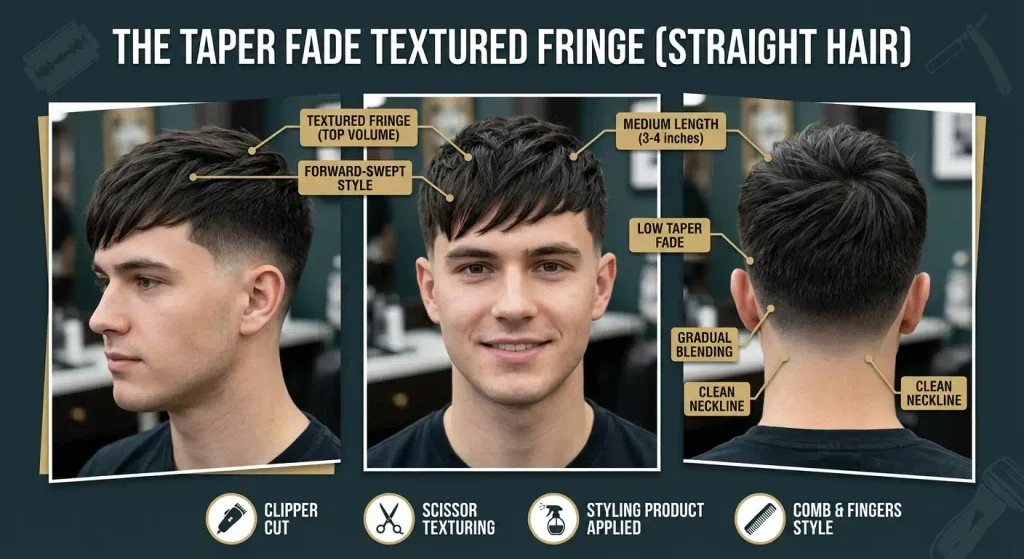
31. Textured Fringe Low Fade Straight Hair
Fading the sides down to skin just above the ear notch while maintaining a full textured fringe on top creates a clean, lightweight hybrid look. Point-cut ends prevent a boxy top silhouette. Fits oval and round face shapes. Style using a lightweight styling cream or matte clay.
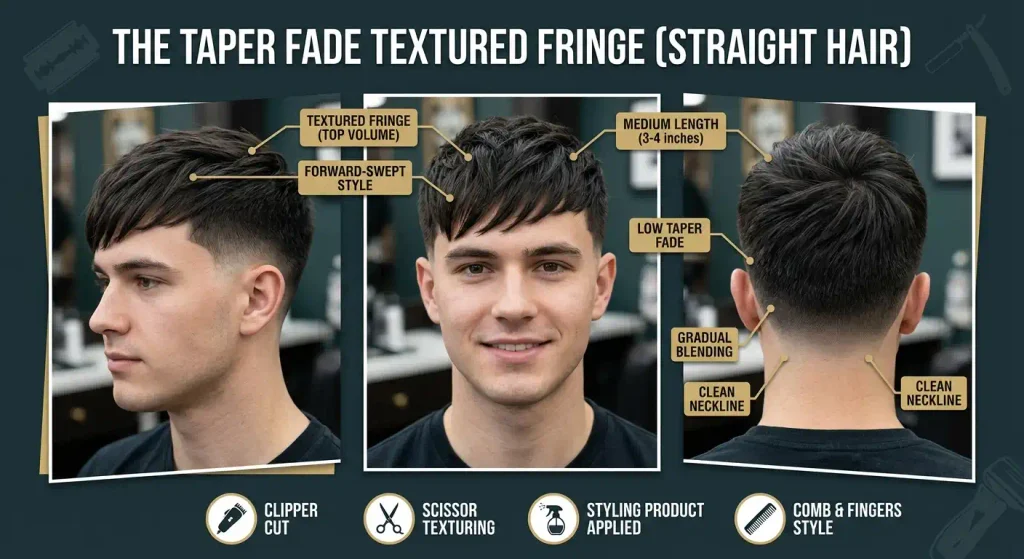
32. Curtain Fringe Low Taper
Straight hair is parted down the middle or slightly off-center, allowing the fringe to frame both sides of the forehead while falling forward. A low taper (#2 guard) keeps sideburns immaculate. Great for heart and oval faces. Blow-dry away from the center part and set with light spray.
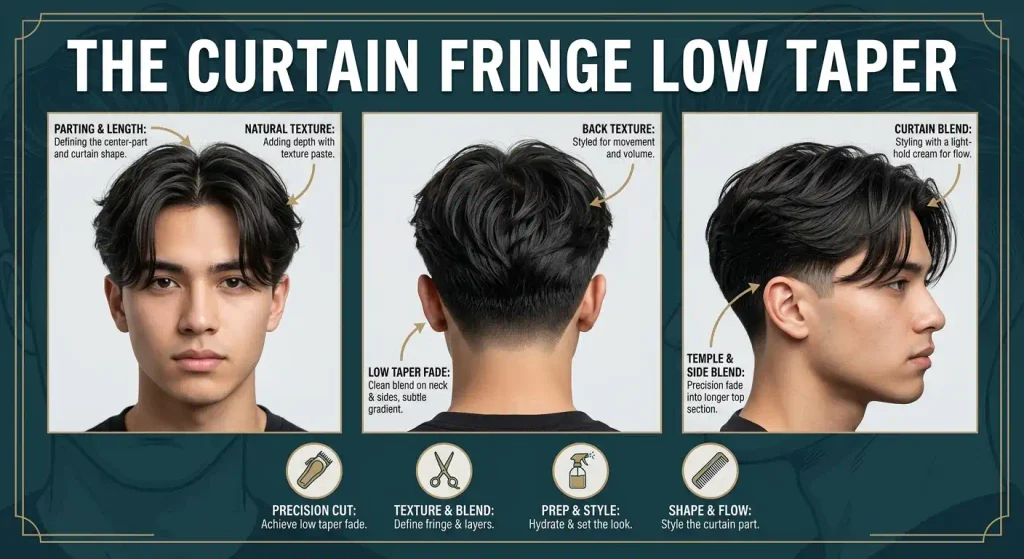
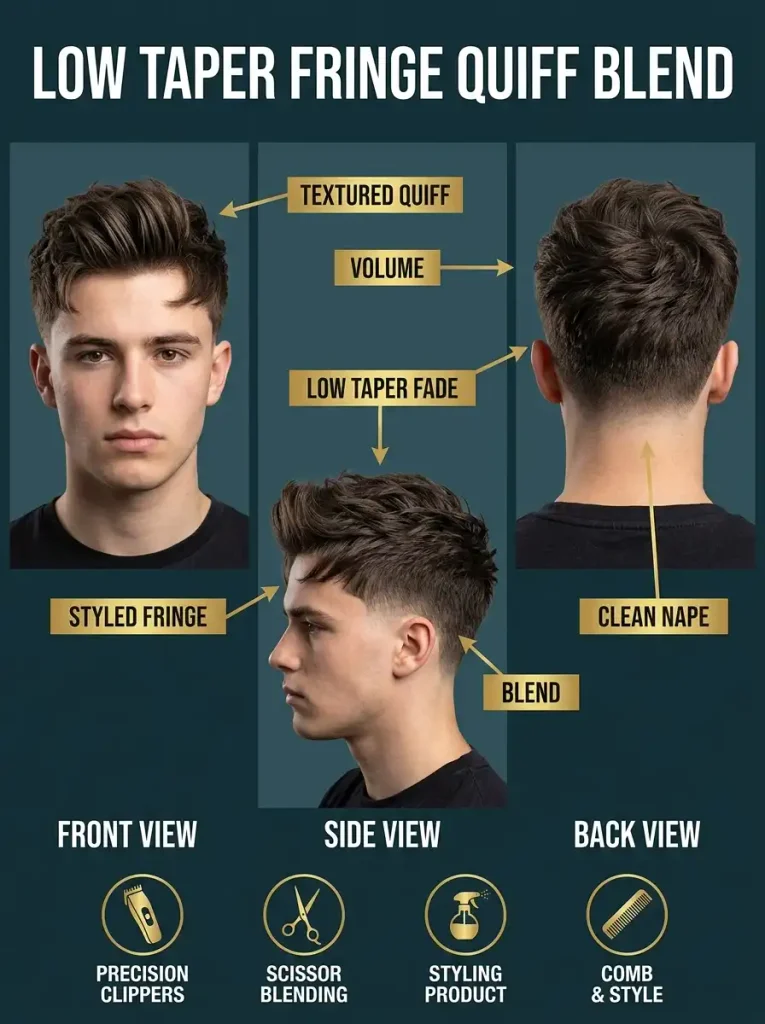
33. Low Taper Fringe Quiff Blend
The bulk of the top hair falls forward as a fringe, but the very front brow line is flipped slightly upward in a short quiff. The low taper uses a #1 guard for tight temporal edges. Works well on round and square faces. Style with pomade at the front edge and matte clay behind.
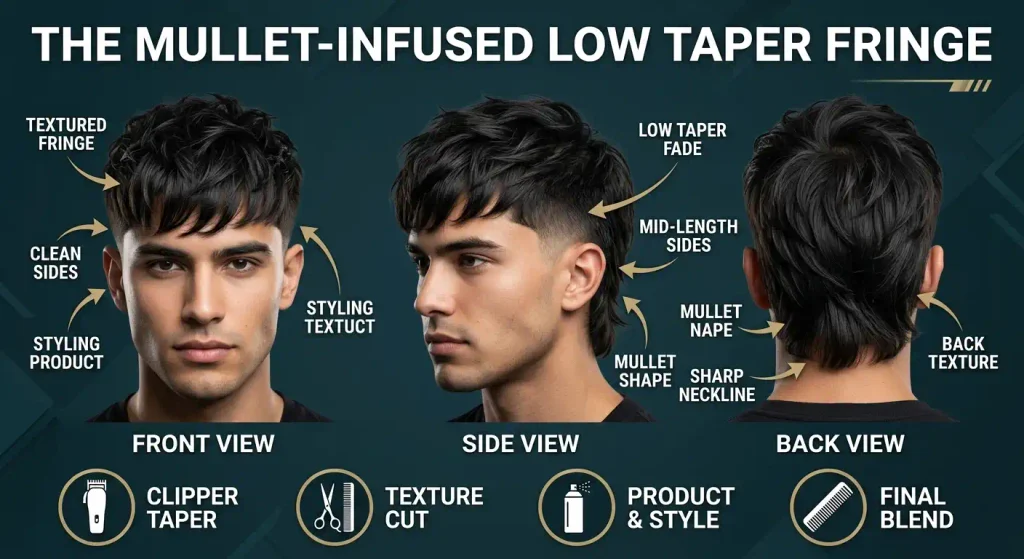
34. Mullet-Infused Low Taper Fringe
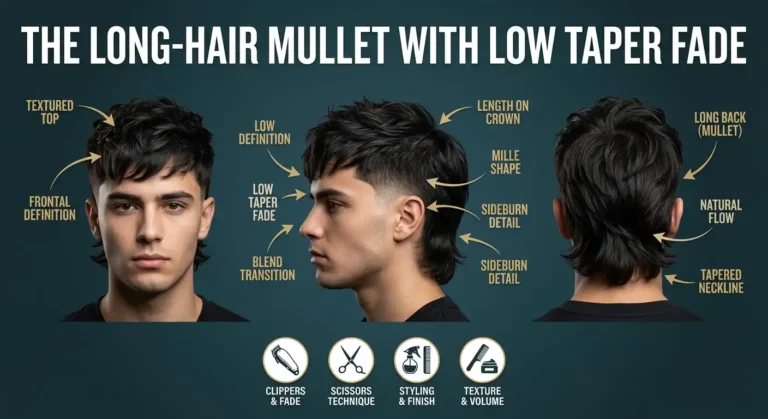
Featuring a forward-falling choppy fringe, tapered sideburns, and longer length preserved down the back of the neck. The low taper isolates the ear zone to keep the profile sharp. Best for diamond and oval faces seeking a modern retro cut. Use sea salt spray throughout for uniform texture.
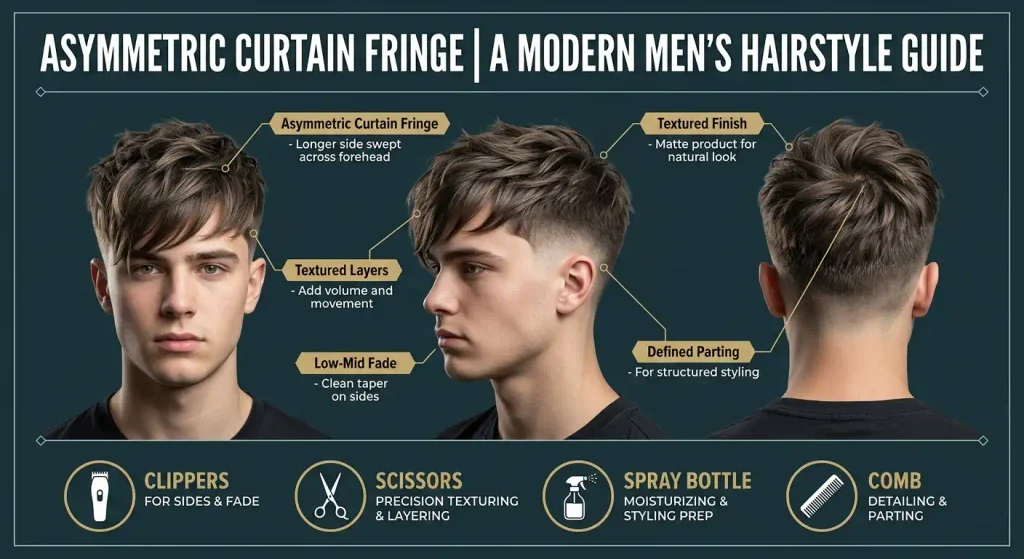
35. Asymmetric Curtain Fringe
A off-center parted fringe where one side hangs longer across the brow line than the other, paired with clean #1 guard tapered sides. Adds dynamic geometry to round face shapes. Style with a comb and light paste to hold the directional drape.
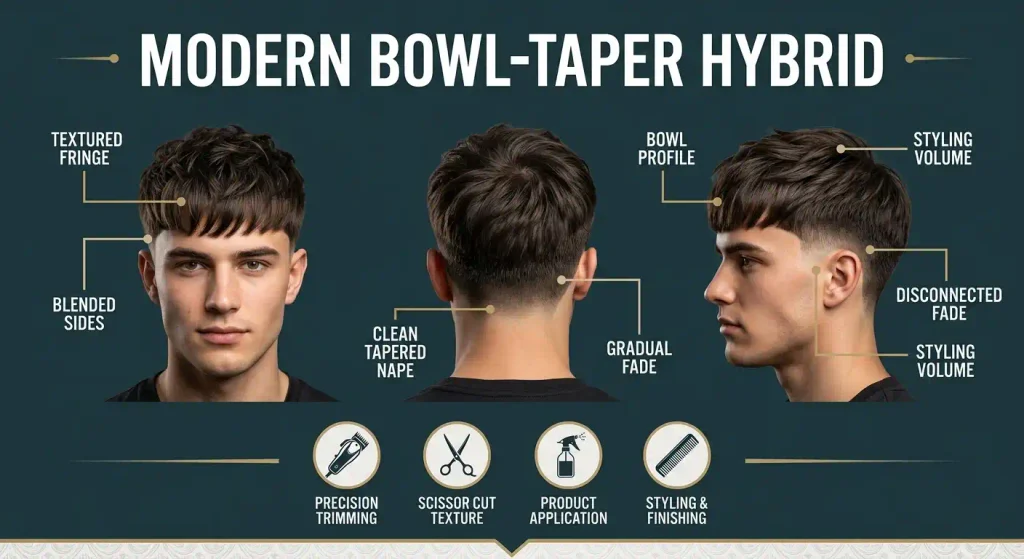
36. Modern Bowl-Taper Hybrid
Inspired by retro bowl cuts, this version softens the heavy perimeter line with deep point-cutting and blends the sideburns down with a low #1 taper. Perfect for oval faces with naturally dense, pin-straight hair. Apply matte paste to keep the top movement piecey.
Category 5: Angled, Asymmetrical & Angular Fringe Styles
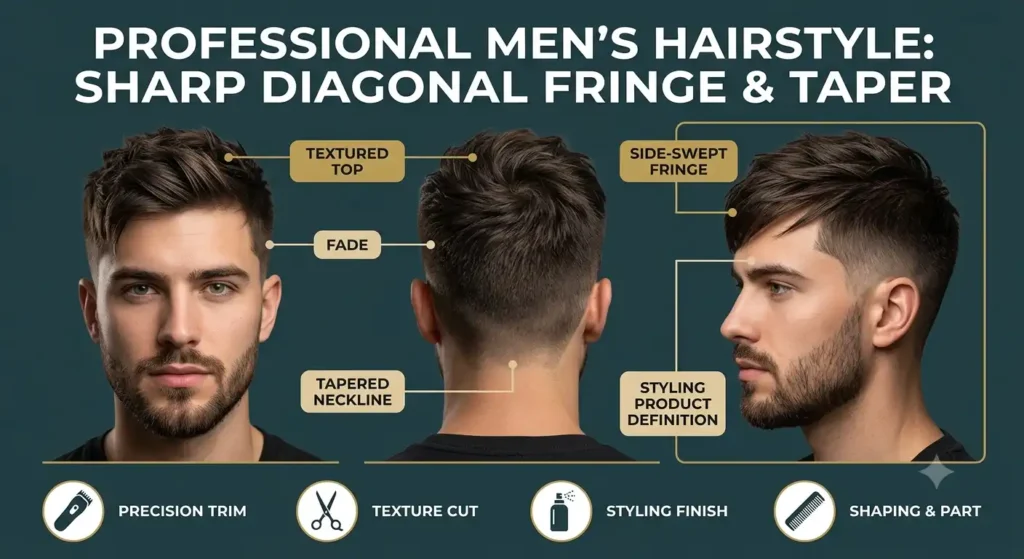
37. Side-Swept Low Taper Fringe
Straight hair is cut longer on one side, allowing the fringe to sweep diagonally across the forehead rather than straight down. A soft #2 low taper keeps the short side neat. Excellent for round faces as diagonal lines elongate facial features. Style with medium-hold paste.
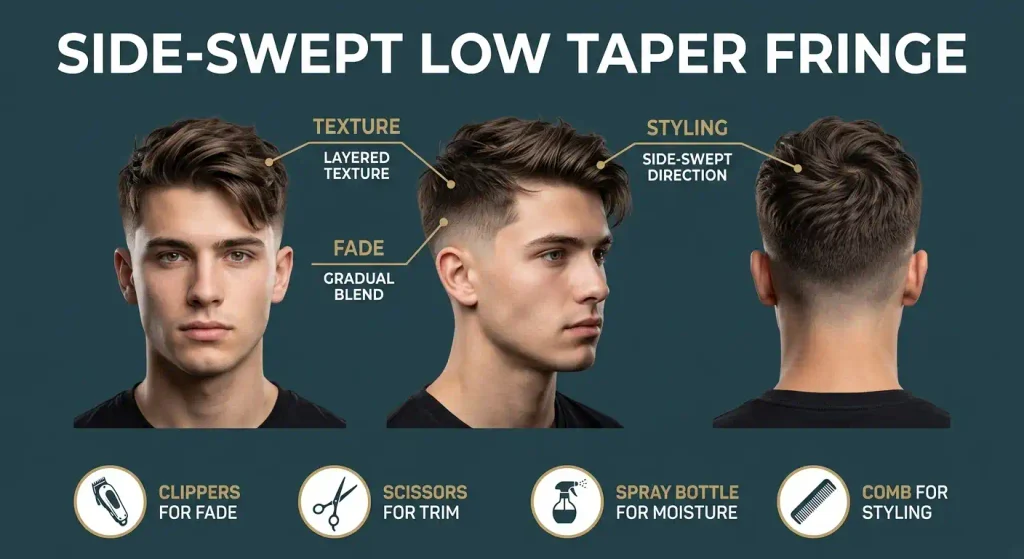
38. Angular Diagonal Fringe
The fringe line is cut at a noticeable 30-degree angle from one temple down to the eyebrow on the opposite side. The low taper uses a #1 guard to create clean negative space around the ears. Best for square and heart face shapes. Use firm matte clay to maintain the sharp angle.
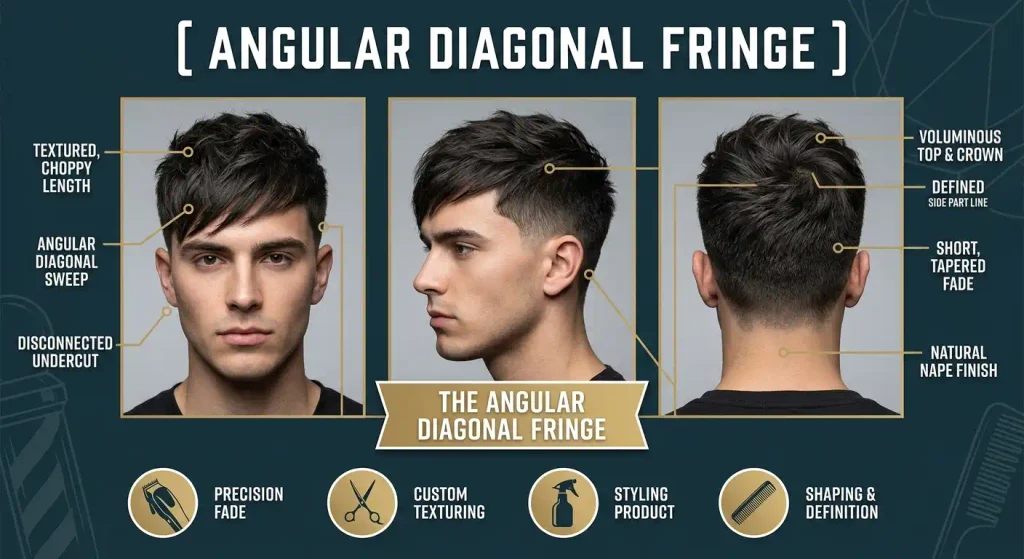
39. Textured Side-Flick Fringe
Most of the fringe falls straight forward, but the lowest tips at the brow are flicked outward to one side using a blow-dryer. A low taper (#1.5 guard) ensures the temporal area remains sleek. Fits oval and diamond face shapes. Apply styling paste to the tips to set direction.
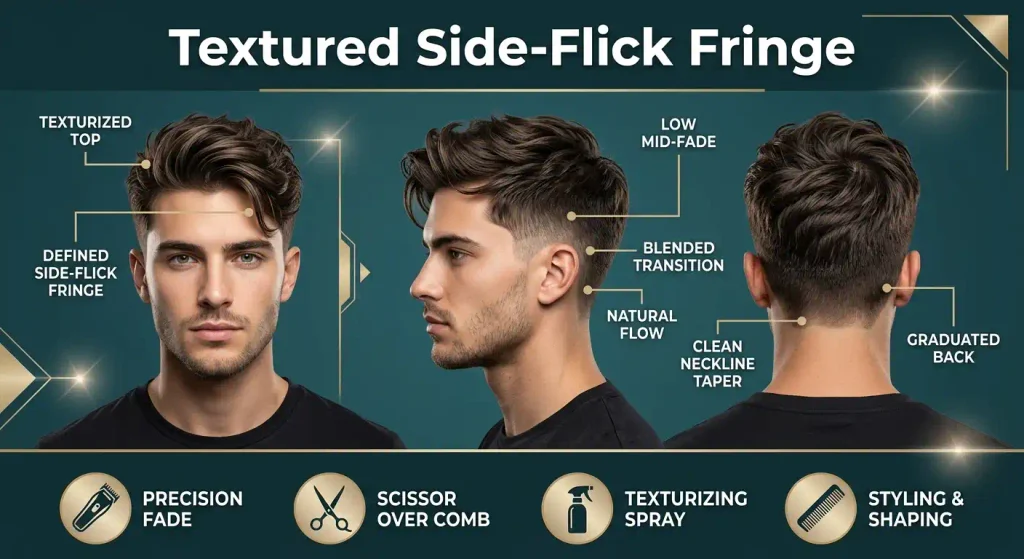
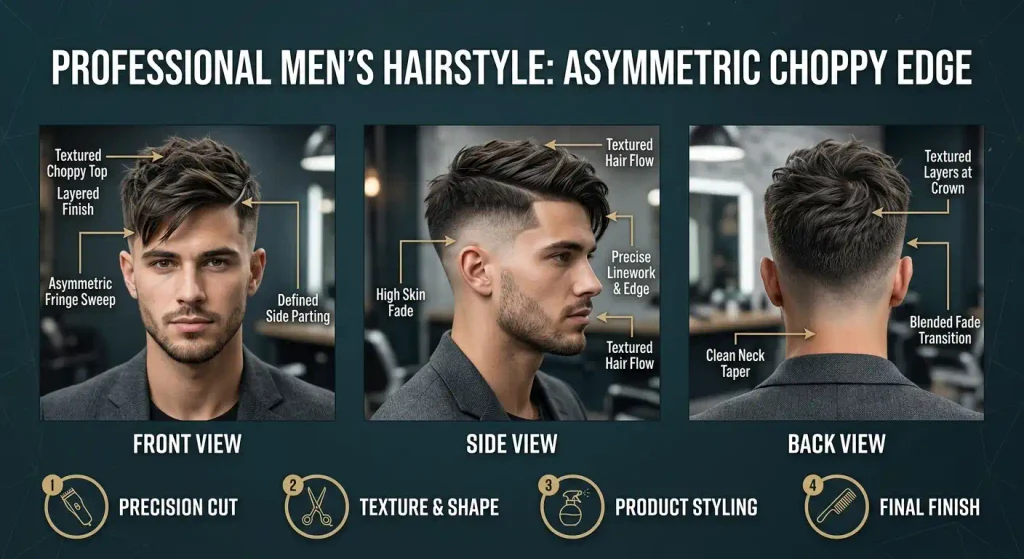
40. Asymmetric Choppy Edge
Featuring irregular lengths along the front edge—some pieces sit mid-forehead while others reach the eyebrows. The low taper blends smoothly using a #2 guard. Great for balancing non-symmetrical facial features on oval shapes. Style using hair dust for casual hold.
41. Sharp V-Shape Fringe
The front fringe is point-cut to converge at a subtle V-point directly over the bridge of the nose. The low taper (#1 guard) narrows the temple profile to accentuate the top geometry. Ideal for oval and round faces. Use a comb and strong matte wax to set the central point.
42. Arched Modern Fringe
Cut in an inverted arch that sits higher over the center brow and dips lower toward the cheekbones on each side. The low taper clears the ear area using a #2 guard. Works well on long or rectangular face shapes. Style forward using a light cream.
43. Deep Side-Part Fringe
A defined side part directs a heavy straight fringe across three-quarters of the forehead, anchoring into a clean low taper on the short side. Suited for formal environments and professional settings. Fits oval and square face shapes. Apply medium-shine pomade.
44. Sweeping Crop Fringe
A short crop length behind the hairline that gradually lengthens into a long, sweeping diagonal fringe over the brow line. The low taper isolates the lower sideburns with a #1 guard. Excellent for diamond faces. Style with matte clay for a touchable finish.
Category 6: Low Maintenance & Short Fringe Styles
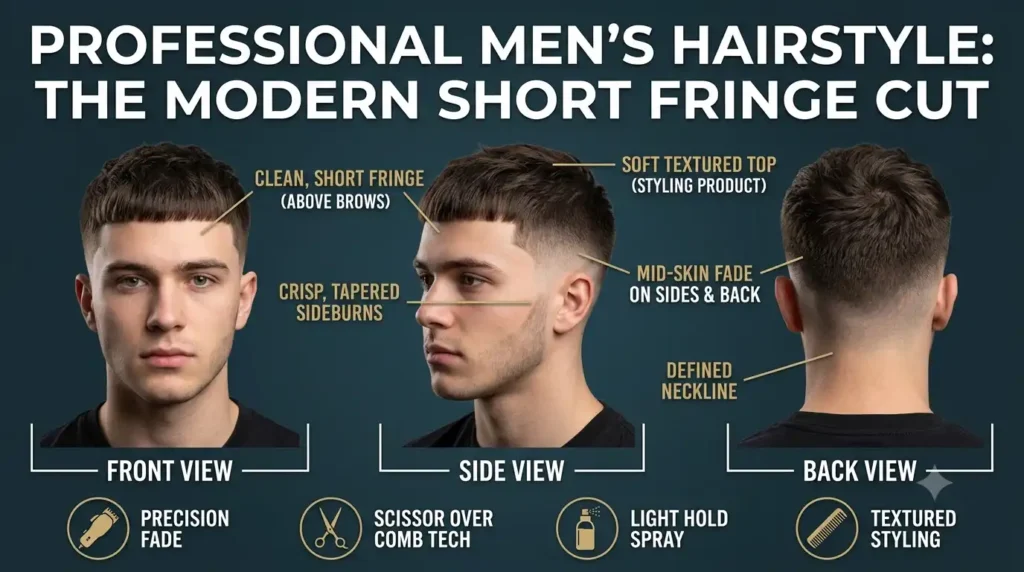
45. Short Micro Textured Fringe
Sitting roughly two inches above the eyebrows, this ultra-short fringe requires minimal styling while keeping a modern silhouette. The low taper cleans the neckline using a #1 guard lever open. Best for square and oval face shapes. A tiny pinch of clay is all that is needed.
46. Minimalist Buzz-Taper Fringe
The top length is clipped down to a #4 guard length, with the front hairline kept slightly longer and point-cut into a micro fringe. The low taper fades the sideburns down to skin. Perfect for athletes and low-maintenance preferences. Requires zero daily styling product.
47. Textured Caesar Micro Fringe
A short, horizontally-aligned crop with subtle vertical notch cuts along the brow edge. The low taper removes bulk around the ears using a #1 guard blend. Excellent for men with busy schedules or active routines. Work a dab of clay through damp hair.
48. Natural Fall Short Fringe
Straight hair is cut short enough to fall forward without falling into the eyes or requiring heavy product to stay in place. The low taper uses a #2 guard to maintain a soft, natural perimeter. Fits round and oval face shapes. Air-dry and go.
49. Compact French Fringe
A tight, controlled variation of the French crop where the fringe stays within an inch of the hairline. A clean #1 low taper gives the side profile a sharp outline. Recommended for square face shapes. Style with a light dusting of texture powder.
50. Tight Crop Low Taper
Very short layers combed forward into a dense, clean fringe strip across the upper forehead. The low taper fades the nape and sideburns neatly with a #0.5 guard. Great for thick, straight hair types. Apply a small paste dab for shine control.
51. Ultra-Short Textured Crop
Point-cut texturizing applied to a short 1-inch top canopy, yielding an effortless forward lay. The low taper maintains sleek sideburn transitions using a #1 guard. Fits oval and heart faces. Style in seconds using root dust.
52. Clean-Line Short Fringe
A short, precise front edge combined with a soft, natural low taper around the neck and ears using a #2 guard. Provides a neat appearance for school or corporate work. Best for oval faces. Style with grooming spray and a fine-tooth comb.
How to Ask Your Barber (Master Consultation Script)
When visiting your barber, showing a photo is helpful, but using precise barbering language ensures you get the exact proportions you want.
Core Master Script
“I want a low taper fringe on straight hair. Please keep the top length between 3 to 4 inches so it falls forward toward my eyebrows. Use point-cutting on top to add texture so it doesn’t sit flat. For the sides, give me a low taper—start fading around the lower sideburns and the bottom of my nape using a #1 guard lever closed, blending up into a #3 guard. Do not bring the taper higher than my ear notch.”
LOW TAPER FRINGE SILHOUETTE
[ 3-4″ Point-Cut Top ]
/ \
/ Forward Fringe Lay \
Temples -> | | <- Scissor Blend Zone
| [Low Taper Zone] |
| (#1 to #3 Guard Blend) |
Ears —> \____ ____/
| [Nape Taper] | (#1 to #3 Guard Blend)
Script Add-Ons for Specific Variations
- For a Messy/Fluffy Look: “Please remove interior weight on top with texturizing shears so I can build volume using sea salt spray at home.”
- For a Blunt/Crop Look: “Cut the front fringe in a clean horizontal line right above my eyebrows, but keep the low taper soft around my ears.”
- For Fine Straight Hair: “Keep the fringe slightly shorter and avoid over-thinning the top so my hair maintains visual density.”
Taper & Fade Comparison Matrix
| Cut Style | Taper/Fade Height | Guard Range | Top Length | Best Face Shapes | Daily Maintenance |
| Low Taper Fringe | Bottom of sideburns & lower nape | #1 to #3 | 3 – 4 inches | Oval, Heart, Square | Low (2–5 mins) |
| Mid Taper Fringe | Level with upper ear curve | #1 to #3 | 2.5 – 3.5 inches | Round, Oval | Low (2–5 mins) |
| Low Skin Fade Fringe | Blended to bare skin at temple notch | #0 (Skin) to #2 | 2 – 4 inches | Square, Diamond | Medium (Requires frequent trims) |
| High Taper Fringe | Near upper temple ridge | #1 to #4 | 3 – 5 inches | Round, Pear | Low to Medium |
Why Low Taper Fringe Straight Hair Style Works & Who It Suits
The Mechanics on Straight Hair
Straight hair naturally grows directly outward or downward without curl patterns to redirect its trajectory. When paired with a forward scissor cut, straight strands fall into an even frame across the forehead. The low taper removes unwanted side volume around the ears where straight hair tends to stick out awkwardly, creating an aesthetically pleasing wedge profile.
WITHOUT LOW TAPER WITH LOW TAPER
(Side Bulk/Spiking) (Clean Streamlined Edges)
/———–\ /———–\
| TOP HAIR | | TOP HAIR |
/| |\ /| |\
( | SIDE BULK | ) | | Clean Taper | |
\| (Sticks Out)|/ \| (#1-#3) |/
\———–/ \———–/
Face Shape Breakdown
- Oval Faces: Can wear almost any variation, from blunt micro fringes to long messy styles.
- Round Faces: Benefit from point-cut, textured, or angled fringes that disrupt round symmetry and add top height.
- Square Faces: Suit classic crops and blunt cuts that complement a defined jawline.
- Heart/Diamond Faces: Soft layered or side-swept fringes balance wider foreheads and narrow chins.
Step-by-Step Styling Tutorial of Low Taper Fringe Straight Hair
Required Barbering & Grooming Tools
- Wide-tooth comb & vent brush
- Blow-dryer with concentrator nozzle
- Matte clay or texturizing paste
- Sea salt spray (for volume and grip)
- Texture dust / powder (optional for fine hair)
STYLING FLOWCHART
[Damp Hair] —> [Apply Sea Salt Spray] —> [Blow-Dry Forward]
|
[Lock in Texture] <— [Apply Matte Clay] <———–+
Styling Steps
- Prep Damp Hair: Wash hair and towel-dry until lightly damp. Spray 3–5 mists of sea salt spray evenly through the top canopy.
- Blow-Dry Forward: Attach concentrator nozzle to your blow-dryer. Set to medium heat and high airflow. Blow-dry hair from the crown forward toward your forehead, using your fingers or a vent brush to direct strands down.
- Build Root Lift (Fluffy Styles): For extra volume, direct warm air upward at the front roots for 5 seconds, then switch to the cool shot button to lock in height.
- Apply Product: Scoop a small pea-sized amount of matte clay or paste into your palms. Rub hands together until product is completely warm and clear.
- Work Back-to-Front: Work product through the back of the top hair first, moving forward to the fringe. This prevents clumping too much heavy cream right at the front brow line.
- Detail the Fringe: Pinch individual hair sections between your fingertips to create piecey, distinct texture across the forehead.
Best Styling Products Chemistry
+——————+—————————————————–+
| Product Type | Primary Benefit for Straight Hair |
+——————+—————————————————–+
| Sea Salt Spray | Adds grip, removes natural slippage, creates volume |
| Matte Clay | Provides pliable hold with zero greasy shine |
| Texture Dust | Delivers instant root lift and lightweight dry grip |
| Grooming Cream | Softens coarse hair and provides light control |
+——————+—————————————————–+
- Matte Clay (Bentonite / Kaolin Clay Base): Ideal for straight hair because it absorbs natural scalp oils and provides a pliable, dry hold without making straight hair look greasy or weighed down.
- Sea Salt Spray: Formulated with magnesium sulfate or sea salt minerals. Adds grit to naturally slippery straight hair strands, allowing layers to grab onto each other for effortless texture.
- Texture Dust / Powder (Silica Silylate Base): Creates instant friction at the hair roots. Best for fine or limp straight hair that struggles to maintain volume throughout the day.
- Styling Cream: Light oil-in-water emulsions that soften coarse, stiff straight hair, helping it lay flat in a controlled, natural manner.
Barber Step-by-Step Cutting & Upkeep Maintenance Guide
Professional Cutting Blueprint
- Sectioning: Establish a horseshoe parting from the upper recession points to the crown to isolate top hair from the sides.
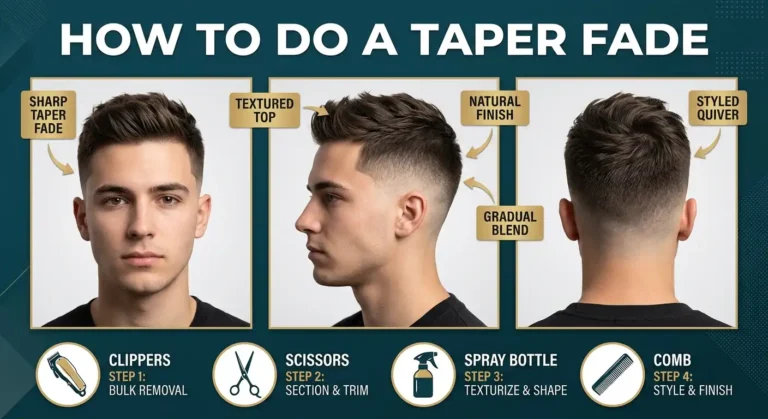
- Tapering Sideburns: Use clippers with a #1 guard lever closed at the bottom of the sideburn. Open the lever gradually as you move up 1 inch, blending into a #2 guard.
- Nape Tapering: Repeat the low blend at the base of the neck, maintaining a soft curved perimeter around the natural hairline.
- Transition Zone: Use scissor-over-comb or clipper-over-comb techniques to smooth the area above the taper into the top canopy.
- Top Scissor Work: Pull hair straight up at a 90-degree angle. Cut guidelines to desired length (3 to 4 inches).
- Texturizing: Work across the top using point-cutting (cutting vertical notches into section ends) to create dynamic texture in straight hair.
MAINTENANCE TIMELINE
Week 1 Week 2–3 Week 4–5
[Fresh Cut] -> [Edge Touch-up Needed] -> [Full Barber Visit]
Maintenance & Trim Frequency
- Barber Visits: Schedule a full trim every 3 to 4 weeks to keep the fringe length out of your eyes and maintain a sharp low taper.
- At-Home Edge Touch-Ups: Use a small trimmer to clean up stray neck hairs between visits if needed, but leave the main taper blend to your barber.
- Washing Routine: Wash straight hair 3 to 4 times per week using a lightweight shampoo. Conditioning daily keeps the fringe soft and manageable.
Common Mistakes to Avoid
- Over-Thinning Fine Hair: Using thinning shears too aggressively on fine straight hair leaves the fringe looking wispy and sparse rather than thick and piecey.
- Applying Product directly to the Front: Putting styling wax onto the front fringe first makes hair greasy and heavy, causing it to collapse over the forehead.
- Taking the Taper Too High: Allowing your barber to bring the side taper above the ear notch transforms a low taper into a mid or high fade, ruining the low profile balance.
- Skipping the Blow-Dryer: Relying solely on air-drying straight hair often leaves it flat against the scalp without texture or volume.
FAQ (PAA-Style): Low Taper Fringe Straight Hair
How do I tell my barber I want a low taper fringe?
Show your barber a reference photo and specify that you want a #1 to #3 guard taper isolated strictly around the lower sideburns and nape. Request 3 to 4 inches of length on top with point-cut texturizing throughout the fringe.
Is a low taper fringe good for straight hair?
Yes. Straight hair naturally falls forward, making it an ideal hair type for fringe hairstyles. The low taper cleans up side bulk around the ears where straight hair usually sticks out, resulting in a neat, balanced shape.
What is the difference between Style 04 (Low Taper Textured Fringe) and Style 20 (Messy Fringe Fade)?
Style 04 keeps a structured, directional forward lay with subtle point-cut texture, while Style 20 incorporates internal weight removal and shorter fade lines to allow tousled, multi-directional movement.
How do I keep my straight fringe from sitting flat?
Pre-style damp hair with sea salt spray and blow-dry forward while lifting roots with your fingers. Finish by applying a small amount of root texture powder or matte clay to dry hair.
How long does my hair need to be for a low taper fringe?
Your top hair should be at least 2.5 to 4 inches long so the fringe can comfortably reach your mid-forehead or brow line without sticking straight up.
How often should I get a low taper fringe trimmed?
To keep the taper looking sharp and prevent the fringe from covering your eyes, visit your barber every 3 to 4 weeks for maintenance.
What product works best for Style 19 (Fluffy Low Taper Fringe)?
Style 19 relies on sea salt spray applied before blow-drying, followed by a lightweight texture powder at the roots to maintain airy height without weighing hair down.
Will a low taper fringe suit a round face shape?
Yes. Opt for a choppy, textured, or diagonal fringe variation rather than a flat blunt cut. Texture and diagonal angles add visual height and break up round facial proportions.
Conclusion
The low taper fringe is a adaptable, low-maintenance haircut option for men with straight hair. By pairing clean perimeter tapering around the ears and neck with textured forward length on top, this style delivers a modern frame for any face shape. Use our barber script and styling tutorial to achieve your ideal variation on your next barbershop visit.
Name: Ryan Cole
Role: Lead Grooming Editor, TaperHaircutGuide.com
Bio angle: Men’s grooming/style content researcher — 4+ years covering barbering trends, hairstyling terminology, and men’s style content for US audience. Cross-checks every guide with practicing barbers before publishing.