Taper Fade Messy Hair: 50 Modern Styles, Barber Guide & Styling Tips

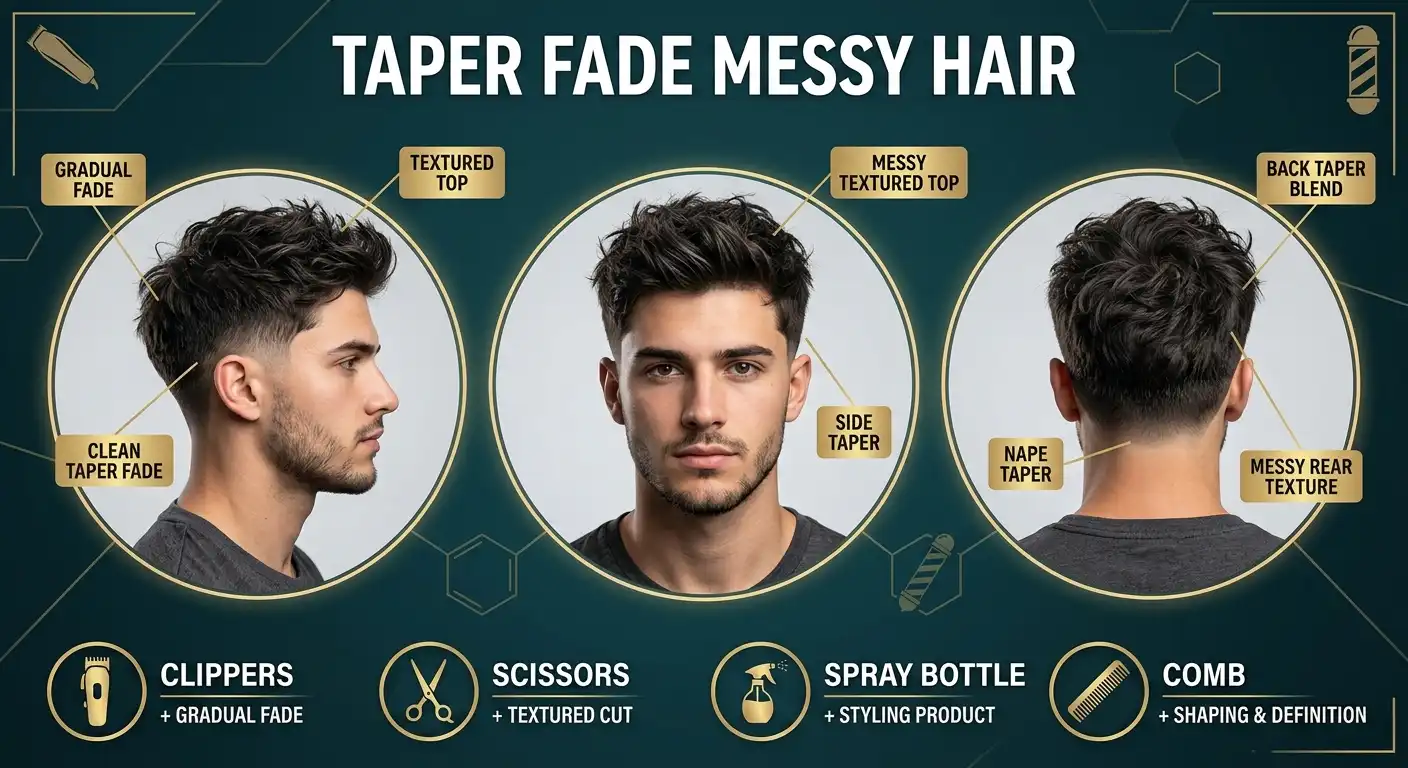
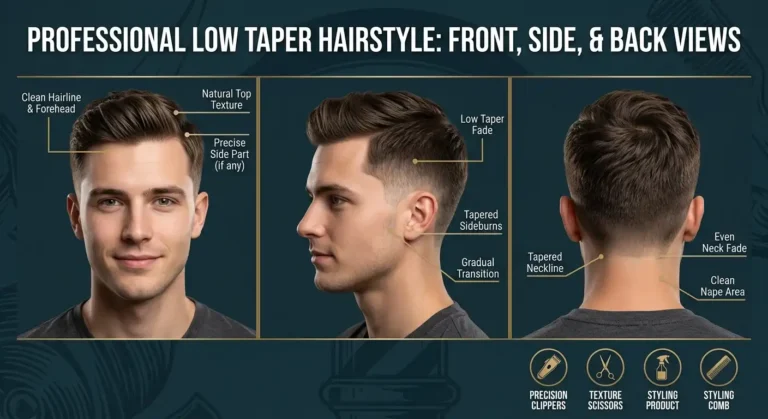
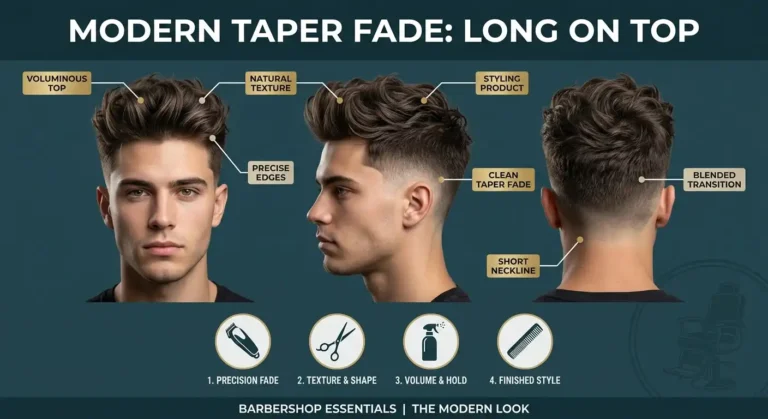
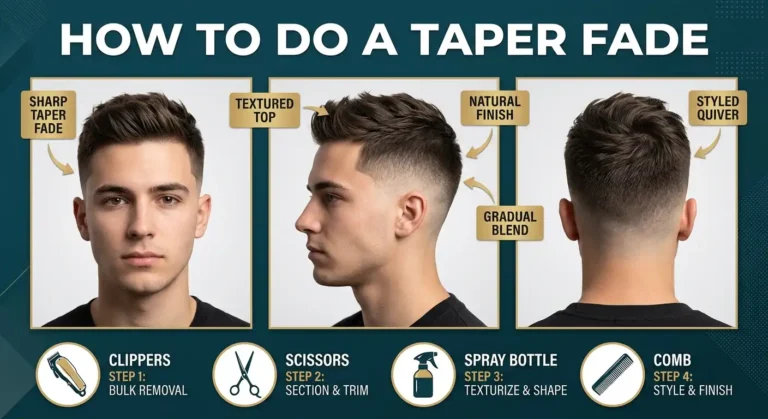
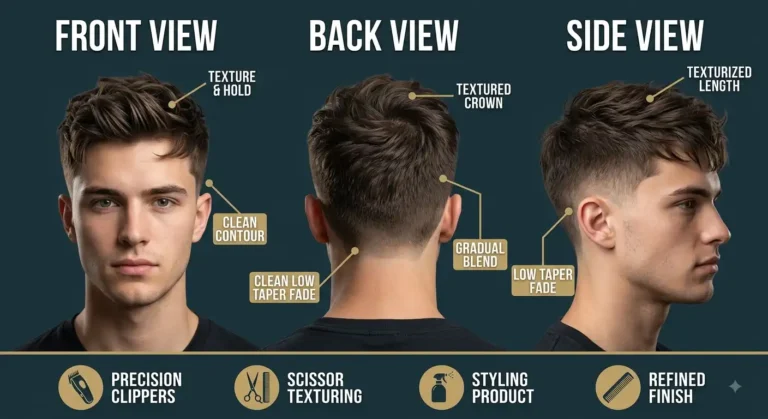
A taper fade messy hair style combines clean, gradually shortened sides and back with a longer, textured top that looks loose rather than perfectly combed. The contrast gives you a haircut that feels sharp without looking stiff. You can keep the taper low for a softer finish, move it higher for more contrast, or match it with curls, waves, fringe, a crop, or extra volume.
Below are 50 distinct ways to wear the look, followed by barber instructions, styling steps, product advice, face-shape guidance, and maintenance tips.
Quick Overview: 5 Styles Worth Considering First
| Style | Best For | Overall Feel | Main Product |
| Low Taper Messy Texture | Straight/wavy hair | Natural and easy | Matte clay |
| Mid Taper Messy Fringe | Thick hair | Youthful and bold | Texture paste |
| Curly Top Low Taper | Curly hair | Relaxed and defined | Curl cream |
| Fluffy Taper Fade | Thick/wavy hair | Full and airy | Sea salt spray |
| Messy Crop with Taper | Short hair | Clean and modern | Matte clay |
1. Taper Fade messy hair and Natural Texture Styles
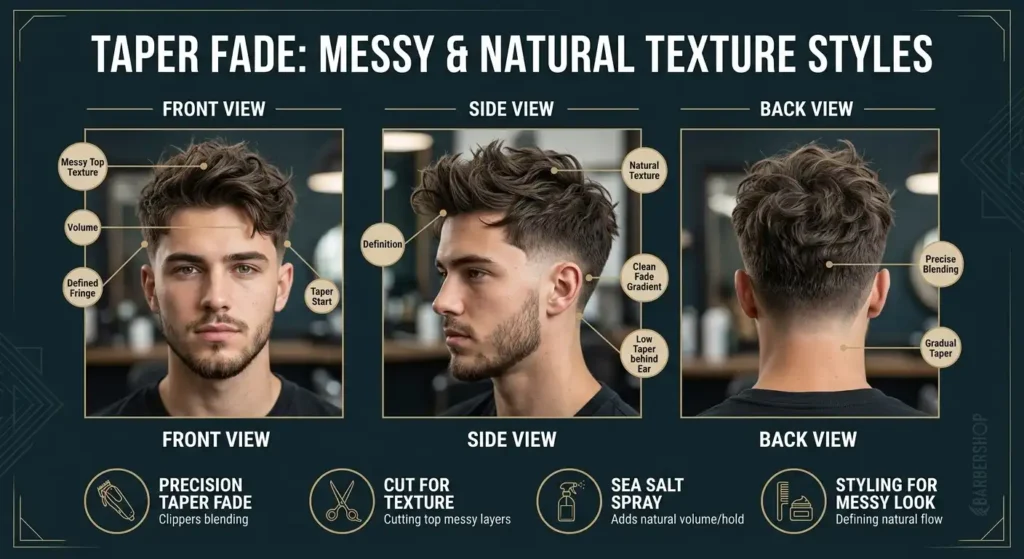
1. Low Taper with Natural Messy Texture
Keep the taper low around the ears and neckline while leaving enough length on top for natural movement. The top should be point-cut lightly rather than made overly choppy. A #0 or #1 can clean the lowest taper area, while the barber can blend upward through #2 and #3 as needed. This option suits straight, wavy, and moderately thick hair. Oval and square faces usually carry the balanced shape well. Work a small amount of matte clay through dry hair with your fingers and let the texture fall naturally.
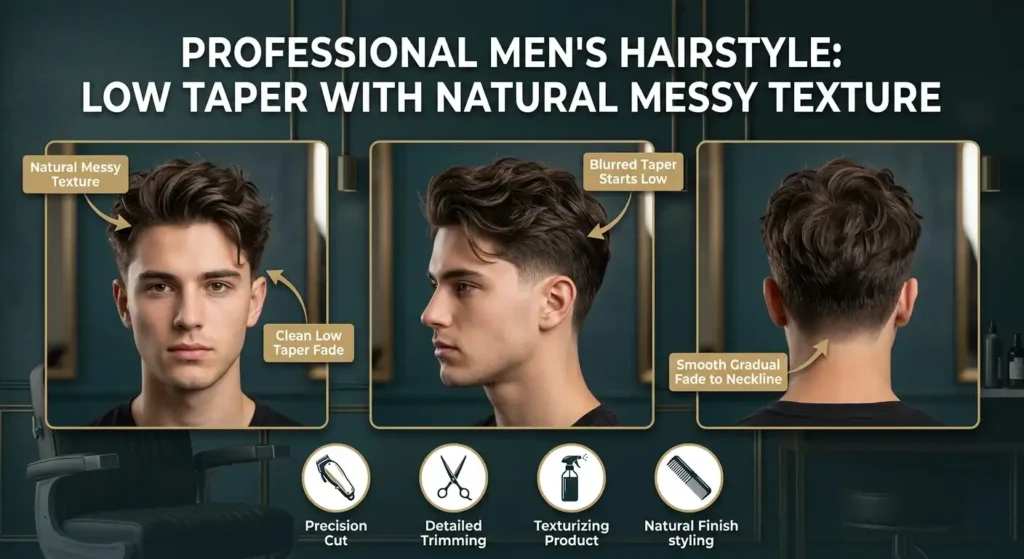
2. Low Taper with Messy Fringe
A loose fringe gives the cut a younger, more relaxed direction. Ask for the front to stay long enough to fall toward the forehead, with point cutting used to break up a heavy edge. The taper should remain low so the fringe stays the main feature. Straight and slightly wavy hair works especially well, while a round face can benefit from a little lift rather than a completely flat fringe. Use a lightweight texture paste and separate the front with your fingertips.
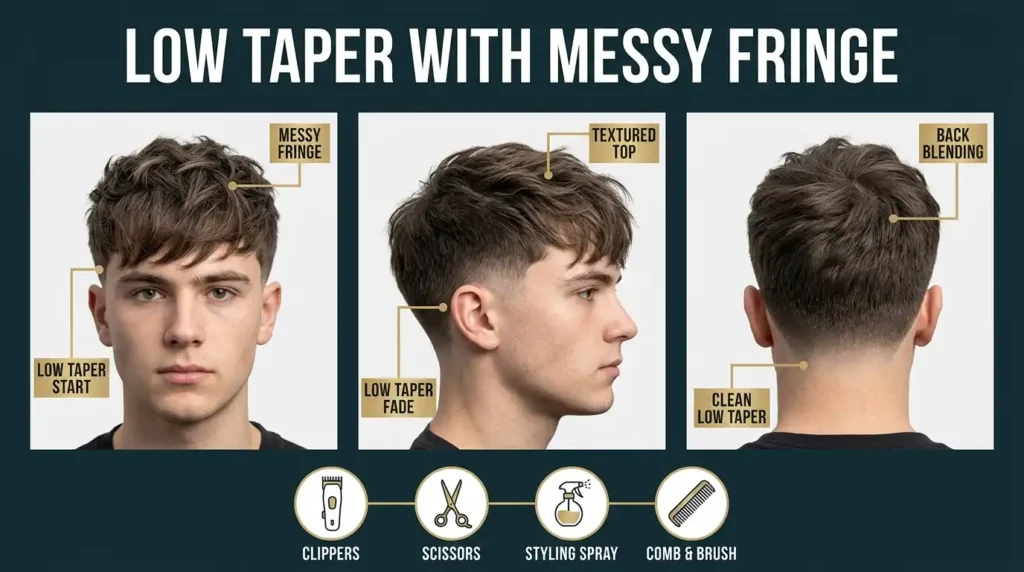
3. Low Taper with Choppy Top
Choppy layers create visible separation without turning the haircut into spikes. The barber can use point cutting and selective texturizing to remove excess weight from thick hair. Keep the taper around the lower sides and neckline using a gradual #0/#1 through #2 blend. This style works nicely with oval, square, and heart-shaped faces. Apply matte clay to dry hair, pinch a few sections upward, then push them slightly forward for an imperfect finish.
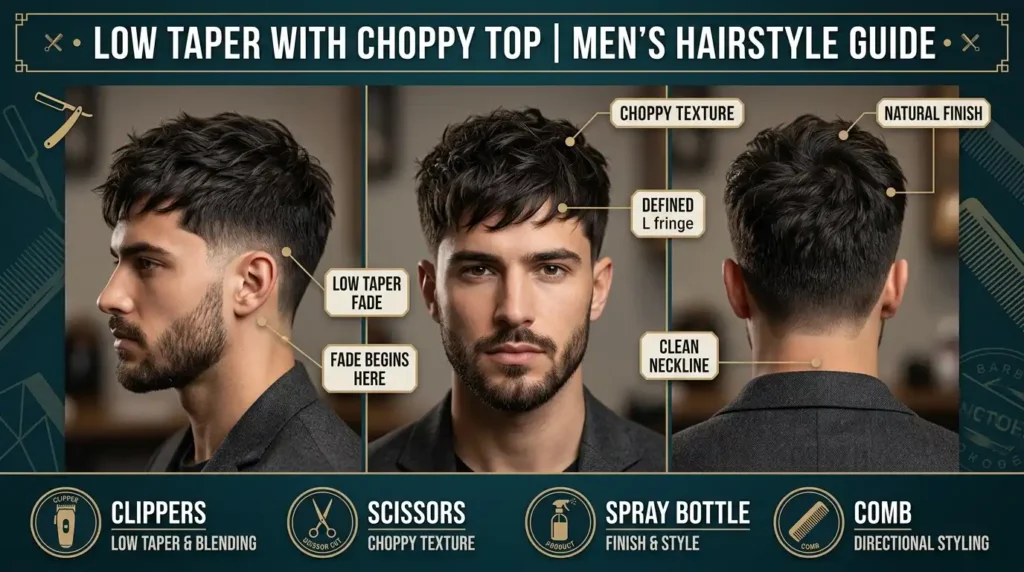
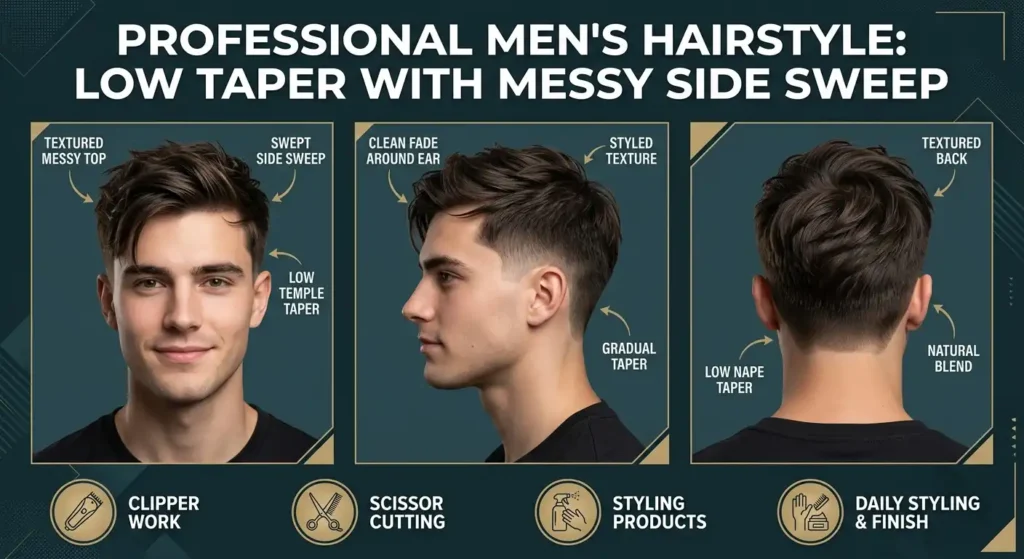
4. Low Taper with Messy Side Sweep
Instead of pushing the hair straight forward, sweep the top loosely to one side. The part does not need to be hard or sharply defined. A low taper keeps the sides understated, making the style suitable for school, work, or casual settings. Medium-density straight or wavy hair is easiest to shape. Longer faces can benefit from keeping some side volume. Use a light matte cream and guide the top sideways with your fingers rather than a fine-tooth comb.
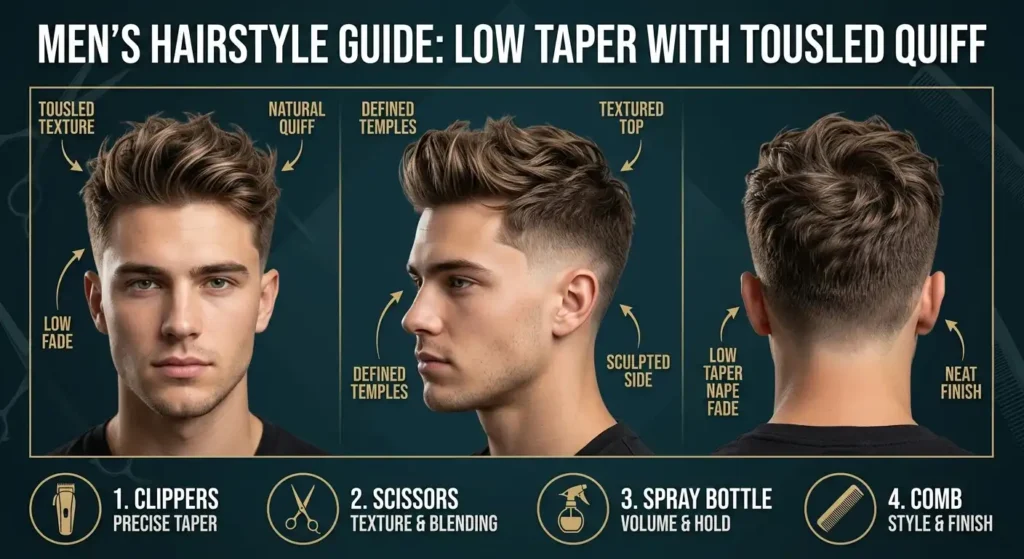
5. Low Taper with Tousled Quiff
The tousled quiff adds height while keeping the finish casual. Leave enough length at the front for the hair to lift, then use point cutting to prevent the quiff from looking like one solid block. A #1 around the lowest taper area can transition into longer lengths without making the sides too bare. This works well for oval and rectangular faces. Blow-dry the front upward with your fingers, then finish with matte clay for flexible texture.
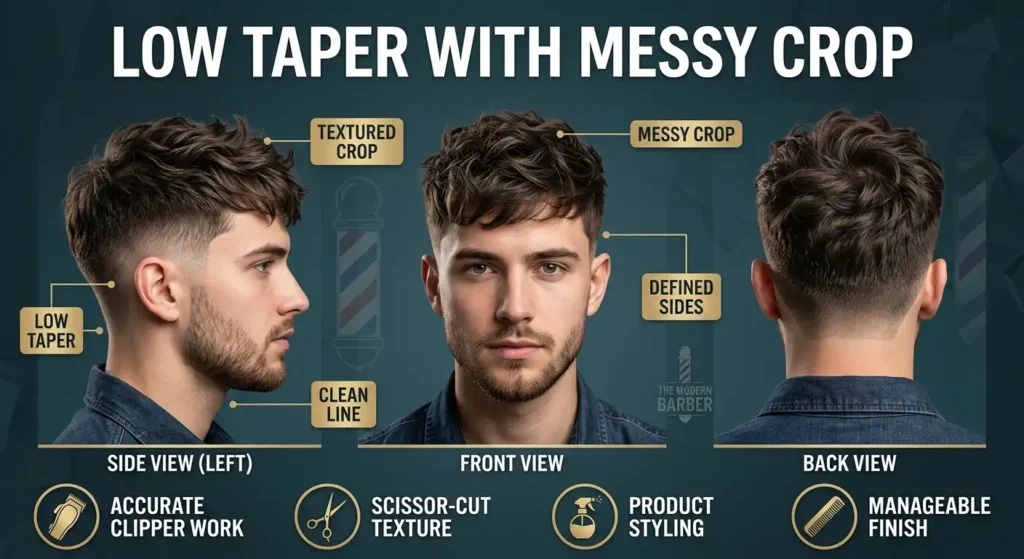
6. Low Taper with Messy Crop
A short crop on top keeps the haircut practical while the low taper gives the outline a cleaner finish. Ask the barber to leave a slightly irregular front rather than creating a perfectly blunt line. Straight and thick hair can hold the shape with very little styling. Square and oval faces suit the compact proportions particularly well. Rub a small amount of matte paste between your palms and press it into the top, working from back to front.
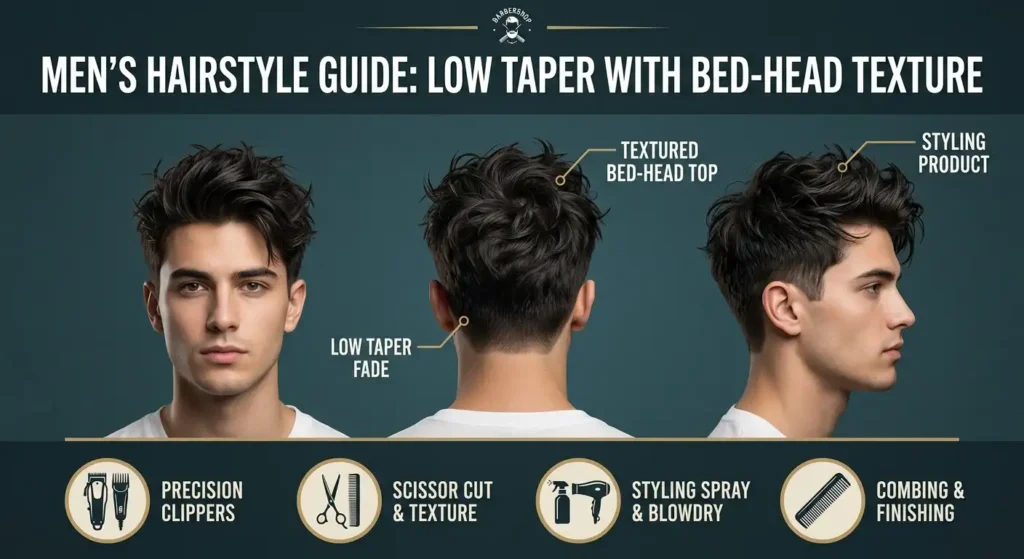
7. Low Taper with Bed-Head Texture
This version intentionally mimics the loose movement of naturally tousled hair. The top should have enough length for several directions rather than being cut into a uniform shape. Keep the taper conservative, especially if you want the haircut to grow out smoothly. It works well on medium-density straight or wavy hair and can soften angular faces. A lightweight styling cream is enough for most hair. Twist a few sections with your fingers and leave the rest loose.
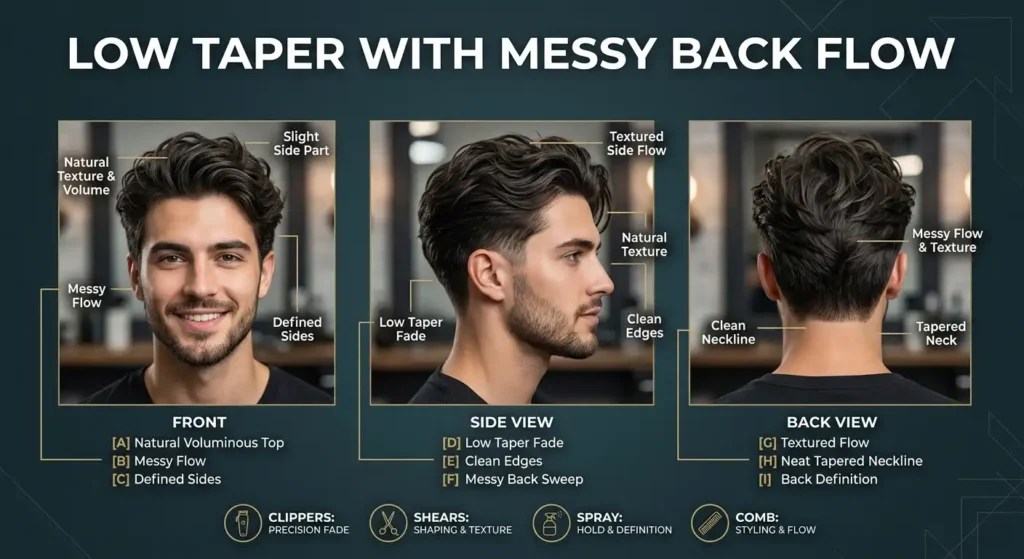
8. Low Taper with Messy Back Flow
Let the top move backward rather than toward the forehead. The back should not become a slicked-back style; it should retain separation and movement. Ask for a low taper that stays close to the natural neckline, using #0 or #1 only where necessary and blending upward. Wavy hair makes this especially effortless. Oval and rectangular faces can handle the added length well. Use sea salt spray before drying, then finish with a light matte cream.
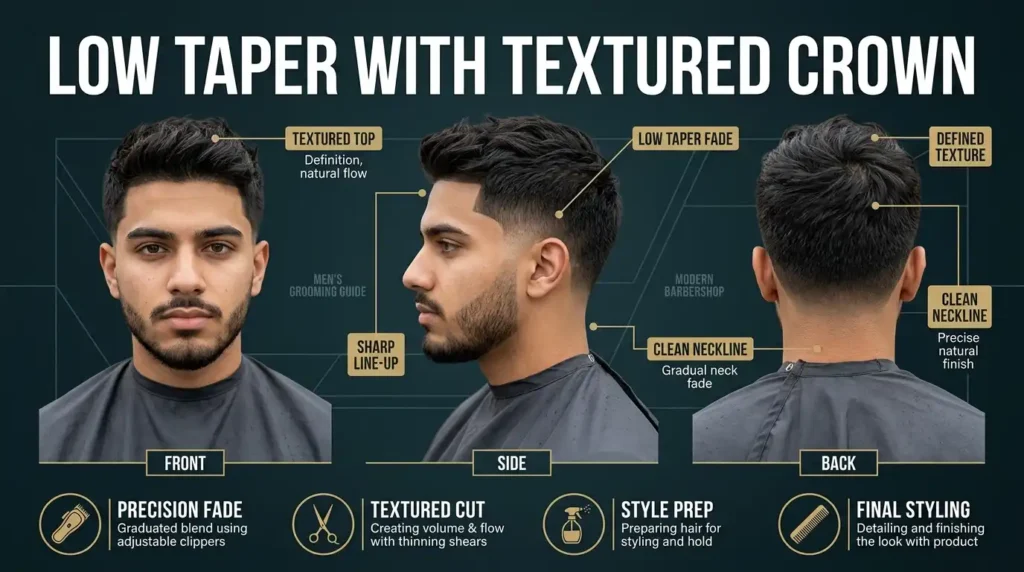
9. Low Taper with Textured Crown
This variation places extra attention on the crown rather than the fringe. The barber should preserve enough crown length and remove bulk selectively with point cutting. The taper remains low to avoid competing with the top. Thick straight or wavy hair is a strong match, especially for oval and square faces. Apply a lightweight texture product to damp hair, dry with your fingers, and use matte clay only where the crown needs extra separation.
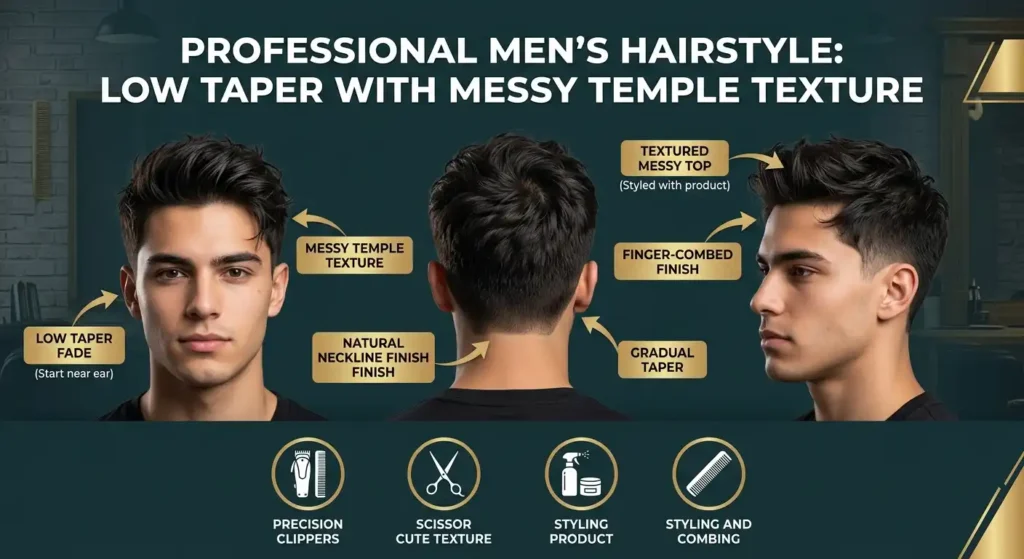
10. Low Taper with Messy Temple Texture
Here the temple area receives a cleaner finish while the top remains loose. It is a useful option if you want visible taper detail without committing to a dramatic fade. The barber can detail around the temples with a #0 or #1 and blend upward into #2 and longer hair. Straight and slightly wavy textures work well. This shape suits most face types. A small amount of styling cream can keep flyaways controlled without flattening the messy texture.
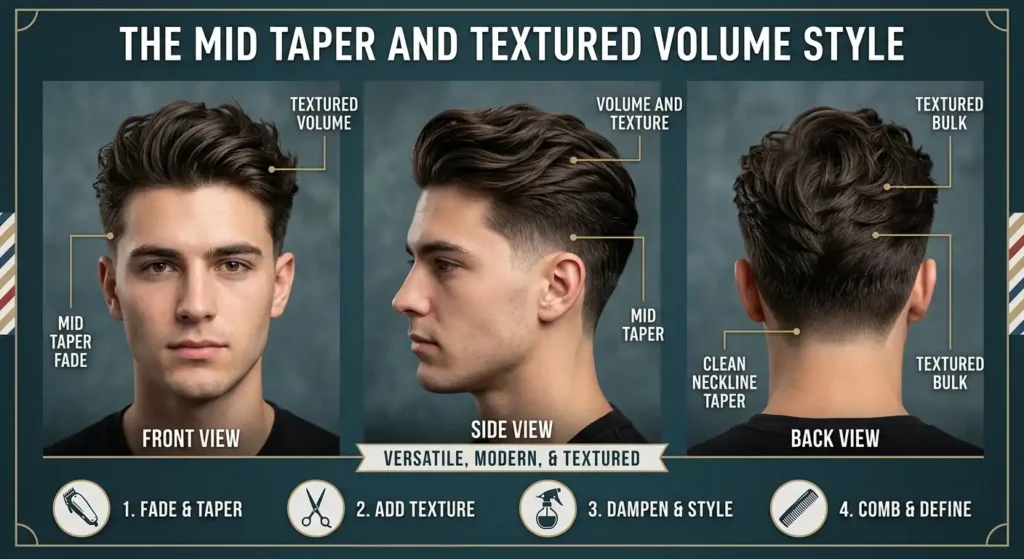
2. Mid Taper and Textured Volume Styles
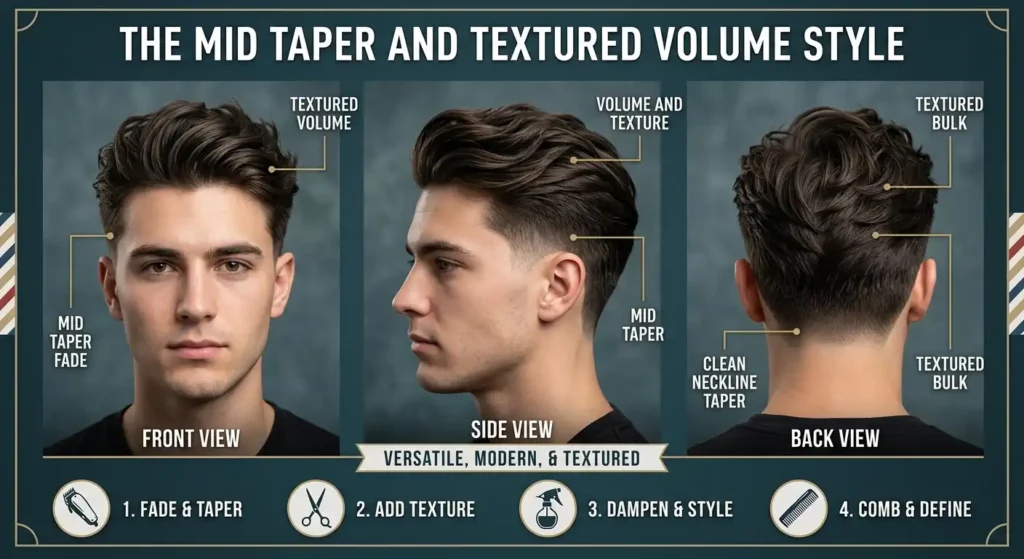
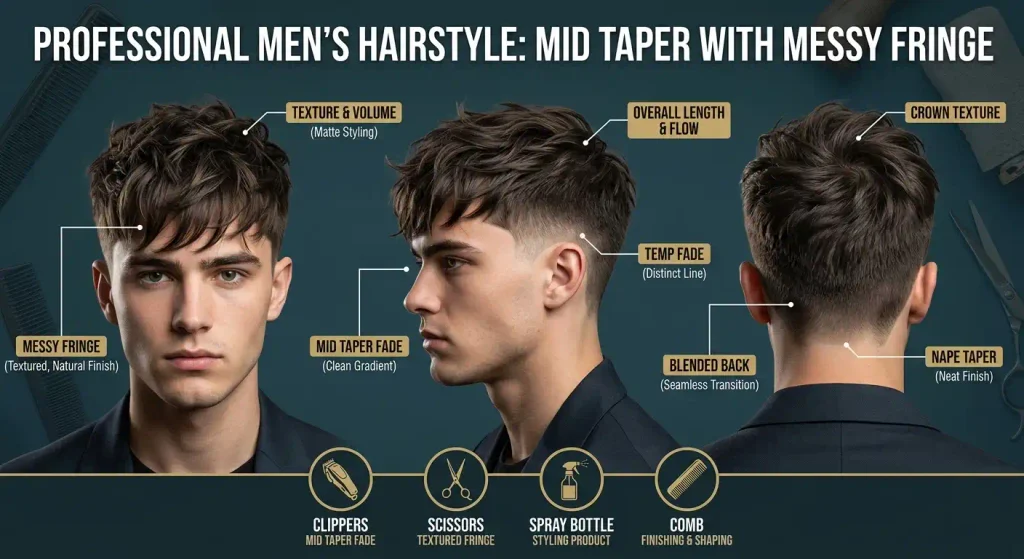
11. Mid Taper with Messy Fringe
Moving the taper higher creates more contrast around the sides while the fringe remains loose. Keep the front textured rather than perfectly straight so the style does not become a formal crop. Thick straight and wavy hair can support the fuller top. A square or oval face generally suits the stronger contrast. Ask for a #0 or #1 starting point with a gradual transition into #2 and #3. Finish with matte clay, separating the fringe into small sections.
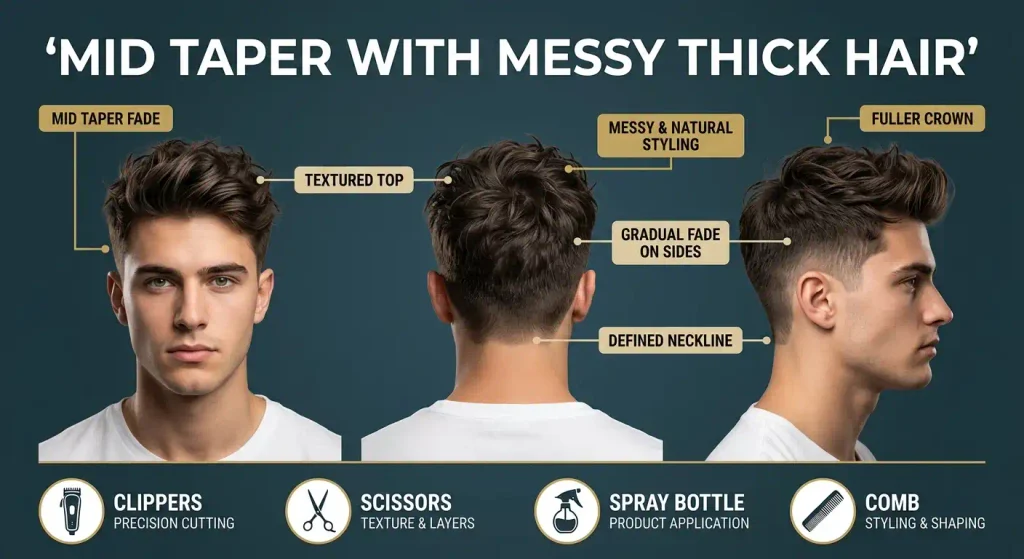
12. Mid Taper with Messy Thick Hair
Thick hair benefits from internal weight removal because too much density can make the top look bulky. Your barber can use point cutting or clipper-over-comb to control the shape without stripping away all the fullness. The mid taper provides a sharper outline around the sides. Oval and rectangular faces can handle the volume well. Use a matte paste on dry hair and push the top into several loose directions rather than forcing one uniform shape.
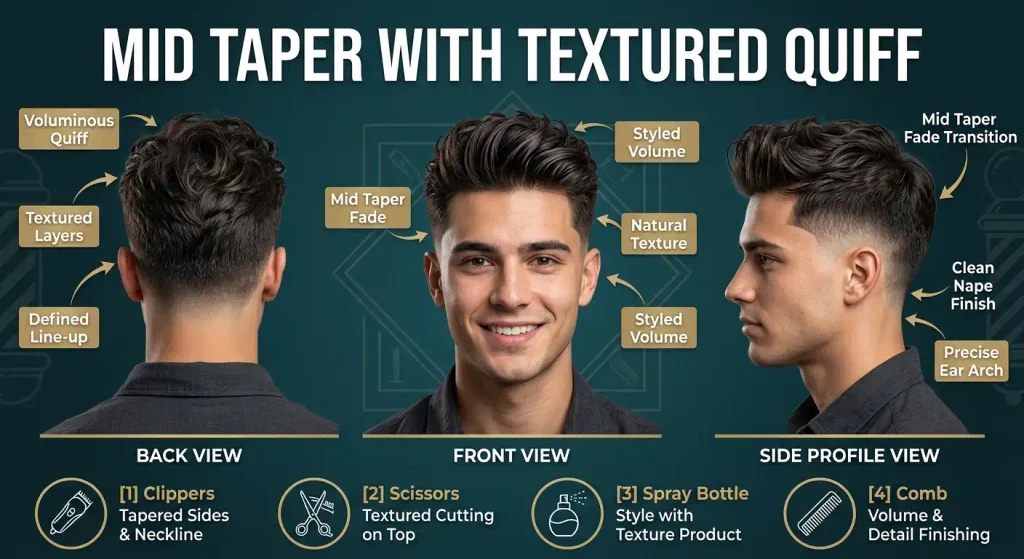
13. Mid Taper with Textured Quiff
A textured quiff adds height while the mid taper gives it a stronger modern outline. Leave extra length through the front and crown, then use point cutting to create movement. Avoid over-thinning thick hair, as that can make the quiff lose its body. This option suits oval, square, and heart-shaped faces. Blow-dry the front upward and slightly backward, then apply matte clay through the ends for a dry, separated finish.
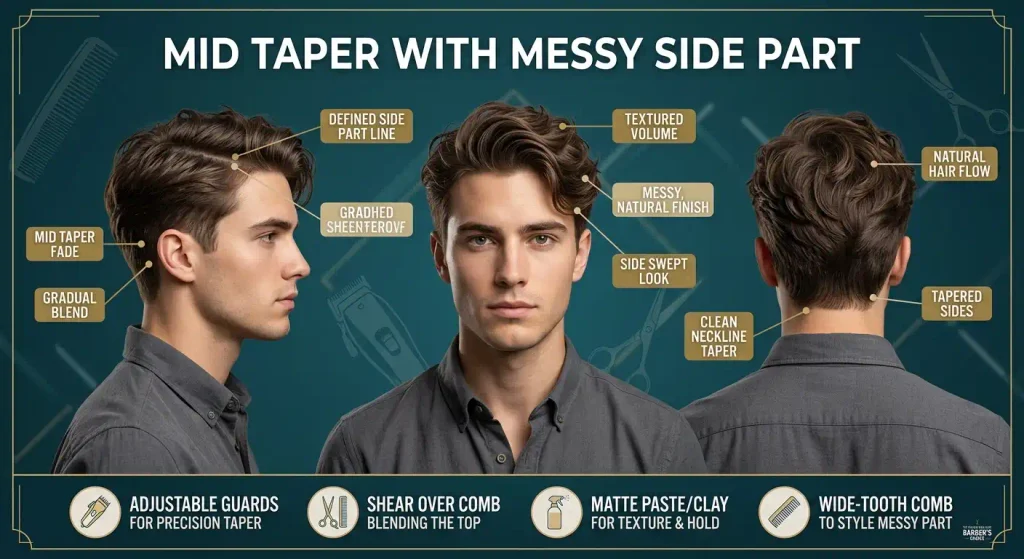
14. Mid Taper with Messy Side Part
A soft side part provides direction without making the haircut look formal. The barber can preserve enough top length to move the hair across naturally, while the mid taper gives the sides a clean transition. Straight and wavy hair are both suitable. Longer faces can benefit from keeping some side fullness. Use a lightweight matte cream, create the part with your fingers, and sweep the hair across without pressing it flat.
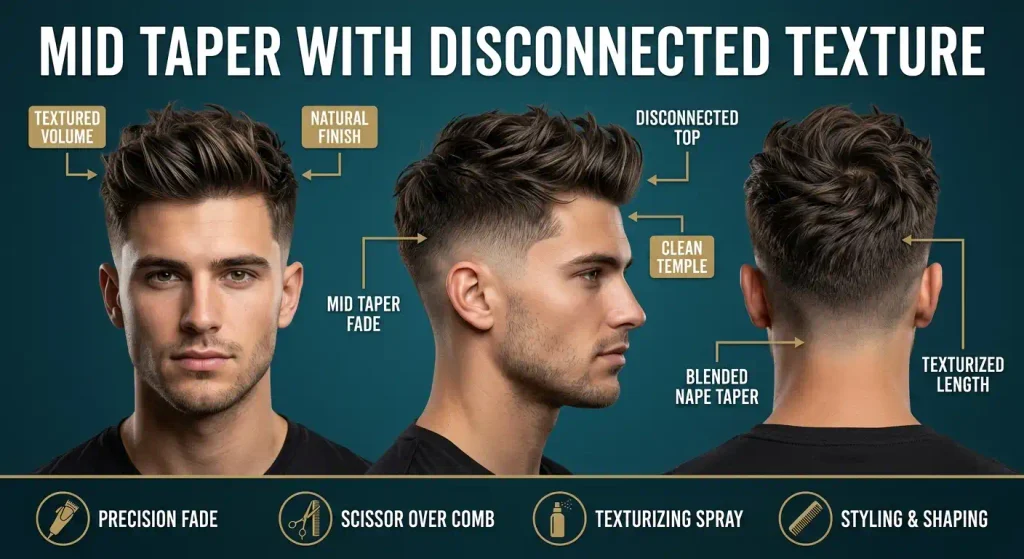
15. Mid Taper with Disconnected Texture
The top has a more noticeable visual break from the tapered sides, although it should still blend enough to avoid looking like a harsh undercut. Ask your barber to maintain top length and use scissor work to create separation. Thick hair is ideal because it holds the stronger shape. Square and oval faces usually suit the added structure. Matte clay gives the best finish. Push several top sections apart to emphasize the disconnected texture.
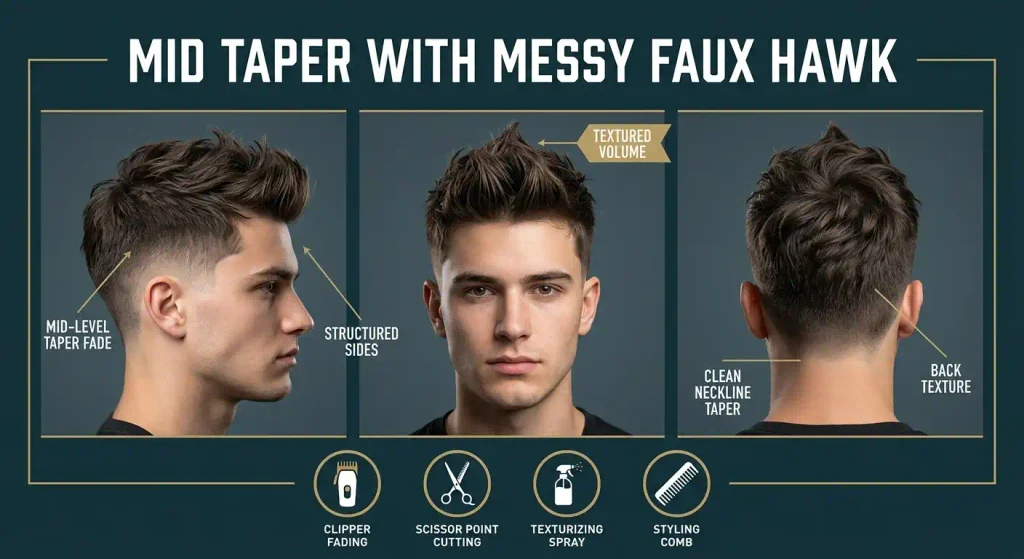
16. Mid Taper with Messy Faux Hawk
The faux hawk direction sends the top toward the center without creating a rigid mohawk. A mid taper gives the sides enough contrast to highlight the central texture. Thick, straight, or wavy hair works particularly well. Ask for a #0 or #1 around the lower taper and a controlled transition upward. This style can add height to round faces. Apply matte paste and use your fingertips to lift the center while keeping the edges loose.
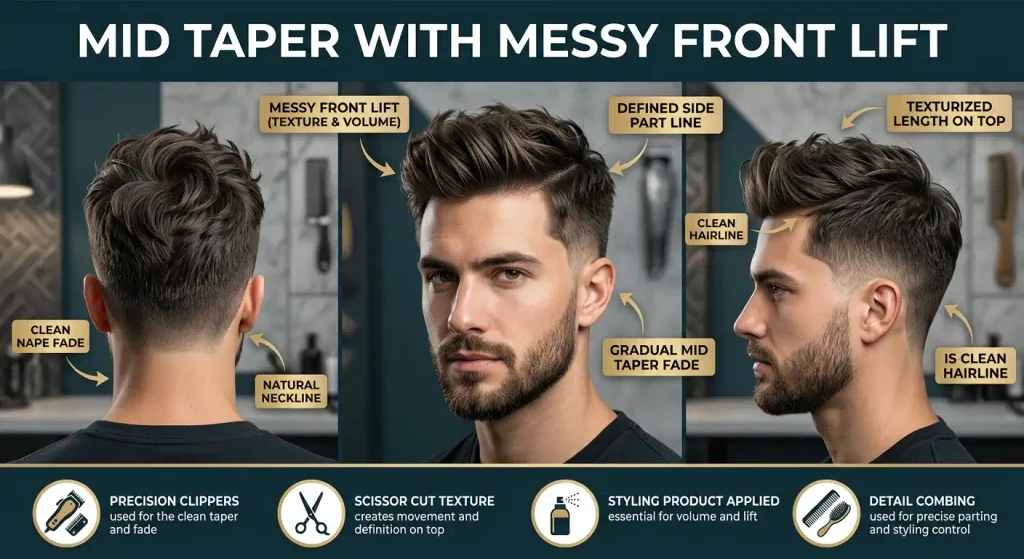
17. Mid Taper with Messy Front Lift
Rather than building a full quiff, this version concentrates volume at the front. The top remains medium length with textured ends, while the mid taper creates a cleaner frame around the face. Straight and wavy hair are easy to manage this way. Oval and round faces can benefit from the added vertical lift. Use a blow dryer with your fingers to raise the front, then apply a small amount of texture clay to hold the separation.
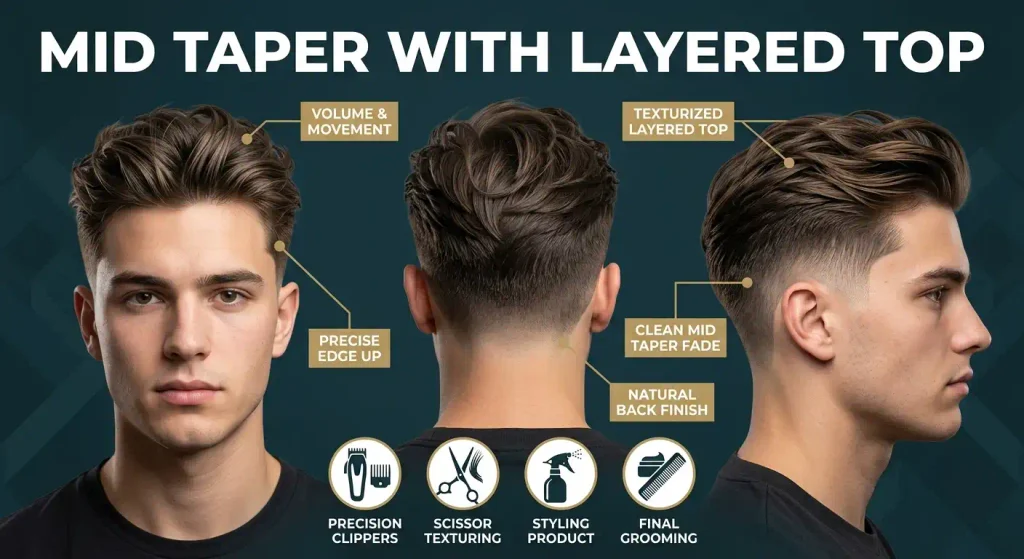
18. Mid Taper with Layered Top
Several layers create movement throughout the top instead of concentrating everything at the fringe. This is useful for thick hair that feels heavy when left at one length. Ask for scissor layering and point cutting, with the taper blended around the sides and neckline. The style works on oval, square, and heart-shaped faces. A lightweight styling cream works well for wavy hair, while matte clay gives straighter hair more definition.
19. Mid Taper with Messy Comb-Over
The comb-over becomes more casual when the part is soft and the top is left slightly disordered. The barber should preserve enough length to move the hair across without creating a thin-looking top. A #1 to #3 transition can form the tapered sides, depending on how much contrast you want. This works especially well with straight, medium-density hair. Use a matte cream and arrange the hair with fingers instead of a comb.
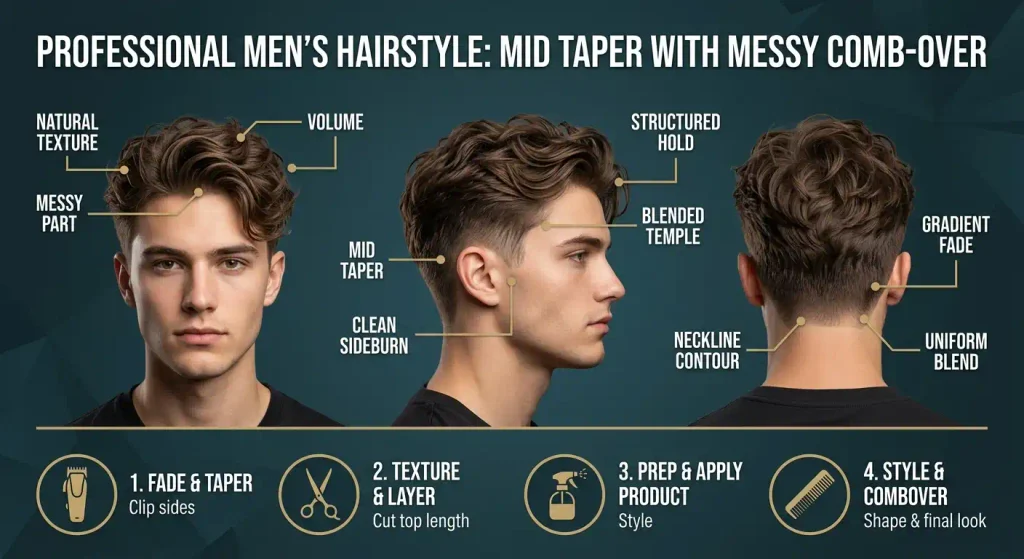
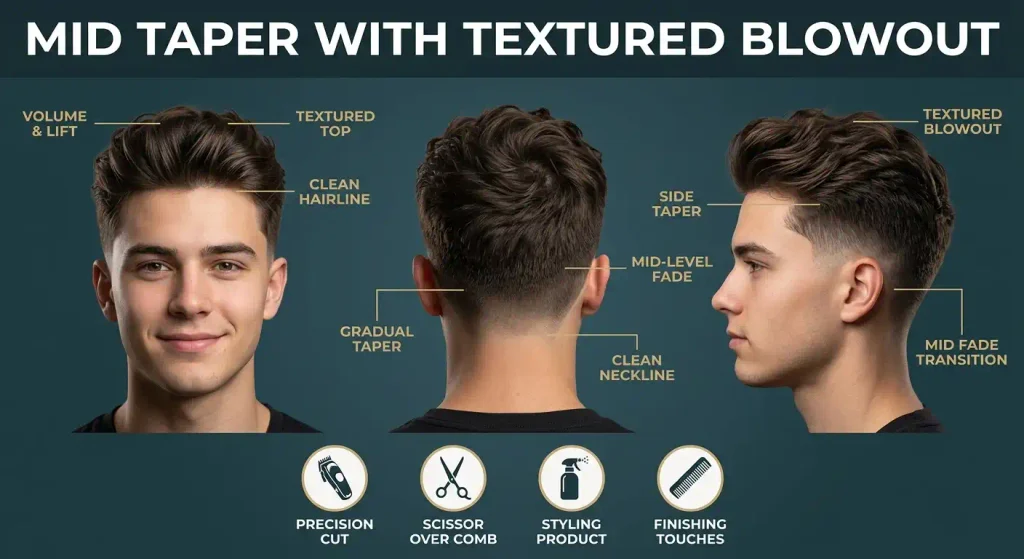
20. Mid Taper with Textured Blowout
A textured blowout pushes the top upward and outward for a fuller silhouette. The taper keeps the sides controlled so the volume does not overwhelm the entire head. Thick and wavy hair are natural matches, though straight hair can achieve the shape with blow-drying. Oval and rectangular faces handle the height well. Ask for weight control with scissors and clipper-over-comb where needed. Finish with sea salt spray and a light matte product.
3. Fluffy, Wavy and High-Volume Looks
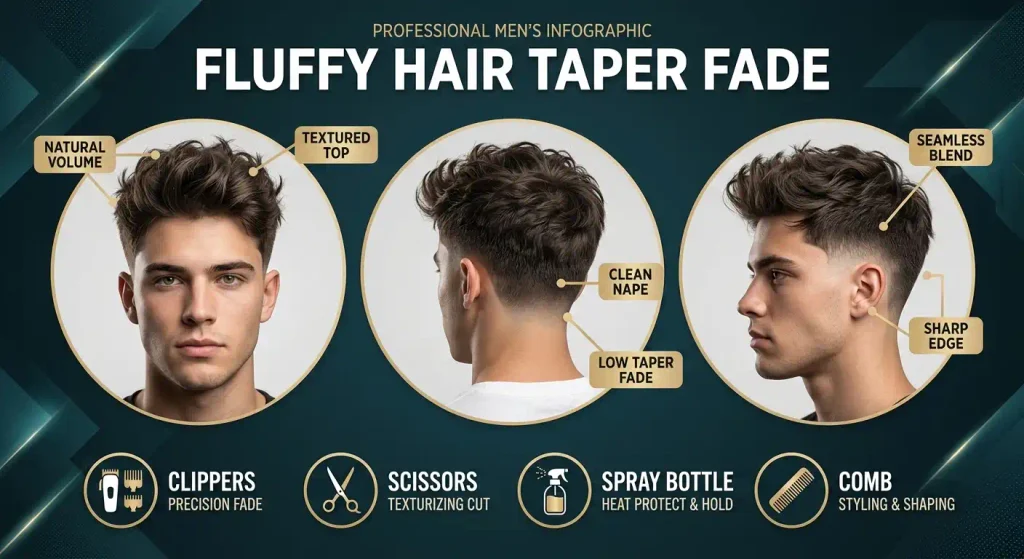
21. Fluffy Hair Taper Fade
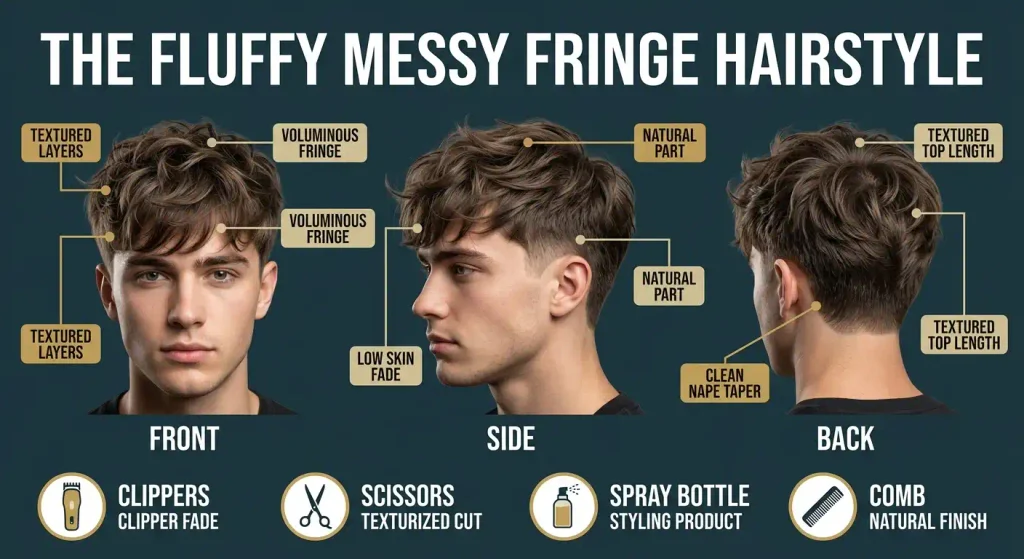
Fluffy hair depends on volume and movement rather than a hard, polished shape. Keep the taper clean around the lower sides while leaving the top long enough to expand naturally. A #1 through #3 blend can work, depending on how tight you want the perimeter. Thick and wavy hair are especially suitable. Oval and square faces balance the volume well. Use sea salt spray before drying, then shape the top with your fingers instead of pressing it down.
22. Fluffy Messy Fringe
This look combines a fuller fringe with airy volume behind it. The front should remain soft and broken up rather than forming a solid curtain across the forehead. Thick, straight, or wavy hair can create the needed fullness. A low taper keeps the sides from competing with the fringe. Round faces may look better with slight upward lift at the front. Use a light texture spray, blow-dry gently, and finish with a small amount of matte cream.
23. Wavy Top with Low Taper
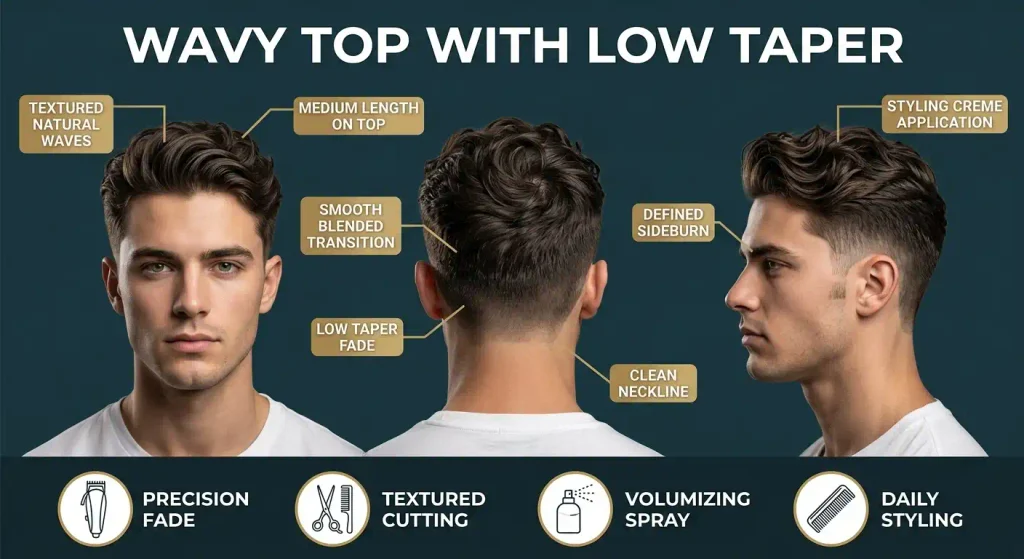
Natural waves make the messy finish easy because the hair already has movement. The taper should stay low, leaving more visual weight around the upper sides and crown. Ask for point cutting instead of aggressive thinning so the waves remain grouped. This shape works especially well for oval, heart, and square faces. Scrunch a small amount of lightweight curl cream into damp hair, then let the waves dry naturally or diffuse them gently.
24. Wavy Top with Mid Taper
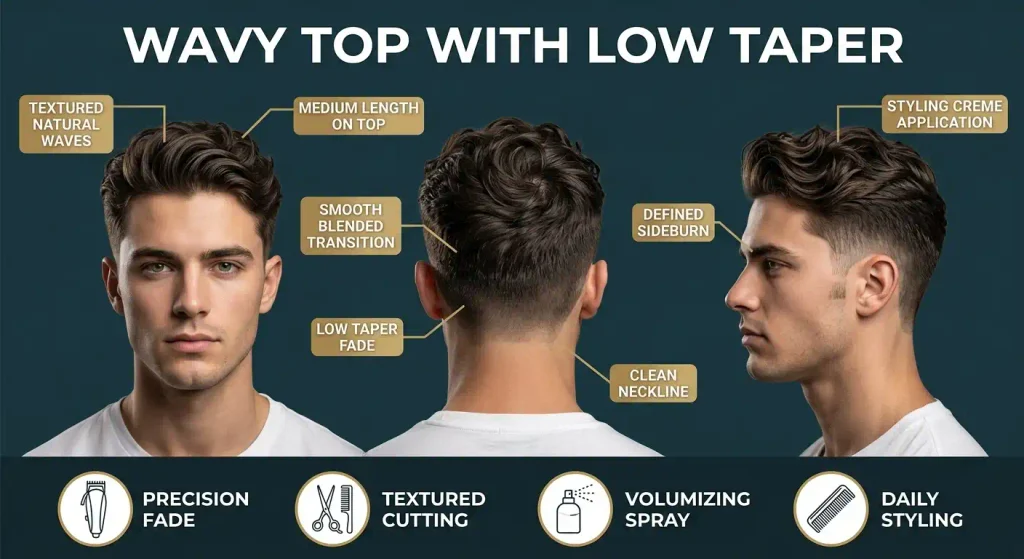
A mid taper gives natural waves a more defined frame. It creates stronger side contrast than a low taper while leaving enough length for the wave pattern to show. The barber should work with the hair’s natural direction rather than cutting against it excessively. Wavy, medium-to-thick hair is ideal. Oval and rectangular faces suit the added height. Apply sea salt spray or a light curl cream, then shape the waves with your fingers.
25. Fluffy Crown with Taper
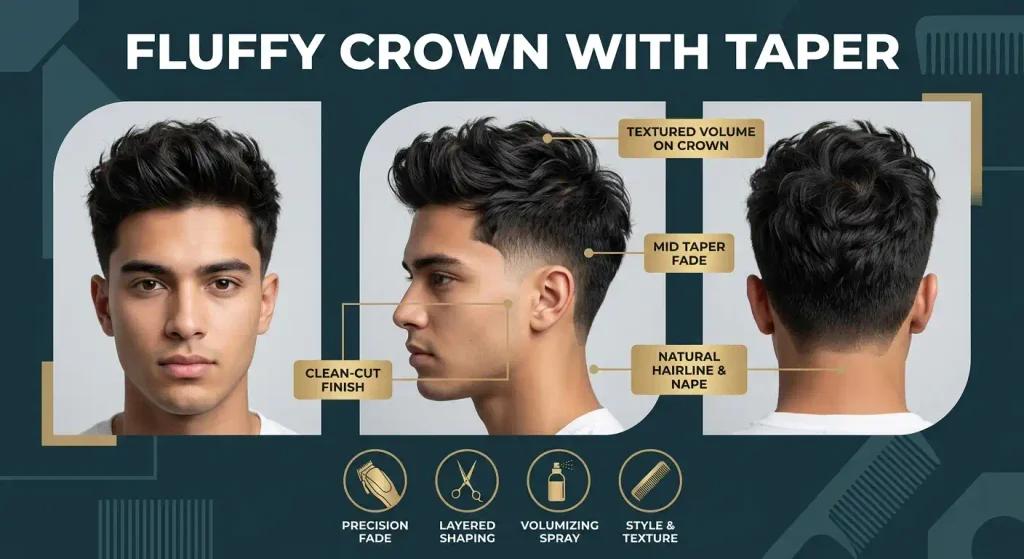
The crown becomes the focal point in this version. Leave enough length through the upper back and crown, while the taper keeps the lower perimeter tidy. Point cutting can remove excess weight without destroying the fluffy effect. Thick hair is especially useful, although medium-density waves can also work. Oval faces suit the balanced volume, while longer faces should avoid excessive height. Use a light styling cream and lift the crown with your fingers.
26. Messy Blowout with Taper
A blowout creates a fuller silhouette with the hair directed upward and backward. The taper provides contrast around the sides without forcing the top into a neat shape. Thick straight or wavy hair holds the style best. Ask the barber to use scissors for the top and clipper-over-comb where the sides need controlled weight removal. Blow-dry with your fingers, add sea salt spray for grip, and finish with matte paste around the ends.
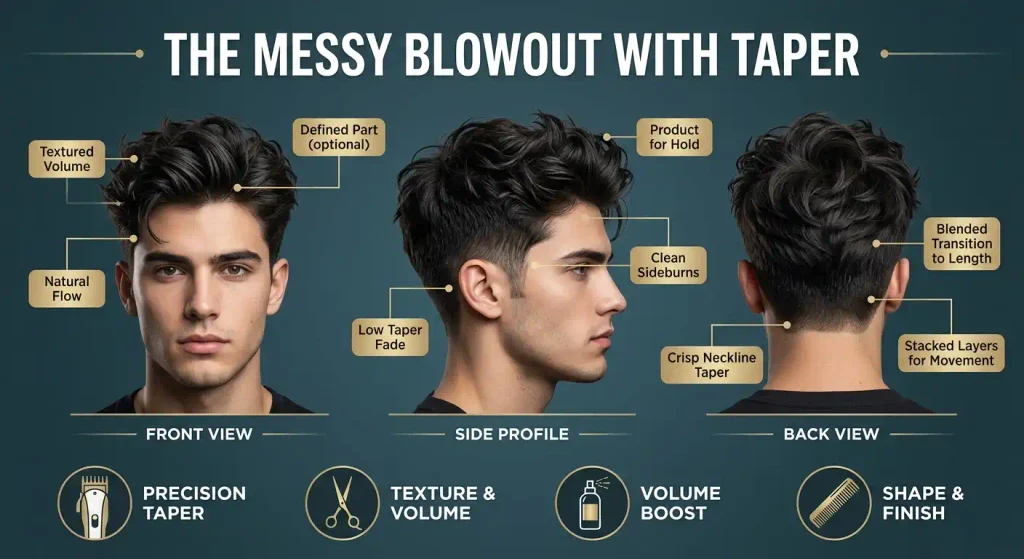
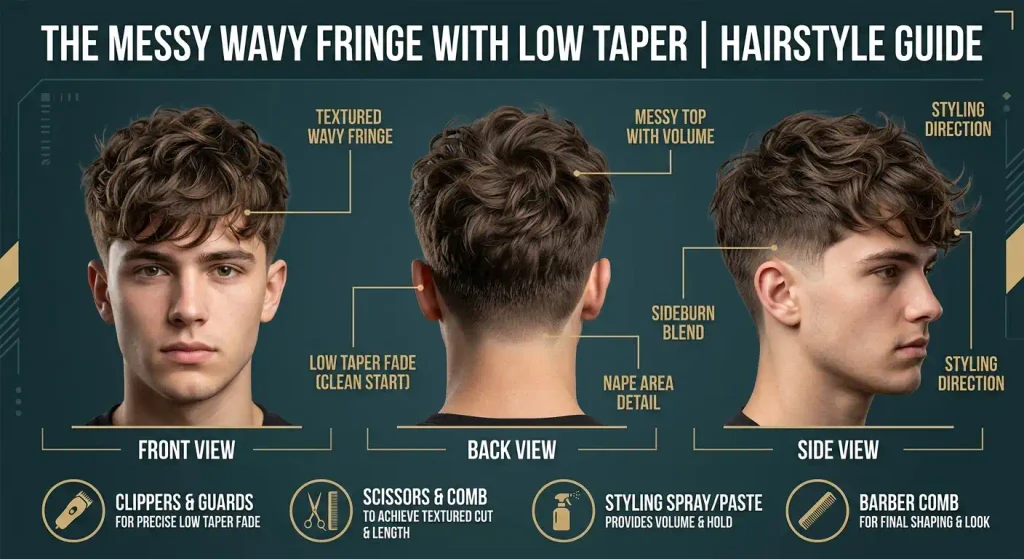
27. Messy Wavy Fringe with Low Taper
Wavy fringe creates a relaxed shape across the forehead while the low taper keeps the outline neat. The barber should preserve the wave pattern and avoid making the fringe too short. This works well for naturally wavy hair and can also suit loose curls. Oval and heart-shaped faces are strong matches. Use curl cream on damp hair, scrunch gently, and allow the fringe to settle without repeatedly combing it.
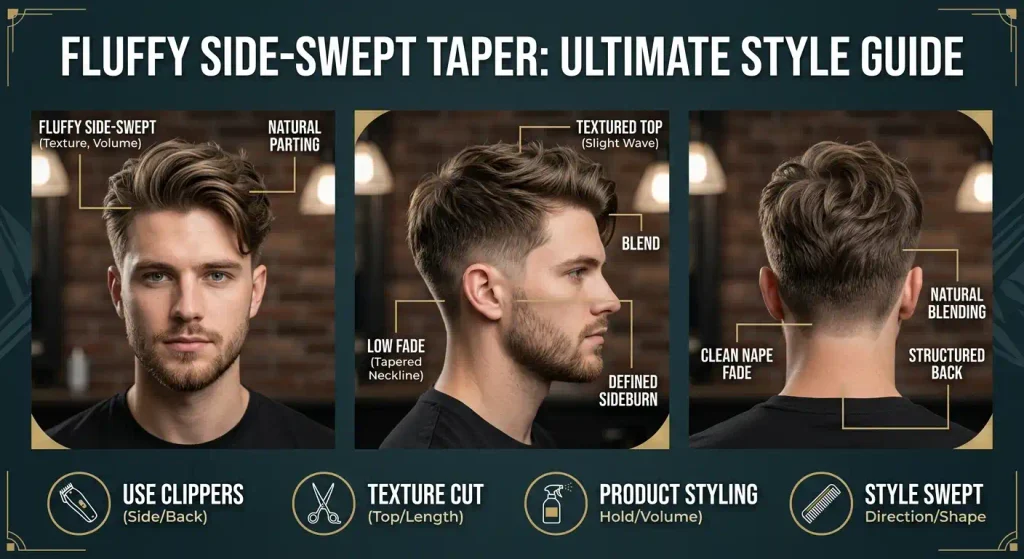
28. Fluffy Side-Swept Taper
The top is directed sideways while keeping its natural volume. Unlike a classic side part, the finish should remain loose and airy. A low or mid taper can work, but a low taper gives the softest result. Thick straight and wavy hair are suitable. Round faces can benefit from some side direction and height. Use sea salt spray for volume, then shape the top with your fingers and a small amount of matte cream.
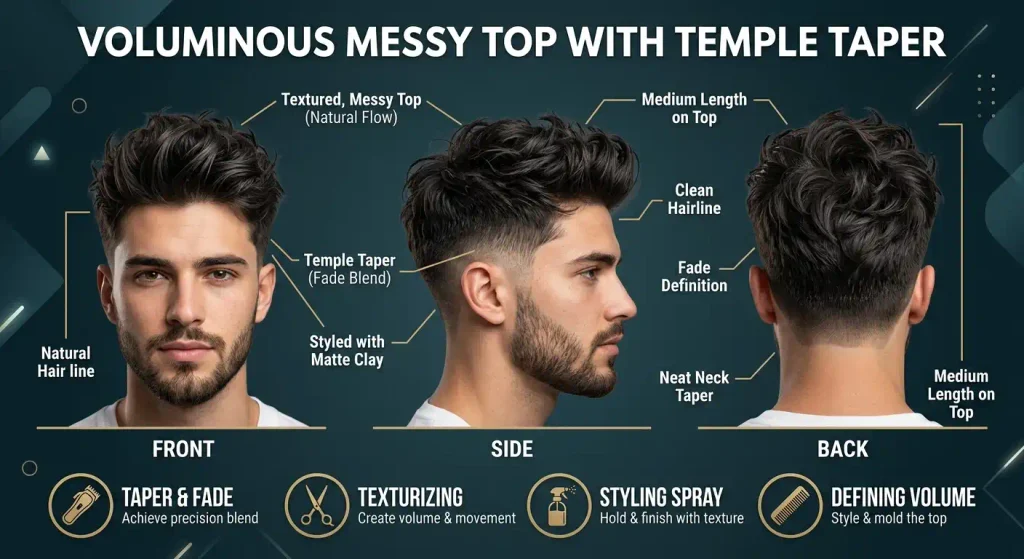
29. Voluminous Messy Top with Temple Taper
This option keeps most of the side hair intact while cleaning the temple and neckline areas. It is useful for men who want volume without a large fade. The barber can detail the temples with a #0 or #1 and blend softly into the surrounding hair. Thick or wavy textures work well. Most face shapes can wear the balanced proportions. A lightweight styling cream adds control while preserving the natural fullness.
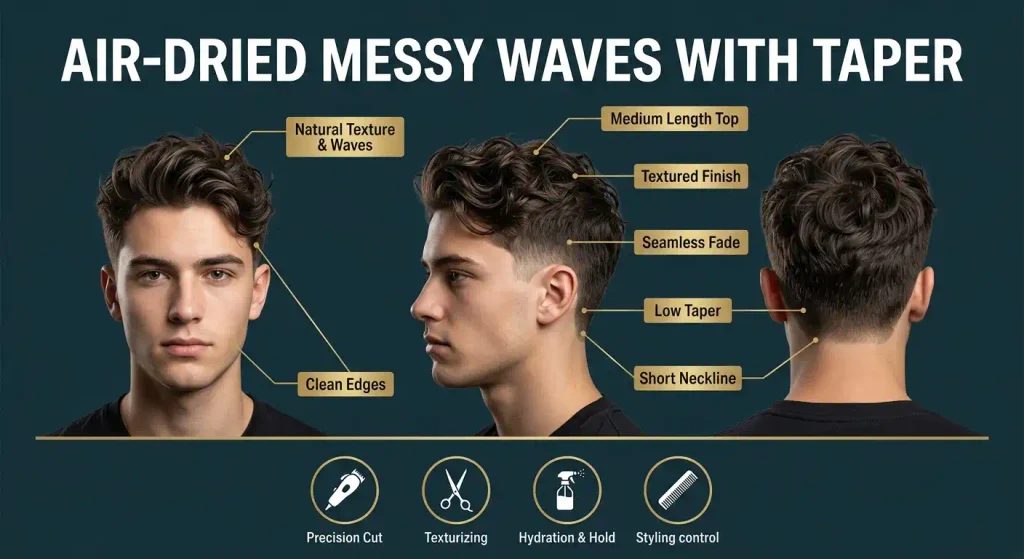
30. Air-Dried Messy Waves with Taper
For a low-effort routine, let the natural wave pattern create most of the texture. The taper gives the haircut enough structure that the top can remain casual without appearing neglected. Ask the barber to use point cutting where the top needs shape and avoid excessive thinning. Wavy hair is the clear match. Oval and square faces work particularly well. Apply a light curl cream to damp hair, scrunch, and let it dry naturally.
4. Curly, Coiled and Textured Hair Options
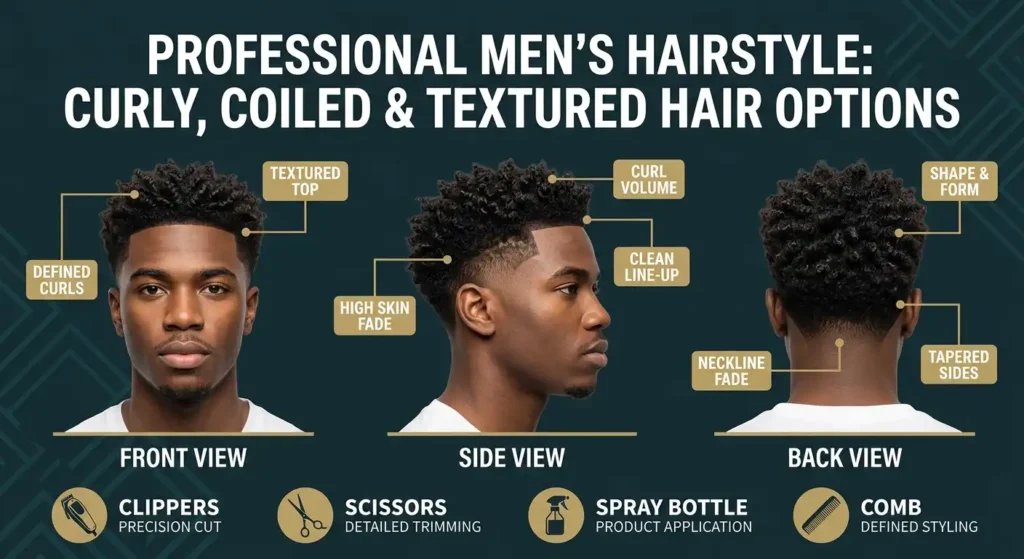
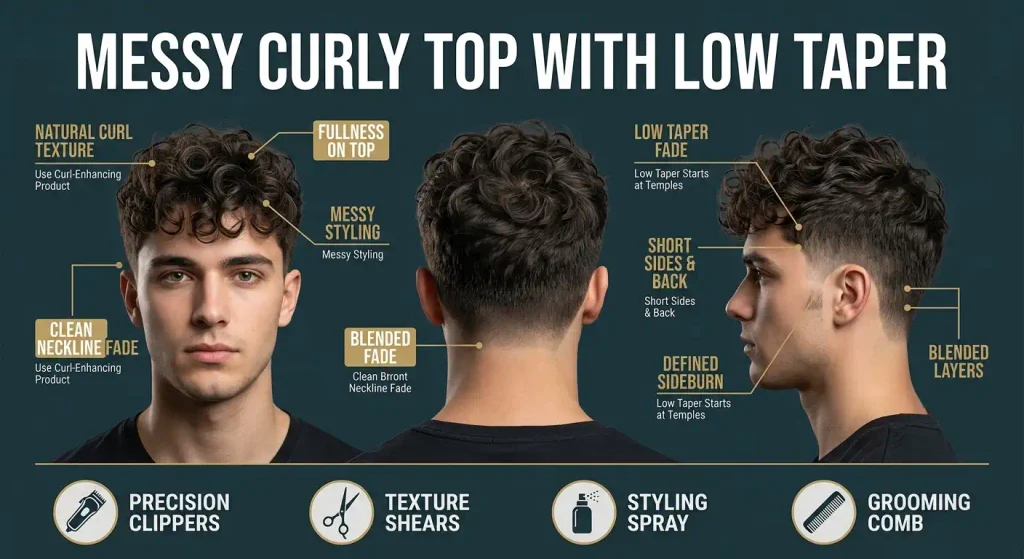
31. Messy Curly Top with Low Taper
Natural curls become the main feature while the low taper cleans up the perimeter. The top should retain enough length for the curls to form rather than being cut too short. Depending on curl density, the barber can use scissors and controlled clipper work around the sides. Oval and square faces often suit the balanced volume. Curl cream is the key styling product. Apply it to damp hair, scrunch the curls, and avoid brushing once the pattern forms.
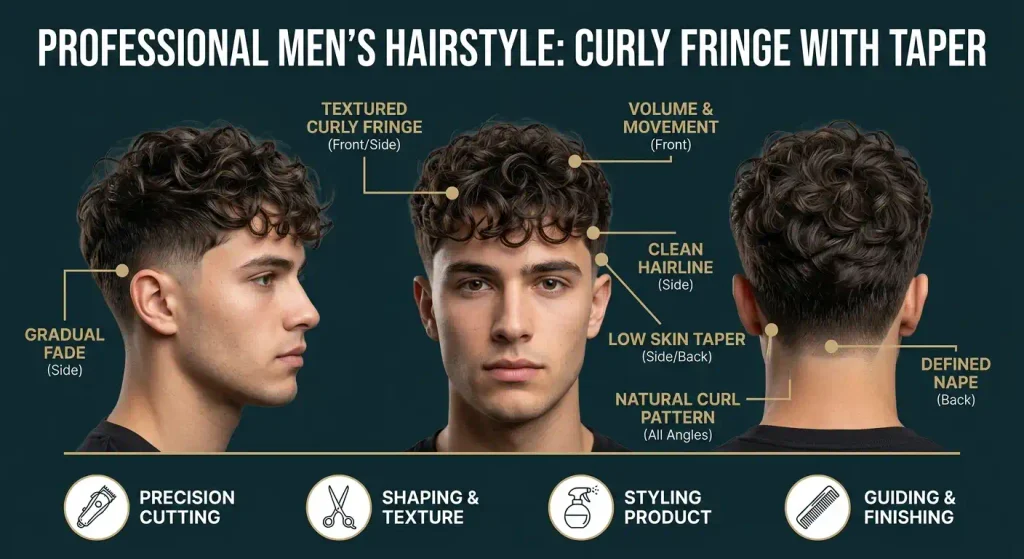
32. Curly Fringe with Taper
Let the curls fall slightly toward the forehead for a softer silhouette. The taper should remain low or moderate so the curly fringe remains visually dominant. Curly hair needs careful length control because it can appear shorter after drying. Ask the barber to assess the hair in its natural curl pattern before removing too much length. Heart and oval faces suit the shape. Use curl cream and lightly separate the front with your fingertips.
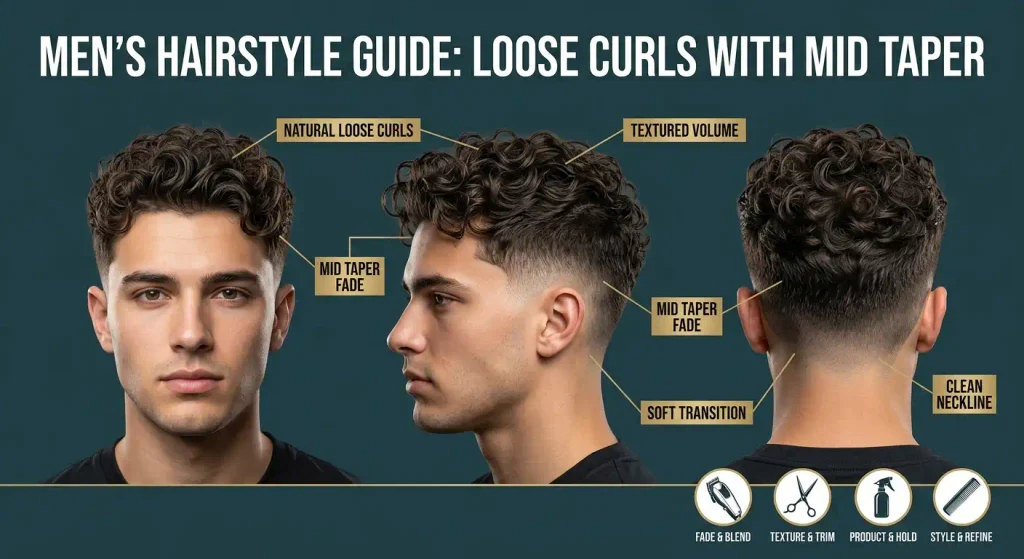
33. Loose Curls with Mid Taper
A mid taper gives loose curls more contrast and makes the top appear fuller. Keep the curl length consistent enough to avoid a patchy shape, while using selective scissor work to control bulk. This style suits medium-to-thick curly hair. Oval, square, and rectangular faces can handle the stronger sides-to-top contrast. Apply a light curl cream to damp hair and scrunch upward. A diffuser can help dry the curls while preserving their shape.
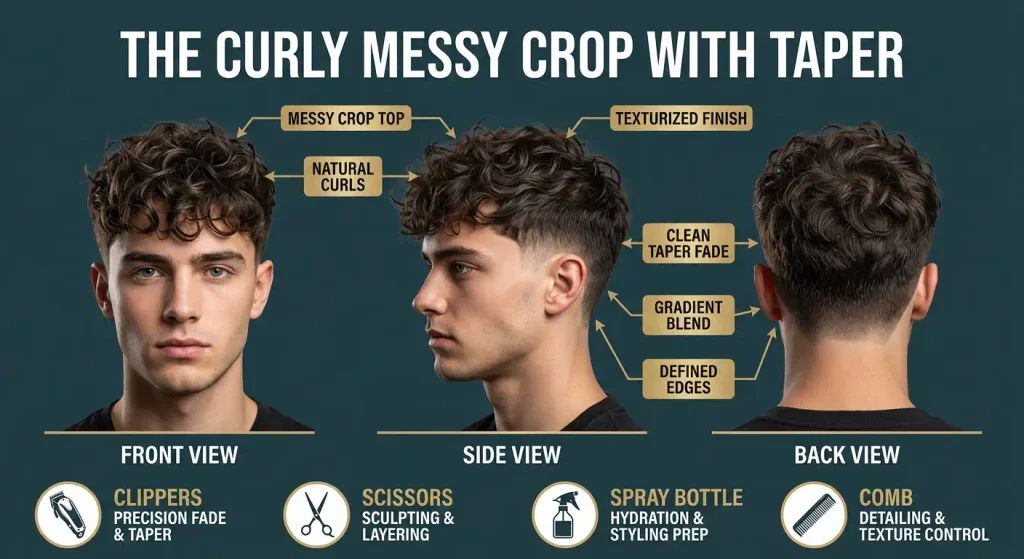
34. Curly Messy Crop with Taper
Shorter curls create a compact, easy-to-maintain version of the look. The front can sit forward while the top remains visibly textured. A low taper creates a softer finish, while a mid taper makes the haircut bolder. Curly and coily hair can both work when the top has enough length. Round and oval faces suit the compact profile. Use curl cream or a light leave-in product, then shape the front with your fingers.
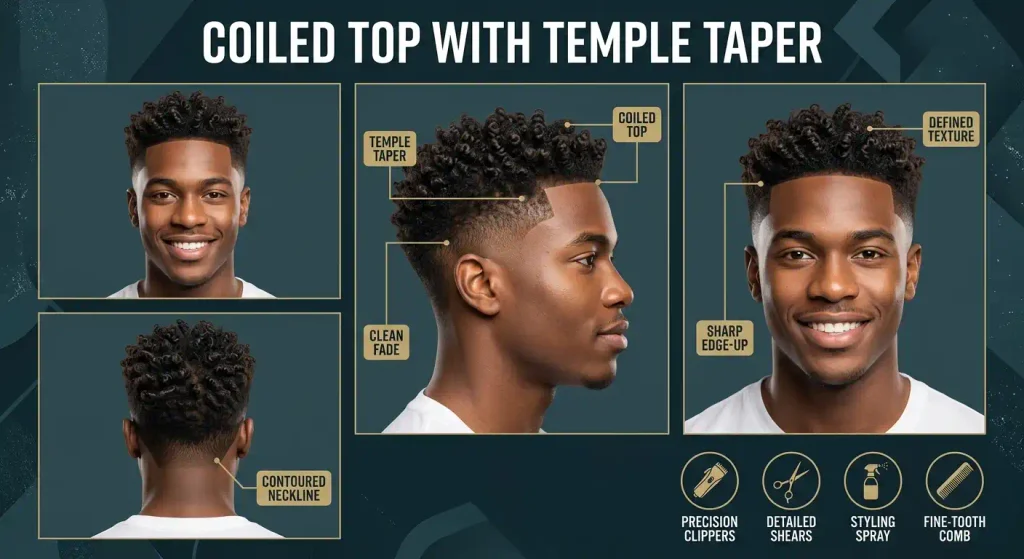
35. Coiled Top with Temple Taper
A temple taper is a strong choice when you want to preserve more of the natural shape around the sides. The temple and neckline receive the cleanup while the coiled top remains full. Depending on density, the barber may use clipper-over-comb to control the transition without flattening the curls. This works well with coily textures and oval or square faces. Apply a curl cream or leave-in conditioner and define the coils gently.
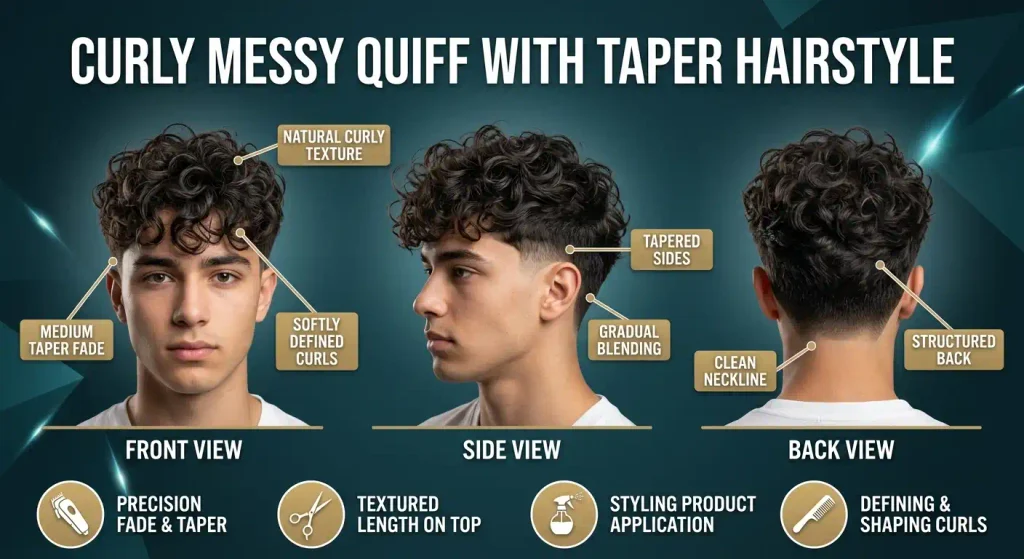
36. Curly Messy Quiff with Taper
Curly hair can form a textured quiff without needing a perfectly sculpted finish. Leave extra length toward the front and crown, then create a controlled taper around the sides. The barber should work with the curl direction and avoid excessive thinning. Oval and rectangular faces can benefit from the upward shape. Use curl cream on damp hair, lift the front with your fingers, and allow the curls to settle naturally.
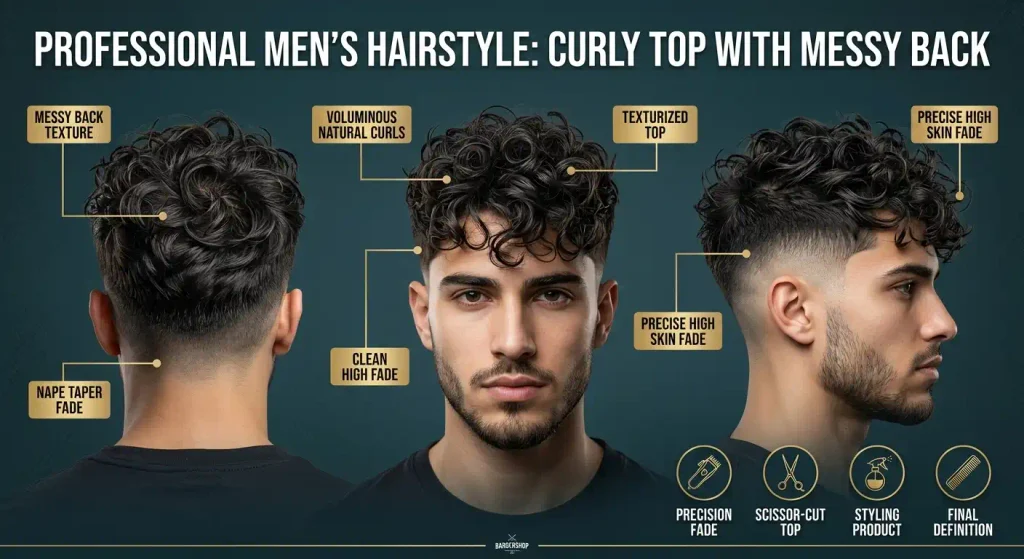
37. Curly Top with Messy Back
This version allows the curls to continue toward the back rather than stopping at the crown. The taper cleans the neckline while preserving a fuller upper shape. It works best when the curls have medium or longer length. Oval and heart-shaped faces suit the softer outline. Ask your barber to maintain the curl pattern and avoid taking too much weight from the back. Use curl cream and scrunch from the ends upward.
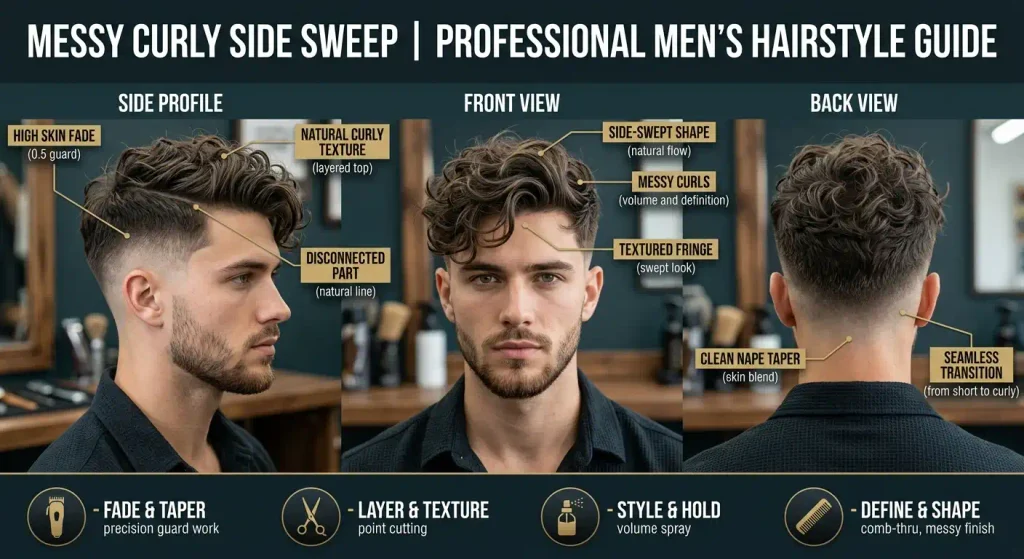
38. Messy Curly Side Sweep
Directing curls loosely to one side creates an asymmetrical but relaxed finish. The taper keeps the lower sides controlled without overpowering the curl pattern. Medium-to-long curly hair is the best match. Square and oval faces can carry the side movement particularly well. Use a lightweight curl cream and guide the curls sideways with your fingertips. Avoid brushing the hair dry, since that can disrupt the natural curl grouping.
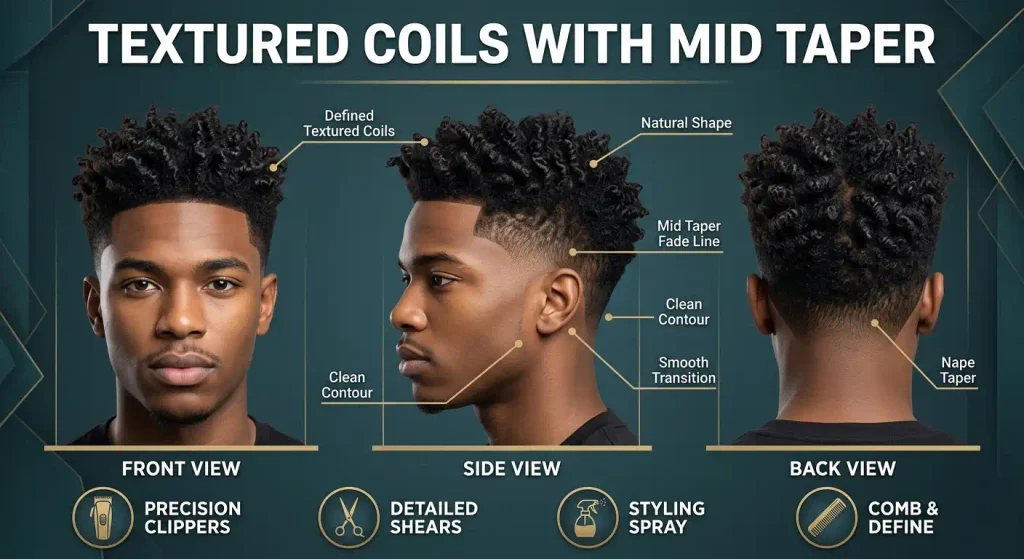
39. Textured Coils with Mid Taper
A mid taper adds definition around dense textured hair while leaving the top strong and full. The barber can use careful clipper-over-comb work around the transition and scissors where the top needs shape. Avoid trying to make the top perfectly even; natural variation is part of the finish. This style suits oval and square faces. Use a lightweight moisturizing cream and gently separate the coils rather than forcing them into a rigid pattern.
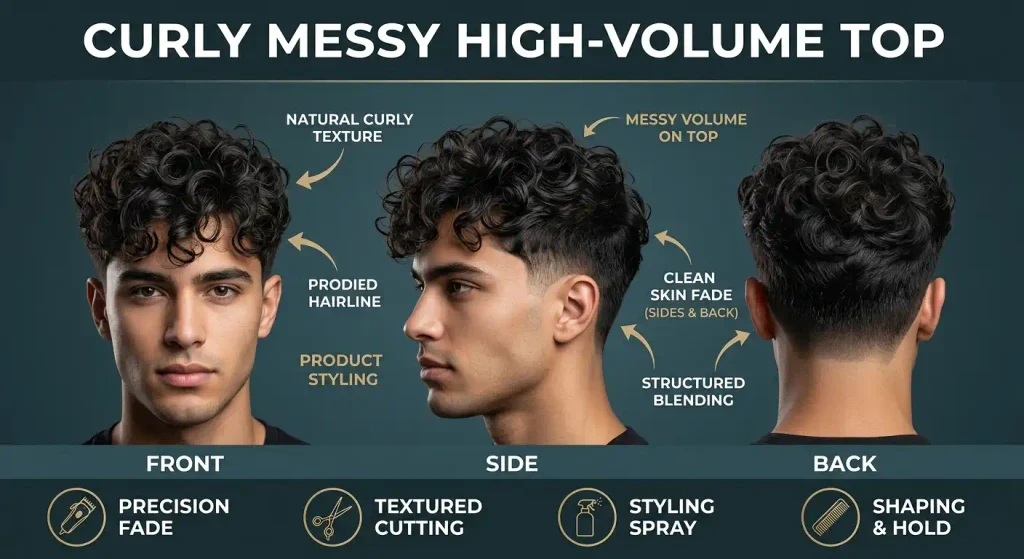
40. Curly Messy High-Volume Top
Maximum top volume makes this the boldest curly option in the collection. The taper should provide enough contrast to define the sides, but the top needs substantial length and density. Curly or coily hair with strong natural volume is ideal. Round faces can benefit from the added vertical shape, while long faces should keep the volume broader rather than excessively high. Use curl cream, diffuse gently, and avoid heavy products that collapse the curls.
5. Fringe, Crop, Shag and Statement Variations
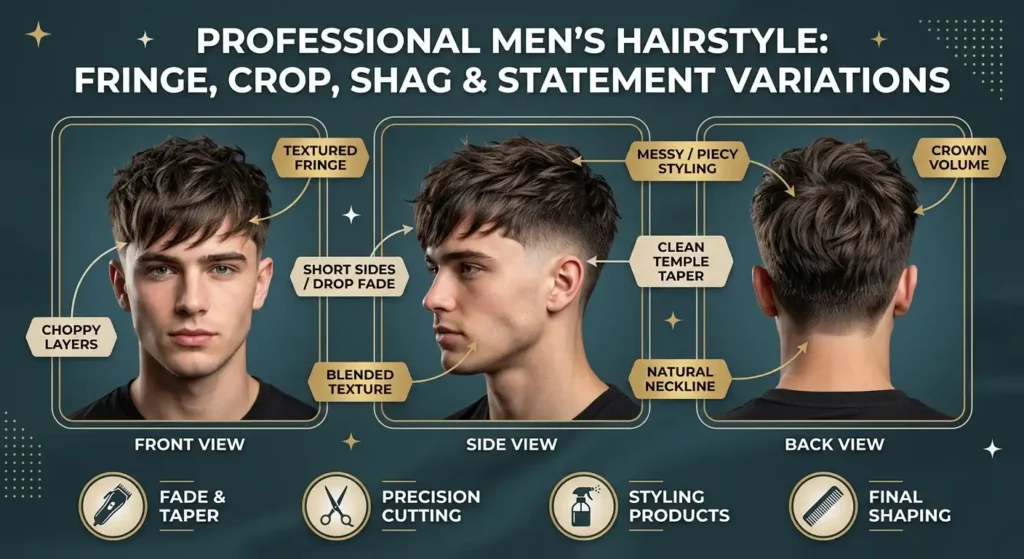
41. Messy French Crop with Taper
A French crop gives you a shorter top while keeping visible texture through the fringe and crown. The taper cleans the sides without taking the haircut into a full skin fade. Straight, thick, and slightly wavy hair work well. Oval and square faces suit the compact shape, while a textured fringe can soften stronger features. Ask for point cutting through the top and an irregular fringe. Matte clay gives the crop a dry, separated finish.
42. Messy Textured Crop with Mid Taper
This variation increases the side contrast while keeping the crop short and practical. The top should have several distinct pieces rather than one flat surface. A #1 or #2 can form the lower taper before transitioning into longer hair. Thick straight hair is especially easy to shape. Round and oval faces can benefit from a slightly raised front. Apply matte clay and pinch the top sections forward to create controlled disorder.
43. Messy Shag with Low Taper
A shag-inspired top gives the haircut more length around the crown and back while the low taper cleans the perimeter. This is a good choice for men who want movement rather than a traditional short haircut. Wavy and thick hair show the layered shape particularly well. Oval and heart-shaped faces are natural matches. Ask for scissor layering and point cutting. Use sea salt spray and let the hair fall into its natural direction.
44. Messy Fringe with Temple Taper
The fringe remains the main feature, while only the temples and neckline receive a tight cleanup. This gives you a softer alternative to a more noticeable fade. Straight and wavy hair work well, especially with medium density. A round face can benefit from keeping the fringe slightly lifted rather than completely flat. Ask for a #0 or #1 temple taper and textured fringe. Use matte cream to separate the front without making it stiff.
45. Messy Middle Part with Taper
A middle part becomes more casual when the two sides are not perfectly symmetrical or flat. Leave enough length to let the hair split naturally, then clean the lower sides and neckline with a low taper. Straight and wavy medium-length hair are ideal. Oval and heart-shaped faces often suit the balanced part. Use sea salt spray for movement, then guide both sides away from the center with your fingers.
46. Messy Curtains with Low Taper
Curtains offer a softer, longer version of the style. The taper stays low so the sides retain enough weight to connect with the curtain shape. Wavy or straight medium-to-long hair works best. Oval and heart-shaped faces can look especially balanced with the center opening. Ask the barber for soft layering rather than a blunt cut. Use lightweight styling cream and let the curtain sections fall naturally around the face.
47. Messy Slick-Back with Taper
This is not a glossy pompadour. Instead, the hair moves backward with visible texture and a slightly imperfect finish. The taper can be low or mid, depending on the contrast you want. Medium-to-thick straight or wavy hair is easiest to manage. Oval and rectangular faces work well with the backward direction. Apply a small amount of matte cream to damp hair, blow-dry backward with your fingers, then break up the finish with your hands.
48. Messy Faux Hawk with Low Taper
The low taper makes the faux hawk less aggressive than a high fade version. Hair from the front toward the crown is directed toward the center, but the edges remain loose. Thick straight or wavy hair can hold the shape naturally. Round faces may benefit from the added height. Ask for textured length through the top and a conservative #0/#1 low taper. Use matte clay and pinch the center upward without making it rigid.
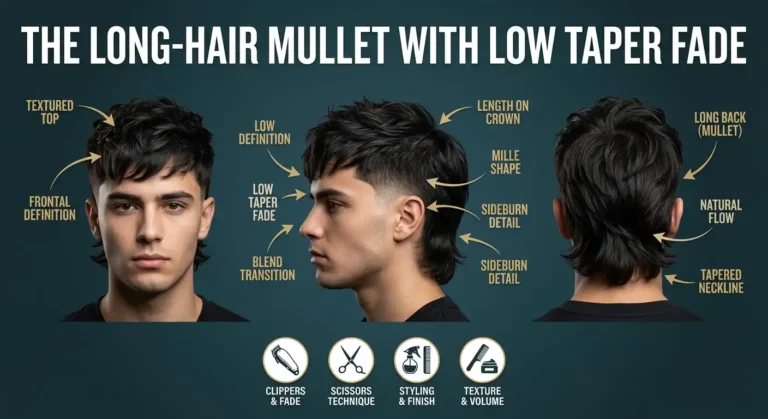
49. Messy Taper Mullet
A modern messy mullet leaves more length toward the back while the taper cleans the sides and neckline. The top should remain layered and loose rather than slicked down. Wavy and thick hair make the transition especially noticeable. Oval and heart-shaped faces can suit the longer back, while round faces may benefit from more height on top. Tell your barber to preserve deliberate length in the back. Use sea salt spray or matte cream for separated texture.
50. Long Messy Top with Clean Taper
For men who want the most freedom on top, keep substantial length while maintaining a clean lower perimeter. The barber can use a low taper and scissor work through the top to remove unwanted weight without sacrificing length. Wavy and thick hair are particularly strong candidates. Oval and square faces can carry the fuller shape well. Use a lightweight cream for natural movement or sea salt spray when you want more texture. This is the most flexible option for growing out the top.
How to Ask Your Barber for the taper fade messy hair Cut
A good barber request should explain where the taper sits, how tight the lower section should be, how much length you want on top, and how you want the texture finished.
Copy-and-Paste Barber Script
“I want a low-to-mid taper around the ears and neckline, starting around a #0 or #1 and blending smoothly into longer hair. Keep the top long enough for a messy, textured finish. Use scissors and point cutting on top rather than making it one solid length. I want natural movement, not a slick or overly polished finish. Please keep the transition soft and show me the shape before taking more length off the top.”
Variation Add-Ons
- For a low taper: “Keep the taper low and close to the natural hairline. I want plenty of weight above the ears.”
- For a stronger mid taper: “Bring the taper higher around the sides, but keep the top full.”
- For curls: “Please cut with my natural curl pattern in mind and avoid removing too much length.”
- For a fluffy finish: “Keep the top airy and full. Remove weight selectively, but don’t flatten the volume.”
- For fringe: “Leave enough length at the front for a broken, textured fringe instead of a straight blunt line.”
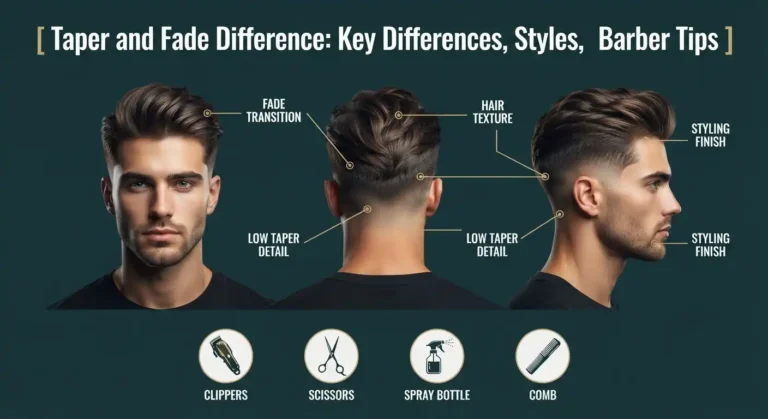
Taper Fade messy hair Cut vs Other Fade Options
| Haircut option | Typical starting area | Common guard range* | Best face shapes | Styling difference |
| Low taper | Near ears/neckline | #0–#2 | Most shapes | Soft, natural contrast |
| Mid taper | Around temple area | #0–#3 | Oval, square, round | Stronger side contrast |
| High fade | Higher on sides | #0–#2+ | Oval, square | Dramatic contrast |
| Skin fade | Very short to skin | Skin/#0–#2 | Oval, square | Sharpest finish |
| Temple taper | Temples + neckline | #0–#2 | Most shapes | Preserves side fullness |
| Burst fade | Around ear | #0–#2+ | Oval, round | Curved side profile |
| Taper with messy top | Varies | #0–#3 | Most shapes | Natural textured top |
*Guard selection varies with hair density, the desired transition, clipper system, and the barber’s blending method.
Why the Combination Works
The appeal comes from contrast. The sides and neckline look controlled, while the top has movement and personality. That means you do not need to choose between a very polished haircut and a completely loose one.
It is also adaptable. Straight hair can use point cutting and matte products for separation. Wavy hair already has movement. Curly and coily hair can use the natural pattern as the messy texture.
Lifestyle matters too. A low taper with a loose top is easier to make work in a professional setting than an aggressive high fade with a dramatic design. A mid taper, meanwhile, gives a stronger fashion-forward shape.
How to Style Taper Fade Messy Hair
- Start with clean hair. Remove excess oil and product buildup so the top can move freely.
- Towel-dry gently. Leave the hair slightly damp if you are using cream, curl product, or sea salt spray.
- Choose the product for your texture. Fine or straight hair often benefits from texture spray. Thick hair usually needs a matte product. Curls need moisture and definition.
- Apply sparingly. Spread the product between your palms before touching the hair.
- Use your fingers. Push, twist, lift, and separate small sections rather than combing everything into one direction.
- Dry according to the style. Blow-dry upward for volume, backward for a messy slick-back, or let curls air-dry when you want natural definition.
- Break up the finish. Once dry, loosen any sections that look too neat.
- Check the sides. The taper should stay clean while the top carries the relaxed texture.
Step-by-Step Cutting Tutorial of Taper Fade Messy Hair
A professional barber should perform the actual cut, especially around the taper and neckline.
Tools Required
- Adjustable professional hair clipper
- Clipper guards #0, #1, #2, #3 and #4
- Trimmer for detail work
- Barber scissors
- Texturizing or thinning shears when appropriate
- Barber comb
- Neck duster
- Spray bottle
- Blow dryer
- Styling product for the finished texture
Basic Barbering Sequence
- Consult first. Confirm taper height, top length, fringe direction, and desired amount of texture.
- Section the top. Separate the longer top from the sides before starting the taper.
- Establish the lowest taper. Use the clipper’s shortest setting or an appropriate #0/#1 guard around the lower perimeter.
- Build the transition. Move through #1, #2, and longer guards as needed, using the lever and controlled flicking motion to soften lines.
- Use clipper-over-comb. Where the sides carry extra weight, remove it gradually instead of creating a harsh shelf.
- Shape the top with scissors. Preserve enough length for the selected messy style.
- Point cut for movement. Cut into the ends selectively to create separation and reduce a heavy, blunt appearance.
- Connect the top and sides. Check the haircut from the front, profile, and back before final detailing.
- Detail the taper. Clean around the ears, temples, and neckline without over-tightening the natural shape.
- Style and inspect. The haircut should still look intentional when the top is moved with the fingers.
Best Styling Products and Their Chemistry
Matte Clay
Matte clay is useful when you want grip, separation, and a low-shine finish. Clay-based formulas can help absorb some oil and give the hair a dry, textured feel. They are especially useful for straight or thick hair that needs direction.
Sea Salt Spray
Sea salt sprays are useful for adding texture and grip before styling. They can make straight or wavy hair feel less slippery and help create a more beachy, tousled appearance. If your hair already feels dry, avoid overusing salt-based products.
Curl Cream
Curl cream is the better choice when the messy texture comes from curls or waves. It helps provide slip and definition while reducing the need to manipulate the hair repeatedly. Apply it while the hair is damp and scrunch rather than brushing through dry curls.
Matte Paste or Styling Cream
A matte paste gives more control than a light cream while remaining less glossy than traditional pomade. Styling cream is better when you want movement and softness rather than strong hold.
Best Hair Types and Face Shapes
Straight Hair
Straight hair benefits from point cutting, layering, and matte products. Without some texture, the top can look too flat or uniform.
Wavy Hair
Wavy hair is naturally suited to a messy finish. A low or mid taper can frame the waves without forcing them into a rigid shape.
Curly Hair
Curly hair should be cut according to its natural pattern. Leave enough length for the curls to form and avoid excessive thinning.
Thick Hair
Thick hair has excellent styling potential, but the barber may need to remove internal weight. Scissor work and clipper-over-comb can help control bulk.
Fine Hair
Fine hair can still work. Avoid aggressive thinning and keep enough coverage on top. Texture spray and lightweight matte products can create the appearance of more movement without weighing the hair down.
Oval Face
Almost every variation can work with an oval face. You can choose the taper height based mainly on your preferred level of contrast.
Round Face
A little height on top can create a longer visual profile. Textured quiffs, faux hawks, and lifted fringes can work well.
Square Face
Square faces can handle stronger taper contrast and structured texture. Messy crops, mid tapers, and textured quiffs are good options.
Long or Rectangular Face
Avoid excessive height if you want a balanced profile. A fuller fringe, side-swept top, or lower taper can keep the proportions softer.
Heart-Shaped Face
A textured fringe or medium-length top can balance a narrower chin. Low tapers also help preserve some side weight.
Maintenance and Upkeep Guide
A taper changes noticeably as the shortest areas grow out, so maintenance depends on how crisp you want the perimeter to remain.
Every 2–3 Weeks
Choose this schedule if you want the taper, temples, and neckline to stay very sharp. It is particularly useful for low or mid tapers where the clean transition is a major part of the look.
Every 3–4 Weeks
This is a practical routine for many men. The taper will soften between visits, but the longer messy top can continue looking intentional.
Between Barber Visits
- Wash according to your hair type and scalp needs.
- Use conditioner when your hair needs extra softness.
- Avoid repeatedly brushing textured hair once it has dried.
- Keep product buildup under control.
- Ask your barber to preserve the top length if you are growing it out.
- Do not attempt to recreate a professional taper with kitchen scissors or an unguarded clipper.
Common Mistakes to Avoid
Making the Taper Too High
A high taper can remove more side weight than you intended. If you want a soft, natural appearance, specify the height before the clippers start.
Taking Too Much Off the Top
Messy texture needs enough length to move. Show your barber a reference and agree on the amount of length to remove.
Over-Thinning Thick Hair
Too much thinning can make the top lose its shape. Controlled point cutting is often enough to create movement.
Using Too Much Product
Heavy product can turn a textured style into a greasy or stiff one. Start with a small amount and add more only when necessary.
Making the Messiness Too Uniform
A messy style should have variation. If every strand is pushed into the same direction, the result can look overly styled.
Ignoring Natural Hair Direction
Your hair grows in patterns. Working with those patterns usually produces a better result than forcing the hair into an unnatural position.
Choosing a Taper Without Considering the Top
The taper and top should work together. A very high, tight taper can create too much contrast with a large fluffy top, while a low taper may be better for a softer silhouette.
FAQ: Taper Fade Messy Hair
1. What is the best taper for a messy top?
A low taper is usually the easiest choice if you want a soft, natural look. A mid taper gives more contrast and a sharper appearance. The best option depends on how much side weight you want to keep.
2. Which of the 50 styles is easiest to maintain?
The Low Taper with Natural Messy Texture (#1) is one of the simplest. It relies on your natural hair movement and does not require a precise part or large amount of product.
3. Can I get this look with curly hair?
Yes. Messy Curly Top with Low Taper (#31) and Curly Fringe with Taper (#32) are especially useful starting points. The barber should account for curl shrinkage and preserve enough length for the curl pattern.
4. Is a low taper or mid taper better for fluffy hair?
A low taper usually creates a softer transition and leaves more side weight. A mid taper creates stronger contrast. If you want the airy look from Fluffy Hair Taper Fade (#21), start with a lower taper if you prefer a natural profile.
5. What guard should I ask my barber for?
There is no universal guard number because the correct blend depends on your hair density and desired finish. A common starting point is #0 or #1 at the shortest area, blending through #2 and #3. Your barber can adjust the sequence to avoid visible lines.
6. Is messy hair supposed to look unstyled?
No. The goal is controlled texture, not neglected hair. The sides and neckline provide structure while the top remains deliberately loose.
7. What product is best for straight messy hair?
Matte clay or matte paste is usually a strong choice because it adds texture without a glossy finish. For lighter hair, sea salt spray can add grip before the final styling product.
8. How often should I get the taper cleaned up?
Many men can maintain the shape with a barber visit around every 2–4 weeks, depending on how quickly the hair grows and how sharp they want the taper to remain.
Final Thoughts: Taper Fade Messy Hair
The best version of this haircut is not necessarily the most dramatic one. A good taper should frame the head while the top reflects your natural hair texture and personal style.
For a safe starting point, choose a low taper with natural texture. If you want more contrast, move toward a mid taper. Curly hair can lean into its natural pattern, while straight hair can use point cutting and matte products to create movement.
Bring your barber a reference photo, explain the taper height, and be clear about how much top length you want to keep. That simple conversation can make the difference between a haircut you tolerate and one you genuinely enjoy wearing.
For more men’s haircut inspiration, explore your site’s related low taper fade white boy.
Name: Ryan Cole
Role: Lead Grooming Editor, TaperHaircutGuide.com
Bio angle: Men’s grooming/style content researcher — 4+ years covering barbering trends, hairstyling terminology, and men’s style content for US audience. Cross-checks every guide with practicing barbers before publishing.